
 By Adri
The rise of AI coding agents is changing what cloud operators need from their processors. GPUs remain responsible for the expensive neural-network computations, but agents also spend considerable time running commands, manipulating files, compiling software and waiting for tools.
Those operations usually run on CPUs. When hundreds of isolated agent environments share a host, CPU performance can directly affect how many jobs a provider can serve and how consistently those jobs complete.
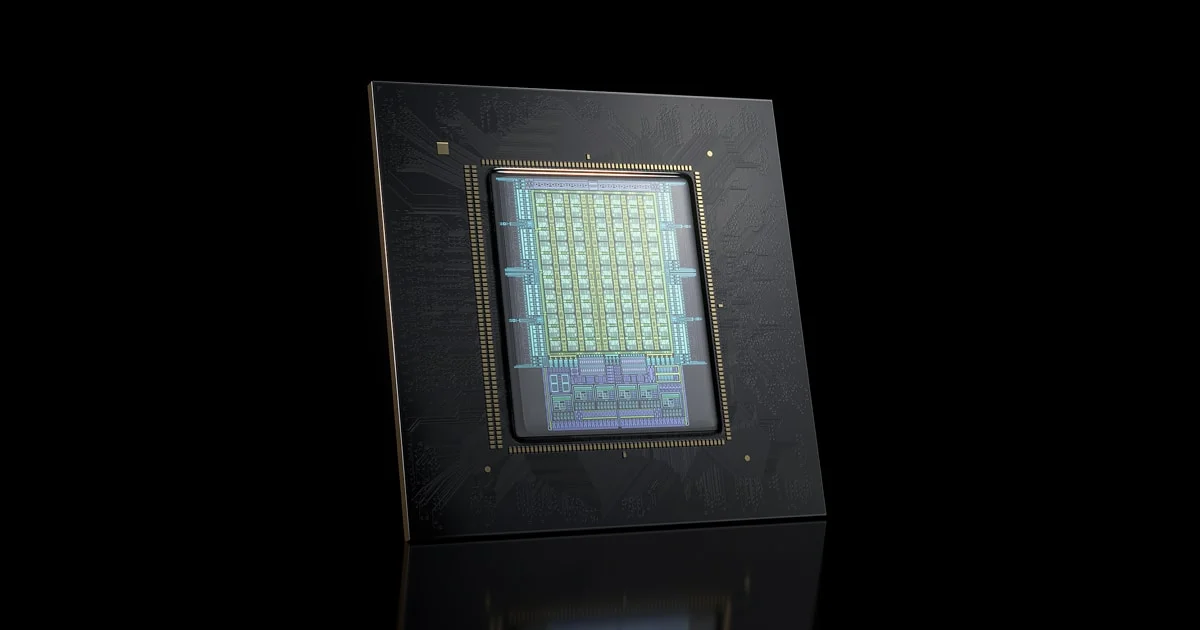
Modal has become an early public example of NVIDIA's attempt to address this market with Vera, an Arm-compatible server processor originally developed for the Vera Rubin platform but also offered in standalone CPU systems.
After receiving its first Vera server in San Francisco, Modal published benchmarks showing up to a twofold improvement in completed tasks under heavy contention.
The company plans to use Vera for its Sandboxes product. Until now, its infrastructure has relied entirely on Intel and AMD x86 processors.
The benchmark reveals a difference between speed and capacity
Modal created Agentless Agent Bench to measure the CPU operations that agents perform during coding tasks.
The benchmark includes 50 tasks derived from Terminal-Bench, covering activities such as software compilation, file searches, Git operations and device emulation. Network calls are removed, and the work runs in prewarmed Docker containers to reduce unrelated sources of delay.
The company performed both isolated latency measurements and concurrent throughput tests.
When executing one task at a time, Vera frequently finished ahead of competing processors, but not consistently. The differences were often relatively small.
The results changed as Modal increased the number of simultaneous containers. A comparable Intel Granite Rapids server reached its throughput limits earlier, while Vera continued completing more work.
Modal reports up to twice the throughput of the x86 comparison system, with individual task latency remaining comparable or sometimes better in the tested configurations.
This is a significant distinction. The reported advantage does not mean that every command becomes twice as fast. It means the server can process substantially more concurrent work under the particular conditions Modal tested.
The tests have not been independently reproduced, and they do not establish a universal advantage over all current Intel, AMD or Arm-based CPUs.
Why agent sandboxes create difficult CPU workloads
An AI coding agent rarely consumes computing resources at a constant rate.
It may spend time waiting for a language model, then suddenly launch a package installation, execute a compiler or search a large project. Modal says CPU demand can rise to ten times its normal level during some of these bursts.
Cloud operators commonly host many containers or virtual machines on each physical server. Their workloads are not synchronized, and individual customers cannot always predict the amount of computing power their agents will require.
This creates contention. A busy container may consume resources that other customers need, increasing latency even when the host appears capable of supporting many simultaneous environments.
Modal's sandbox scheduler supports burst capacity, allowing customers to reserve less than the maximum computing resources they might briefly need.
That approach improves flexibility but makes predictable performance under heavy load especially valuable.
According to Modal, Vera's memory subsystem and sustained per-core performance allow higher container density without the same decline in individual task responsiveness seen on its x86 comparison platform.
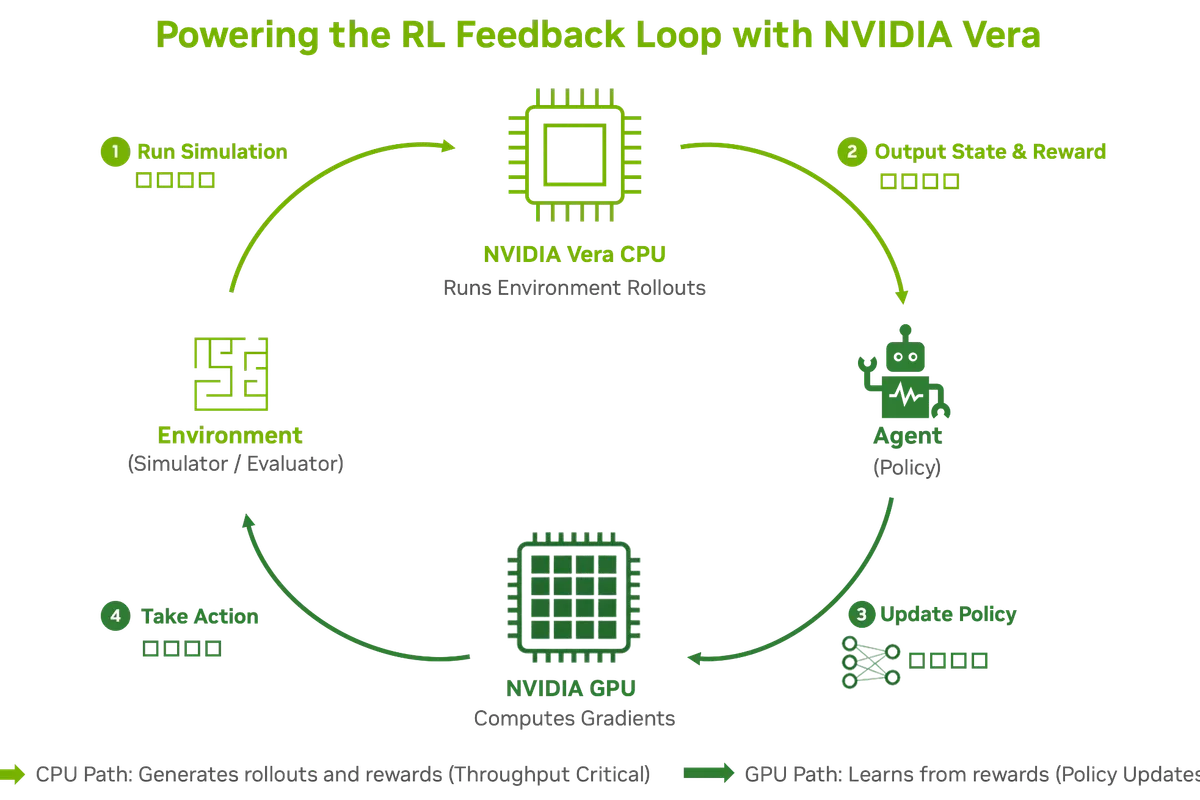
Reinforcement learning is another potential beneficiary. CPU environments may execute simulations or evaluations while expensive GPU infrastructure waits for the resulting feedback. Completing more of those operations within a fixed time can improve the efficiency of the overall training process.
Inside Vera: 88 Olympus cores and high-bandwidth memory
NVIDIA Vera uses 88 custom Olympus CPU cores implementing the Arm instruction set. Its spatial multithreading design provides two execution threads per core.
The architecture combines advanced branch prediction, wide instruction decoding and out-of-order execution intended for irregular, sequential workloads. These characteristics matter for software dominated by control flow, system operations and frequent transitions between different tasks.
Unlike some multi-chiplet server designs, Vera places its CPU cores on a monolithic compute die connected by a shared coherency fabric.
NVIDIA emphasizes predictable performance under full load, when memory traffic and communication between cores can become limiting factors.
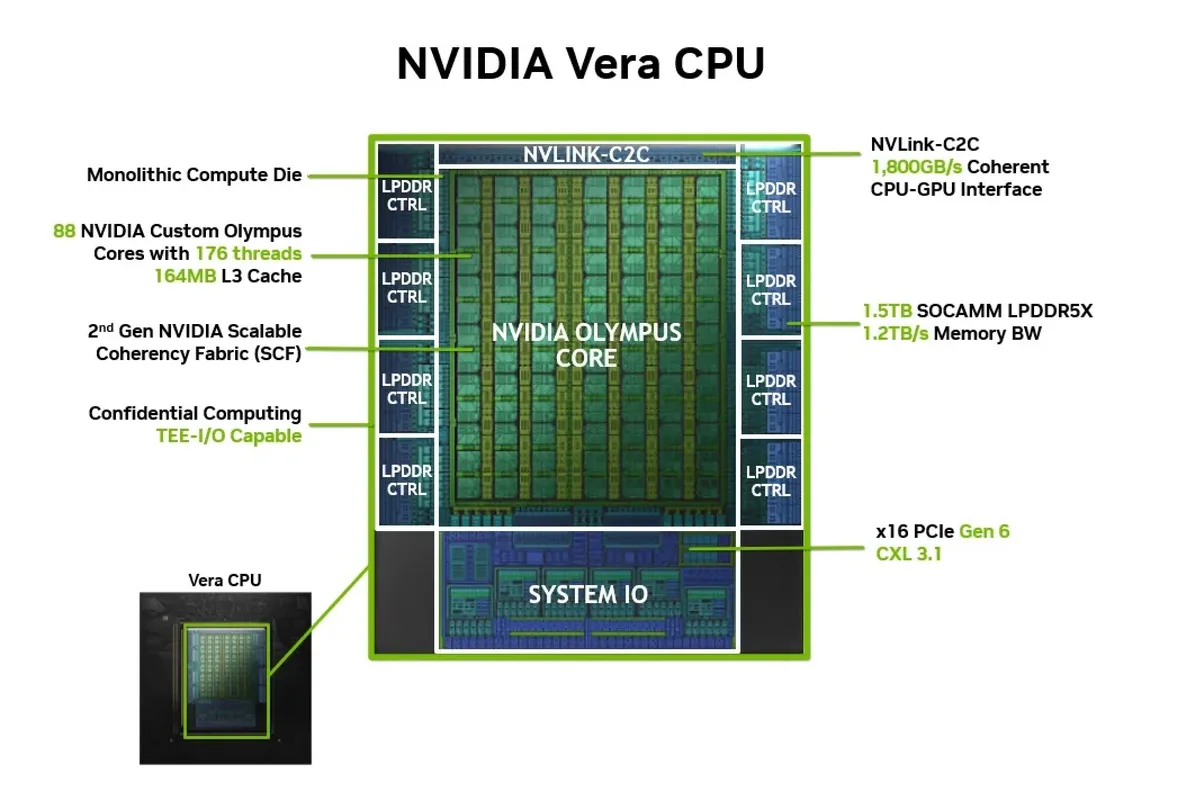
Its LPDDR5X memory subsystem provides up to 1.2 TB/s of aggregate bandwidth, with supported system configurations reaching up to 1.5 TB of memory capacity.
That bandwidth is especially relevant when many containers repeatedly access code, libraries, data structures and independent process states.
Modal attributes much of the processor's advantage to its ability to sustain high memory throughput under contention.
The published comparison does not isolate every architectural contribution. The improvement may reflect several factors, including core design, caching, memory bandwidth and the behavior of the competing server platforms.
Moving to Arm introduces its own migration costs
Modal's decision is notable partly because its existing infrastructure has historically been built around x86 systems.
Adding Vera requires changes beyond purchasing new hardware. Container images, build pipelines, native dependencies and software tools must work correctly on Arm.
Applications written in portable languages may migrate with relatively little effort, but packages containing x86-specific binaries or compiled extensions require compatible alternatives or rebuilding.
Modal acknowledges that supporting a second CPU architecture will require modifications across its infrastructure and image-building systems.
The company does not intend to abandon Intel and AMD.
Its CEO, Erik Bernhardsson, told Reuters that Modal expects to maintain a mixed fleet, selecting processors according to the needs of individual workloads.
That approach recognizes an important limitation of specialized benchmarks. Vera may be particularly attractive for heavily concurrent agent workloads while other CPUs remain competitive for different applications.
Modal has not announced when Vera-backed Sandboxes will become generally available to customers.
NVIDIA wants more of the AI infrastructure stack
NVIDIA has already established a commanding position in GPUs used for AI training and inference. Vera extends its strategy to the CPU operations surrounding those accelerators.
Agentic applications alternate between neural-network inference and conventional software execution. A processor capable of reducing the time spent on tool calls, simulations and code execution may improve end-to-end system performance.
The company also argues that faster CPU operations can improve GPU utilization by reducing the gaps between successive model interactions.
In heavily loaded inference environments, shorter pauses may help preserve cached model context and reduce unnecessary recomputation. These benefits depend on the architecture and scheduling behavior of the complete system.
Vera is offered both as a standalone CPU and as a component of larger NVIDIA computing platforms, including Vera Rubin.
The processor gives NVIDIA a more direct presence in a server market traditionally dominated by Intel Xeon and AMD EPYC products, while also competing with Arm-based offerings from major cloud providers.
Reuters reports that NVIDIA is targeting at least $20 billion in Vera sales during its current fiscal year and estimates the broader data-center CPU opportunity at approximately $200 billion. These are reported ambitions and market estimates, not completed revenue figures.
Two times the throughput is not automatically half the cost
For a cloud provider, task throughput is only one component of the economic calculation.
Higher density can reduce the number of servers required for a given workload, but the benefit depends on hardware acquisition costs, electricity, cooling, system administration and utilization over time.
Modal has not published a complete total-cost-of-ownership comparison establishing that Vera halves the cost per sandbox task.
Its benchmark also excludes network activity and uses prewarmed containers. Real agent deployments may be constrained by remote storage, external API calls, model inference latency or incompatible software components rather than local CPU execution.
These limitations do not invalidate the initial measurements. They define what the results can reasonably demonstrate.
The announcement confirms that Modal has obtained Vera hardware, run its own tests and plans to introduce the architecture into its sandbox infrastructure. It does not confirm that the complete fleet has migrated or that customers can already select Vera-backed environments.
Further evidence will come from production deployment, independently comparable benchmarks and measured cost per completed task. For NVIDIA, Modal's decision is an early commercial indication that AI agents may create new demand for specialized CPUs alongside the GPUs that receive most of the attention.