 By Tsuky
NVIDIA announced on September 3 that it has agreed to acquire Hugging Face for $12,930,300,000.
That is an enormous price for a company whose last publicly disclosed funding valuation was $4.5 billion in 2023.
Reuters reports that roughly $11.9 billion will go to Hugging Face shareholders, while NVIDIA plans up to $1 billion in equity-based retention incentives for employees joining the company.
This is therefore an acquisition agreement, not another strategic investment or expanded partnership. It should not, however, be described as a transaction that has already completed integration: NVIDIA has announced an agreement to buy the company.
NVIDIA is not merely buying a website full of model files
Calling Hugging Face a repository undersells its role.
The platform hosts models, datasets and applications, but developers also use it to discover, evaluate, compare, customize and deploy them.
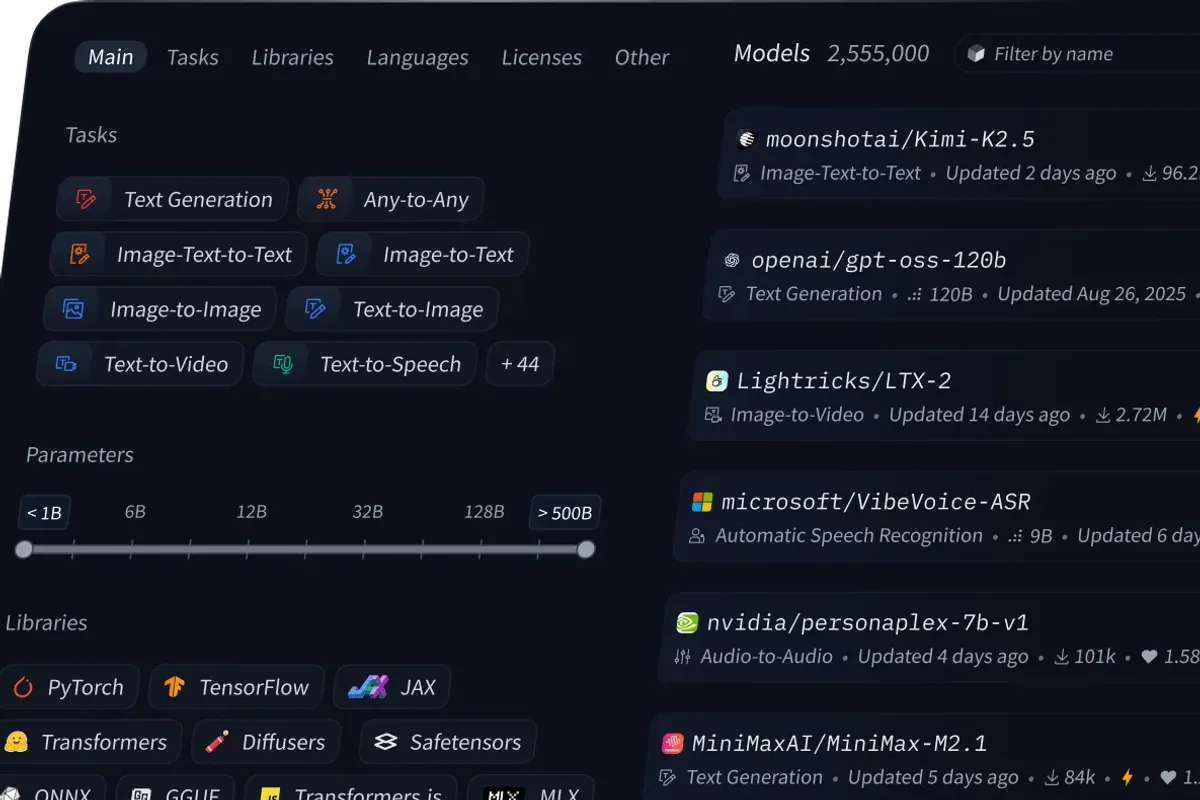
NVIDIA says more than 18 million developers, researchers and creators now use Hugging Face.
The platform hosts more than 3 million models, roughly 500,000 datasets and 1 million applications, while more than 200,000 companies use it for AI development and deployment.
NVIDIA is therefore acquiring more than hosted content. It is acquiring a heavily trafficked intersection between research, open-source software, enterprises and computing infrastructure.
NVIDIA already sits at the bottom of the stack; Hugging Face operates much higher up
NVIDIA's historical leverage begins with compute.
Its GPUs run a major share of AI training and inference, while CUDA, NCCL, TensorRT and a large software ecosystem make that hardware difficult to replace for many teams.
Hugging Face sits at another part of the workflow.
A developer can begin there by searching for a model, checking its license, testing a demo, downloading weights, fine-tuning through Transformers and then selecting an inference provider.
The acquisition moves NVIDIA closer to the moment when developers choose both models and infrastructure, well before anyone orders a physical server.
NVIDIA explicitly says its GPUs will not become mandatory
Jensen Huang addressed the most obvious concern directly in the announcement.
NVIDIA says Hugging Face will remain open to the entire AI ecosystem.
Developers are supposed to retain their choice of models, frameworks, clouds, inference providers and computing platforms.
The company explicitly says NVIDIA compute will not be required to build on or deploy through Hugging Face.
It also promises continued multi-cloud and multi-accelerator support alongside open-source and open-weight models from every model builder.
That promise matters because AMD, Intel and cloud providers already live inside the ecosystem
Hugging Face did not grow as an exclusive extension of CUDA.
Its ecosystem contains models and tools optimized for NVIDIA hardware, but also AMD, Intel, Google, AWS, specialist accelerators and CPU deployments.
AMD was itself an investor in Hugging Face's 2023 funding round.
Maintaining neutrality therefore requires more than leaving a few compatibility checkboxes intact.
A platform can remain officially open while creating subtler differences through optimization quality, integration speed, documentation, demo availability, runtime support or placement of services inside the user interface.
That is why some developers and analysts quoted by Reuters say they will watch whether competing accelerators continue to receive equal practical treatment.
NVIDIA is already the platform's largest model contributor
The buyer is not arriving as an outsider.
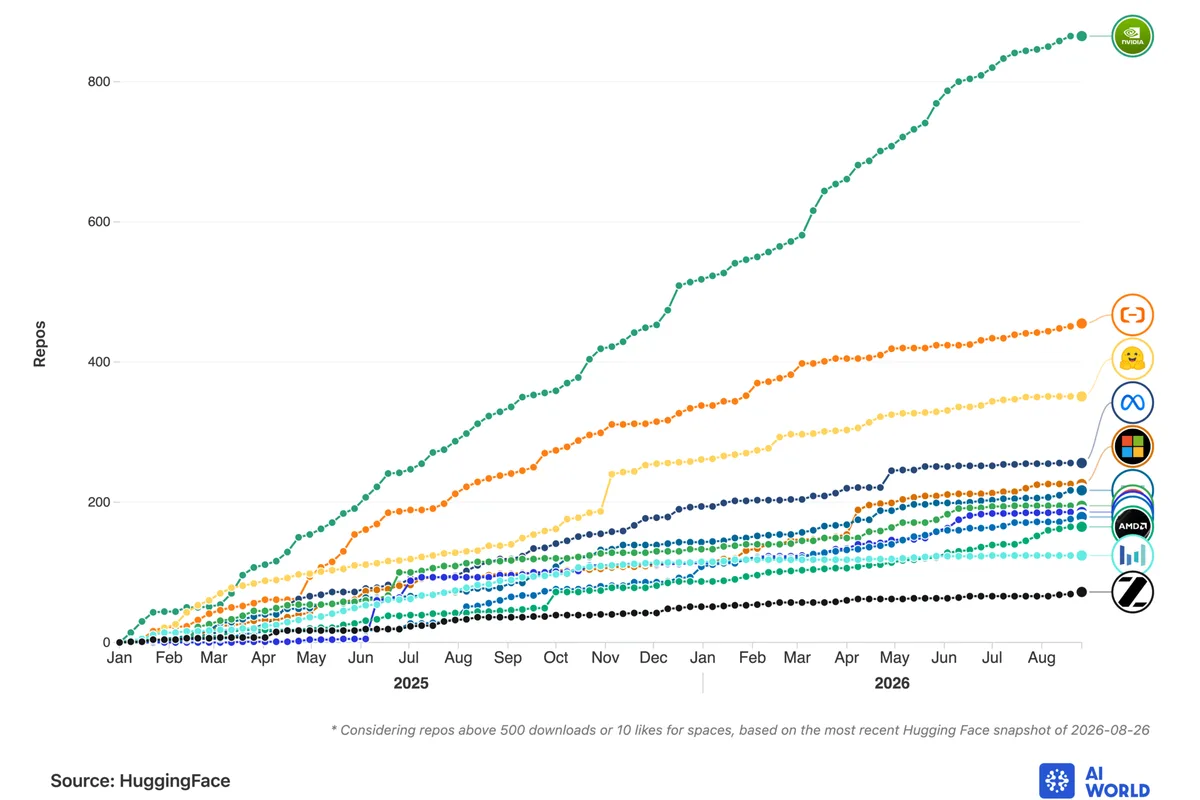
NVIDIA says it is currently the largest contributor of open models and data on Hugging Face.
The company has released more than 500 models and more than 250 datasets there.
The two companies have also worked together for years. In 2023 they announced integration between Hugging Face and NVIDIA DGX Cloud to give developers easier access to NVIDIA infrastructure from the platform.
The acquisition formalizes an already close technical relationship rather than creating one from scratch.
The price suggests NVIDIA is buying ecosystem position more than current revenue
The $12.93 billion figure looks even more unusual when compared with Hugging Face's current business.
Reuters reported annualized revenue of roughly $150 million before the acquisition announcement.
That gap should not be reduced to one simplistic revenue multiple, but it makes clear that NVIDIA is valuing more than Hugging Face's present sales.
The Hub, its libraries and its community provide something much harder to build quickly: a platform already embedded in the daily habits of AI developers.
NVIDIA is also paying for relevance at a time when several of its largest customers are building their own accelerators.
Meta, Microsoft and OpenAI are all looking for ways to reduce hardware dependence
The broader industry context makes the deal particularly significant.
The world's largest buyers of NVIDIA hardware are investing billions in their own silicon strategies.
Google has TPU, AWS develops Trainium and Inferentia, Microsoft has Maia, while Meta and OpenAI are pursuing their own accelerator programs as well.
Those projects will not replace NVIDIA GPUs overnight, but they show that hyperscalers do not want to depend permanently on a single supplier.
Hugging Face gives NVIDIA a direct relationship with millions of developers who are not large enough to design their own chips.
Open models can also protect the market for independent compute
NVIDIA's interest in open-weight AI is not purely philosophical.
A world where a handful of companies control the strongest models, the cloud services around them and their own proprietary accelerators can become less favorable to an independent GPU vendor.
An ecosystem where thousands of models can be downloaded, modified and deployed by almost anyone creates many more places where compute must be purchased.
Jensen Huang frames open models as a way to distribute AI capability across more companies and institutions.
For NVIDIA, they also have an obvious commercial advantage: the more organizations can independently deploy AI, the larger the potential compute market remains.
Hugging Face could receive infrastructure on a very different scale
NVIDIA says it will use its infrastructure, engineering resources and global reach to improve Hugging Face.
The company specifically mentions reliability, security, model evaluation, inference and deployment.
Those are areas where the resources of one of the world's largest technology companies can materially change scale.
Hosting millions of models, datasets and applications requires storage, networking, indexing, security, demo compute and inference capacity that all continue to grow.
The difficult part will be delivering that infrastructure without gradually making the easiest path the NVIDIA-only path.
Transformers may be as strategically important as the Hub itself
Much of Hugging Face's influence comes from open-source software that developers can use without ever visiting the website.
Transformers has become one of the central libraries for loading, training and running a huge range of model families.
Diffusers occupies a similar role for image and media generation, while Datasets, Tokenizers, PEFT, TRL, Safetensors and Accelerate each cover different parts of the workflow.
Those projects place Hugging Face inside development pipelines even when customers are not buying its hosted services.
Owning the company behind that software layer therefore brings NVIDIA much closer to how AI models are actually consumed.
The open-source commitment will now receive much more scrutiny
Hugging Face became central partly because direct competitors can coexist there.
Meta publishes models on the Hub. Microsoft, Google, NVIDIA, Intel and numerous independent labs maintain their own organizations. Startups distribute model weights beside academic projects and community releases.
That practical neutrality is as valuable as the technical infrastructure.
NVIDIA promises to preserve it, but the Hub's owner will now directly compete with some of the companies publishing software and infrastructure through the platform.
That question will not be resolved on announcement day.
It will show up over time in APIs, hardware integrations, hosting policy, inference providers, optimization work and governance of open-source projects.
The deal moves the boundary of what NVIDIA is one more time
NVIDIA stopped being simply a graphics-chip company years ago.
It now controls a stack extending from accelerator silicon through data-center networking, complete systems, libraries and deployment software.
Hugging Face brings it closer to developers and to the model catalog itself.
That is both the strategic logic of the acquisition and the main reason it will be watched closely.
If Hugging Face remains genuinely neutral across hardware and model providers, NVIDIA gains an enormous ecosystem that can keep expanding the overall market for compute.
If that neutrality erodes, the community has enough open-source software to build elsewhere, but recreating Hugging Face's accumulated network effects, habits and visibility would be much harder.
The $12.93 billion is therefore buying much more than a website. It is buying a position in the middle of how AI models circulate.