 By Tsuky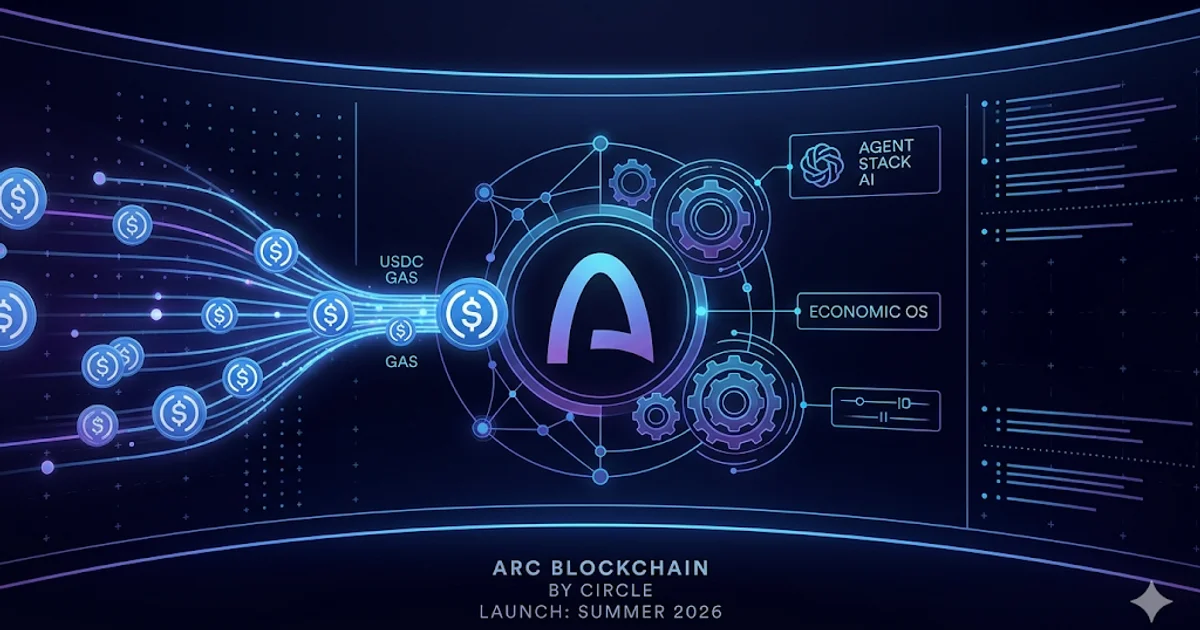
Circle officially opened Arc's public mainnet on September 16, 2026 after running the network through testnet and private-mainnet phases with more than one hundred institutional and ecosystem participants.
Arc is an EVM-compatible Layer 1, allowing Solidity contracts and familiar Ethereum development tooling to work without forcing developers into an entirely new programming environment.
Its design, however, is much narrower than simply becoming another general-purpose smart-contract chain.
Circle is building Arc around stablecoin payments, financial markets, tokenized assets and economic activity performed by software agents.
The first difference appears when it is time to pay gas
Arc transaction fees are payable directly in USDC.
That sounds like a small user-experience detail until the user is a corporate treasury team.
A business that holds and transfers digital dollars no longer needs to maintain a second volatile crypto asset solely to keep transactions running.
On Ethereum, USDC users still need ETH for gas. Other Layer 1 networks generally require their own native asset.
Arc allows the dollar-denominated asset itself to cover normal network fees, making transaction costs easier to budget and account for in fiat terms.
Circle is targeting deterministic finality in under a second
The other foundational feature is settlement finality.
Circle says Arc provides deterministic sub-second finality. Once a transaction is finalized, applications do not have to wait an arbitrary additional number of blocks to become increasingly confident that settlement will stick.
That characteristic is particularly useful for payments and trading.
An application can move to the next leg of a transaction immediately after final settlement instead of managing several intermediate confirmation states.
Sub-second network finality should not be confused with a universal promise that every end-user workflow completes in under one second. Application infrastructure and external systems still add their own latency.
“Open” does not yet mean anybody can validate the chain
Arc is publicly accessible, but block validation currently follows a deliberately controlled model.
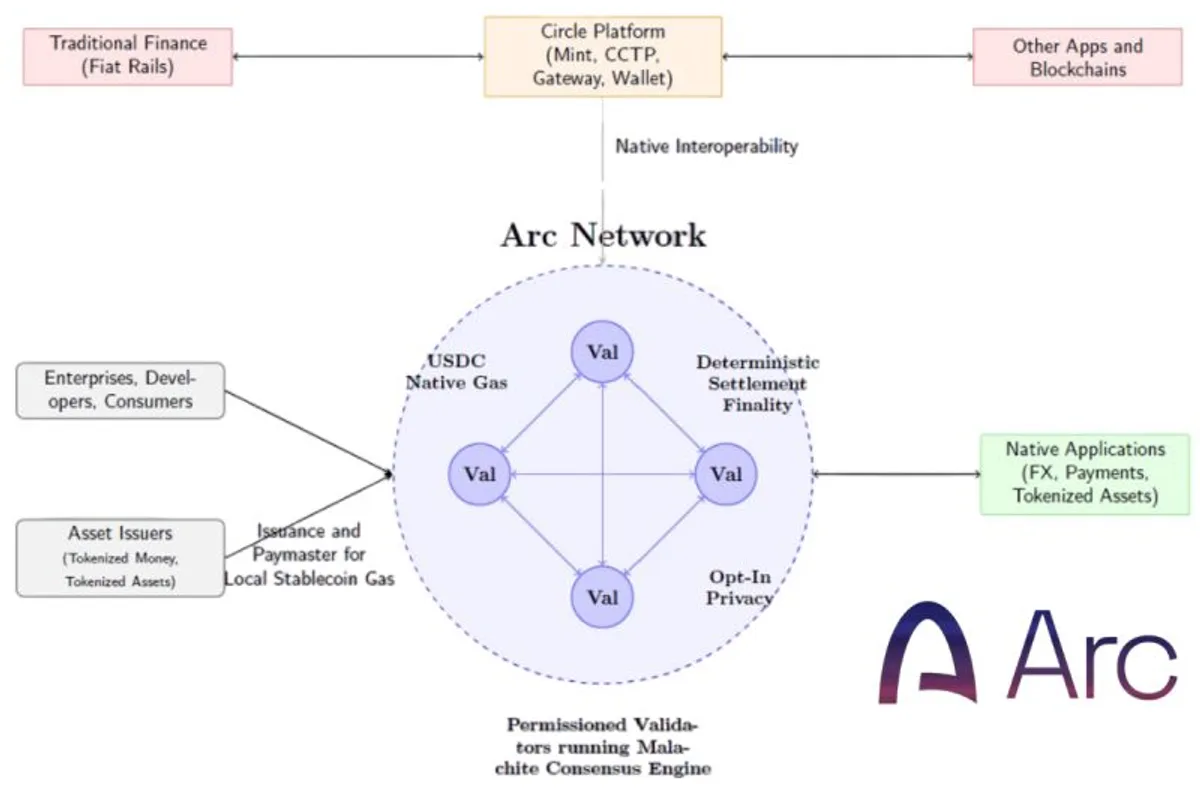
The network launches with a permissioned validator set under Proof of Authority.
Circle's founding cohort includes BlackRock, DTCC, Galaxy, ICE, Mastercard, MoneyGram, SBI Group, Standard Chartered, Sumitomo Corporation, Visa and Worldpay, alongside Circle itself.
That is almost the inverse of a blockchain whose first objective is maximizing the number of anonymous or independent validators.
Circle is beginning with identifiable organizations that operate major financial and technology infrastructure.
That structure may make the network easier for banks and regulated institutions to adopt. It also means Arc currently has a much narrower validator-access model than broadly permissionless proof-of-stake networks.
A transition toward proof of stake is already on the roadmap
Circle does not present the current structure as necessarily permanent.
The company intends to broaden network participation over time and is exploring a transition from Proof of Authority toward Proof of Stake in 2027.
That explains one of the more surprising technical milestones around launch.
Circle completed the genesis mint of ARC in the United States and created its entire initial supply of 10 billion tokens.
Those tokens have not simply been released for public trading.
Circle explicitly says the genesis mint is not a commitment to publicly launch ARC.
The token is designed as a future coordination mechanism around network security, utility and governance.
Even if that transition happens, Circle says network fees are intended to remain payable in USDC.
Circle is becoming both a money issuer and part of the infrastructure carrying that money
That is the larger strategic change.
USDC became useful partly because it could operate across many independent chains including Ethereum, Solana, Base and numerous others.
Circle continues to describe Arc as interoperable rather than a replacement for those networks.
It now also controls an environment designed around its own stack: USDC, EURC, Circle Payments Network, Gateway, StableFX and Agent Stack.
That vertical integration can make development easier.
It also gives Circle influence over more layers of the system. The company no longer only issues the asset. It participates in the network design, gas model, interoperability layer, development tools and services built above it.
Arc launches with more than 100 announced applications
Circle is trying to avoid the classic cold-start problem of launching a technically functional Layer 1 with almost nothing to do on it.
The company says more than 100 applications and more than 100 institutional and ecosystem builders are live or involved at launch.
Trading infrastructure includes Uniswap, Aero and fomo.
Aave and Morpho are positioned around credit markets.
Wallet support includes MetaMask, Ledger, Phantom, Rainbow and Trust Wallet, while exchanges and access providers named by Circle include Binance, Coinbase, Kraken, OKX, Bybit and others.
Assets planned for the network include Circle's USYC and BUIDL, BlackRock's tokenized Treasury fund issued through Securitize.
An organization appearing on an ecosystem list does not mean every integration has the same maturity, liquidity or production usage on day one.
More than 700 million testnet transactions came before public mainnet
Arc is not entering production directly from a small demonstration environment.
Circle says its testnet processed more than 700 million transactions in less than a year.
It also reports more than 75,000 active Arc House community members, 10,000 Architect ambassadors and over 1,200 projects built around the ecosystem.
Those are Circle's own ecosystem metrics and should not be mistaken for independent measures of economic adoption.
The more important data now begins accumulating on mainnet: actual settlement value, reliability under production loads, liquidity concentration and real transaction costs.
Institutional privacy is central to the pitch, but it is not fully deployed yet
Circle talks extensively about confidentiality on Arc.
The current network needs to be separated from the roadmap.
Opt-in confidential balances and transactions using view keys are still being developed for network-wide release.
The concept would let a business conceal sensitive economic information publicly while retaining controlled visibility for auditors or authorized parties.
That is particularly relevant to institutional markets where absolute public transparency can itself be problematic. Companies generally do not want every treasury position or counterparty relationship visible in real time.
For now, however, the complete privacy system remains a planned capability rather than a fully deployed mainnet feature.
Circle is planning specialized network sectors too
The roadmap goes further through what Circle calls Network Sectors.
A future Payment Sector targets low-cost payments above 100,000 transactions per second.
A Privacy Sector is intended for opt-in confidential transactions.
An Agent Sector is planned around verifiable agent identity and auditable records.
Those performance numbers and features are future targets. They should not be read as the current measured throughput of public mainnet.
The AI part is more than a crypto press-release keyword
Circle is making agentic economic activity one of Arc's primary use cases.
The idea is that software could hold a policy-controlled wallet, pay another service, exchange assets or execute a contract without requiring a human to approve every individual step.
Circle Agent Stack already provides policy-controlled Agent Wallets and nanopayment infrastructure.
Arc Portal is designed to let humans fund those wallets, assign spending limits and delegate tasks while retaining oversight.
Circle is also developing AgentVM, an environment intended to let agents work with sensitive data while producing an auditable record of what happened.
Circle cites data indicating that USDC represents 98.8% of identified agent-driven transaction volume in the dataset it references. That figure describes a particular measured ecosystem rather than every autonomous software payment occurring globally.
Interoperability matters because Circle cannot afford to turn USDC into another liquidity island
Building its own chain creates an obvious tension for Circle.
USDC's usefulness comes partly from being available across many networks. Confining its best experience to Arc would undermine that advantage.
Circle is therefore using CCTP and Gateway to connect Arc with more than twenty other blockchains.
The goal is to let applications reach existing liquidity rather than treat Arc as an isolated financial universe.
How well that works in practice will depend on integrations, cross-chain security and how liquidity fragments as production activity grows.
Arc raises an unusual question about what an institutional blockchain is supposed to be
Arc uses familiar crypto components: a Layer 1, EVM execution, smart contracts, tokenized assets and potentially proof-of-stake in the future.
Its launch structure looks much closer to managed financial infrastructure.
Validators are selected. Gas is paid with a regulated stablecoin. Future privacy features are being designed around both confidentiality and auditability. Many of the network's core participants are banks, asset managers and payment networks.
For institutions, those characteristics may be exactly the reason to use Arc.
For users whose priority is maximum trust minimization and permissionless validator participation, they represent the network's clearest compromises.
Arc therefore begins in a different part of the market from the usual general-purpose Layer 1 competition.
Circle does not appear to be building a chain where everything on the internet is supposed to live.
It is building an environment where USDC, tokenized finance and software capable of spending money can operate as one integrated stack.