
 By Adri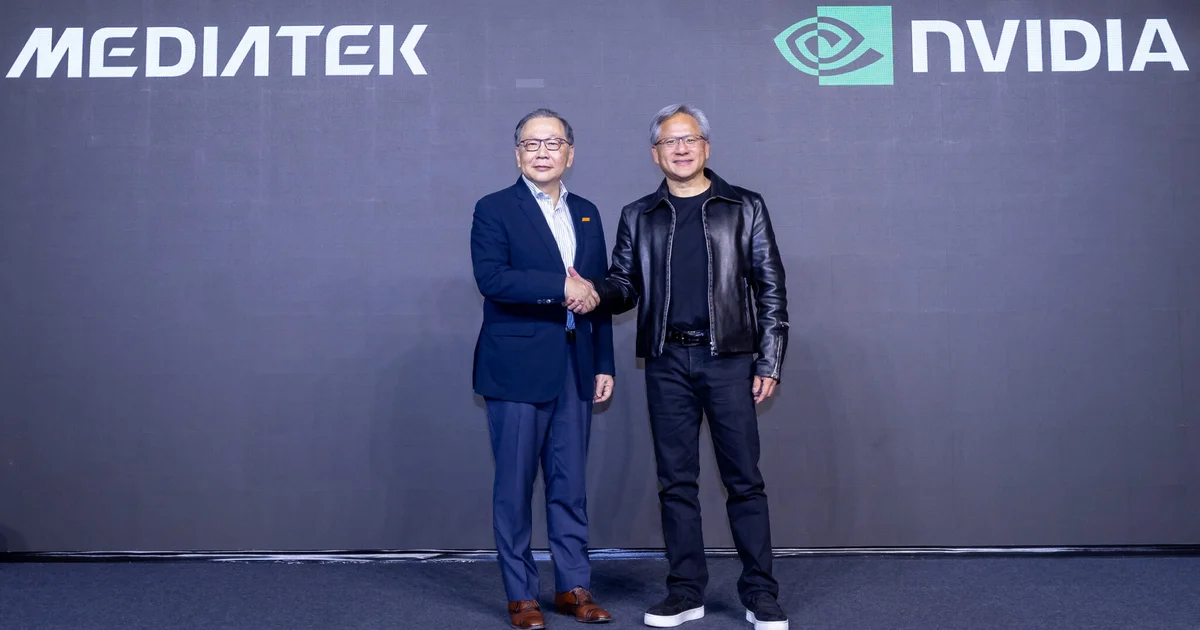
NVIDIA is investing $3.5 billion in convertible bonds issued by MediaTek.
That structure is worth stating precisely. NVIDIA is not announcing an outright $3.5 billion equity purchase today, and the transaction is not an acquisition of MediaTek. Convertible debt can become shares under specified terms, but those conversion mechanics are not detailed in the joint announcement.
Reuters reports that NVIDIA's commitment represents most of a roughly $3.9 billion overseas convertible-bond offering by MediaTek. Alphabet also participated, according to the report, without disclosing the size of its investment.
The data-center piece is about custom chips
MediaTek will adopt NVIDIA NVLink Fusion as a platform for customers developing custom AI accelerators.
Instead of forcing a hyperscaler to choose between its own XPU and an NVIDIA architecture, the pitch is that the custom compute can plug into NVIDIA's larger rack-scale ecosystem.
MediaTek can work on the silicon while the broader design draws on NVLink connectivity, memory architecture, advanced packaging, manufacturing support and NVIDIA's infrastructure stack.
That lowers a specific engineering burden. A company can spend more of its design budget differentiating the compute block rather than qualifying every surrounding piece of a rack-scale AI system from scratch.
NVLink Fusion is NVIDIA's answer to customers building around its GPUs
Custom accelerators are no longer an edge case for the largest cloud operators. They are a deliberate way to optimize particular workloads and reduce dependence on one general-purpose GPU supplier.
NVIDIA's response is not simply to fight that trend.
NVLink Fusion gives the company a route to remain inside the infrastructure even when the central compute device is designed by somebody else. NVIDIA can still supply the interconnect, rack architecture, networking technology and software environment surrounding the custom XPU.
MediaTek was already named as an NVLink Fusion partner. The new agreement turns that participation into a broader, multigenerational relationship backed by a very large financial commitment.
DGX Spark already contains the first proof point
The companies have a shipping example of joint silicon in the GB10 Grace Blackwell Superchip.
GB10 combines Blackwell GPU technology with an Arm CPU in a coherent-memory design connected through NVLink-C2C. MediaTek contributed to the CPU and SoC engineering.
It powers DGX Spark, NVIDIA's compact personal AI system for developers running CUDA workloads and large models locally.
The important language in this week's announcement is “multiple generations.” NVIDIA and MediaTek are explicitly committing to continue their work on both DGX Spark and RTX Spark chips beyond the current products.
RTX Spark moves the same partnership into mainstream Windows hardware
RTX Spark was unveiled in June as a Windows-focused superchip for thin laptops and compact desktops.
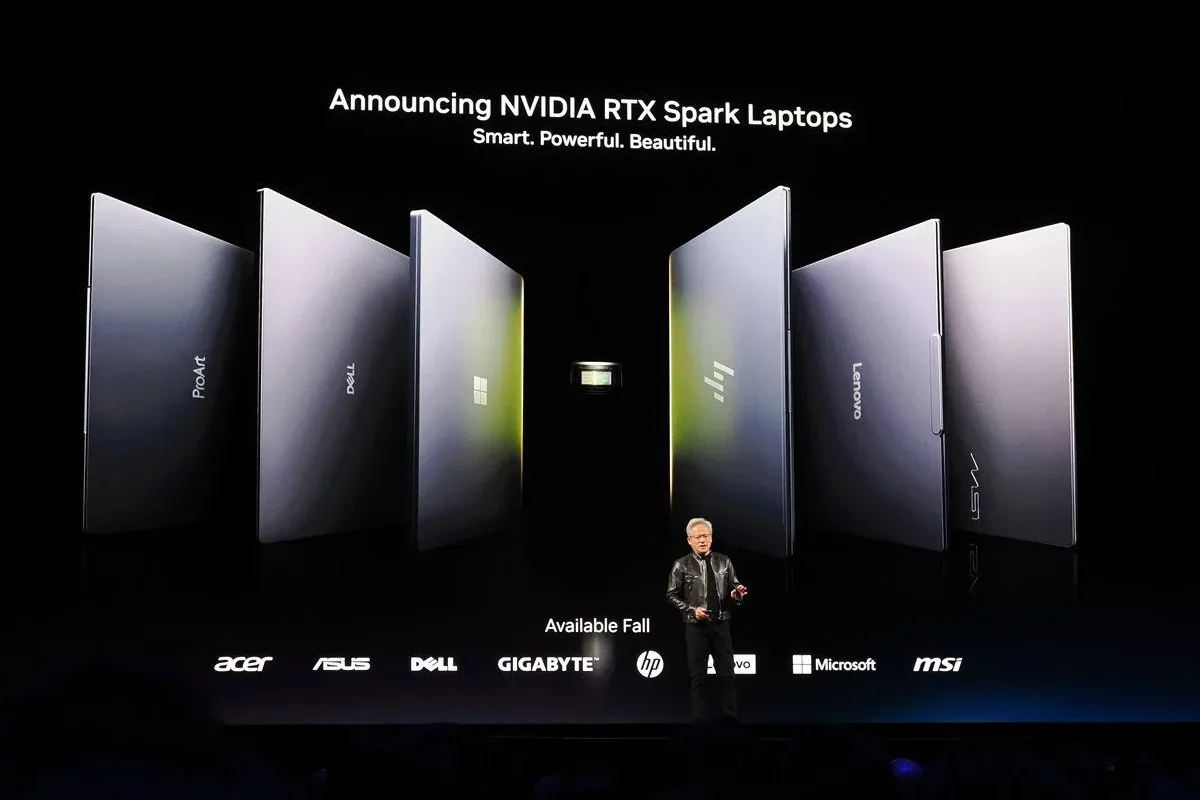
NVIDIA specifies up to 6,144 Blackwell CUDA cores, a 20-core CPU, as much as 128GB of unified memory and up to 1 petaflop of FP4 AI performance.
MediaTek's role extends beyond providing a peripheral controller. Its engineering work covers areas including CPU design, memory control, connectivity and power management.
The first RTX Spark laptops are scheduled for fall 2026 from ASUS, Dell, HP, Lenovo, Microsoft and MSI, with Acer and GIGABYTE systems also planned.
That gives the $3.5 billion deal a consumer-hardware consequence as well as a data-center one.
MediaTek is using its mobile skill set in much more expensive silicon
MediaTek built much of its scale around highly integrated, power-efficient chips for phones and connected devices.
Those same engineering strengths are valuable in a thin AI PC where CPU, GPU, memory and connectivity have to behave like one system rather than a collection of discrete high-power components.
At the other end of the spectrum, its custom-silicon business can apply packaging, SerDes, memory and system-integration expertise to accelerators that will live in data-center racks.
The partnership effectively stretches MediaTek's SoC model from local AI devices all the way to custom cloud compute.
A convertible bond does not tell us NVIDIA's eventual ownership
The financial commitment unquestionably makes the partnership harder to unwind casually, but it does not yet tell us how much of MediaTek NVIDIA may ultimately own.
The companies have not provided the complete conversion price, timing or resulting ownership percentage in their public partnership release.
For now, two things can be stated without speculation: NVIDIA has committed $3.5 billion to MediaTek-issued convertible bonds, and the companies have expanded their technology roadmap across three major computing markets.
Cars remain the third leg
MediaTek and NVIDIA are also extending their automotive work across future generations.
Dimensity Auto platforms already integrate NVIDIA technology for AI and RTX graphics in digital cockpits and can operate alongside NVIDIA DRIVE AGX.
The August 31 announcement does not introduce a newly named automotive chip or a specific launch date. It confirms that this architecture remains part of the longer partnership.
NVIDIA is making itself useful even when the customer wants different silicon
That may be the most strategic part of the agreement.
If a cloud company wants a custom accelerator, NVIDIA wants NVLink and its rack-scale technology around it. If a Windows manufacturer wants an efficient integrated AI PC, NVIDIA can combine its GPU and software stack with MediaTek's SoC expertise.
The common thread is not ownership of every transistor.
It is keeping NVIDIA technology attached to the system from local Windows PCs through custom AI factories, with MediaTek now financially and technically tied to multiple generations of that plan.