 By Tsuky
An AI system that answers a question in seconds is not necessarily capable of finishing complex work. Fixing a problem in an application may require reading multiple files, finding an error, changing code, running tests and repeating the process when something fails. Each step consumes time and tokens. When several agents work together, the total cost can increase quickly. That is the market MiniMax is targeting. The Chinese AI company officially launched M3.1 Flash on October 19, 2026. Rather than focusing entirely on conversation, the announcement emphasizes tasks in which AI needs to act. Those include software engineering, computer use, professional workflow automation and cybersecurity analysis. MiniMax says inference is nearly three times faster than with its previous model. It also claims a 70% reduction in the overall cost of agentic tasks. These are the central commercial claims of the release. They come from the developer and should not be mistaken for improvements independently established across every possible workload.
Why speed matters so much for AI agents
When using a conversational assistant, a few additional seconds may be acceptable. Agent-based workflows are different. An agent may need to call a model dozens of times to complete one assignment. It begins by interpreting the request. It then gathers information, selects tools and performs a series of actions. It may have to check the outcome, correct an error or start another search. A shorter response time at each stage can therefore affect the entire workflow. MiniMax reports output speeds exceeding 200 tokens per second in some everyday scenarios. It also claims median output speeds above 170 tokens per second. Those figures are potentially attractive for applications that generate substantial amounts of text. However, token output speed is not the same as the time needed to finish an entire job. An agent also depends on the latency of external tools, the volume of information being analyzed and the number of corrections required. A fast model that repeatedly makes mistakes may ultimately cost more than a slower but more reliable alternative. That is why developers need to measure completed tasks, not just generated tokens per second.
Aggressive pricing for developers
The official M3.1 Flash pricing is particularly notable. MiniMax charges $0.15 per million input tokens. Output tokens cost $0.60 per million. Cached input tokens are priced at $0.015 per million. To understand the numbers, consider an application that sends ten million input tokens and receives two million output tokens. At the published rates, the input would cost $1.50. The output would cost $1.20. Total model token charges would therefore be $2.70, before any other services or fees. This is a simple calculation based on the advertised prices, not a measured cost for a real professional task. Agent workflows often introduce additional expenses. They may require tool execution, computing resources, online research or third-party APIs. Pricing also depends on how much context is reused and whether caching applies. MiniMax says overall agentic task costs are 70% lower than those associated with its previous model. That figure reflects the company's evaluation conditions. It cannot be treated as a guaranteed reduction in every customer's bill.
The more meaningful metric is cost per successful task
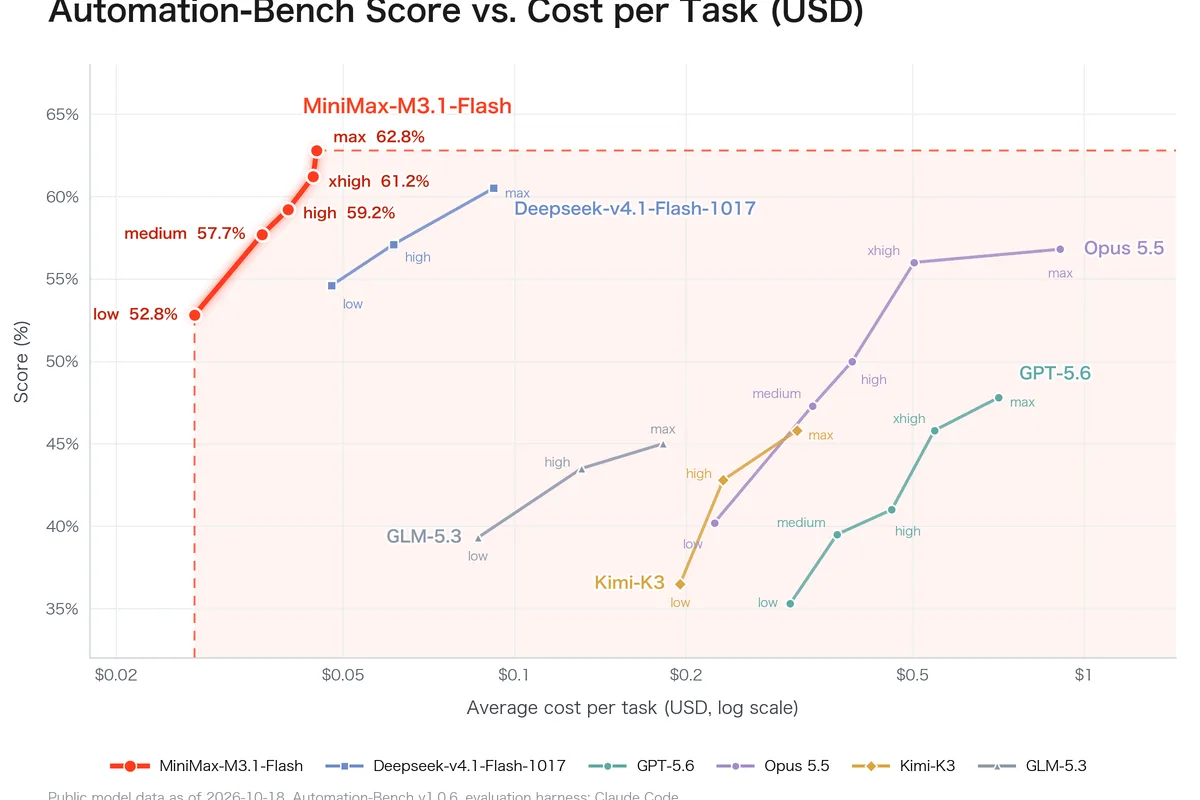
AI vendors frequently advertise their models using the price of one million tokens. That is useful information, but it can be misleading when comparing systems with different capabilities. Consider two models asked to repair the same software bug. The first charges very little per token but repeatedly fails before producing a working fix. The second costs more per request but completes the task correctly on its first attempt. The apparently cheaper model may end up being more expensive. MiniMax has chosen to emphasize performance relative to cost per task in several of its charts. It uses Automation-Bench to assess professional workflows and DeepSWE to examine software engineering tasks. The company's argument is that M3.1 Flash can approach the performance of more expensive models while requiring less spending per successful result. That is a relevant approach. However, comparisons depend on the evaluation settings. Scores may change according to the model's reasoning effort, the agent framework, the tools provided and the precise test conditions. A performance-per-dollar chart does not establish a universal result. It describes a comparison under a particular methodology.
A 73.7% DeepSWE score targets software developers
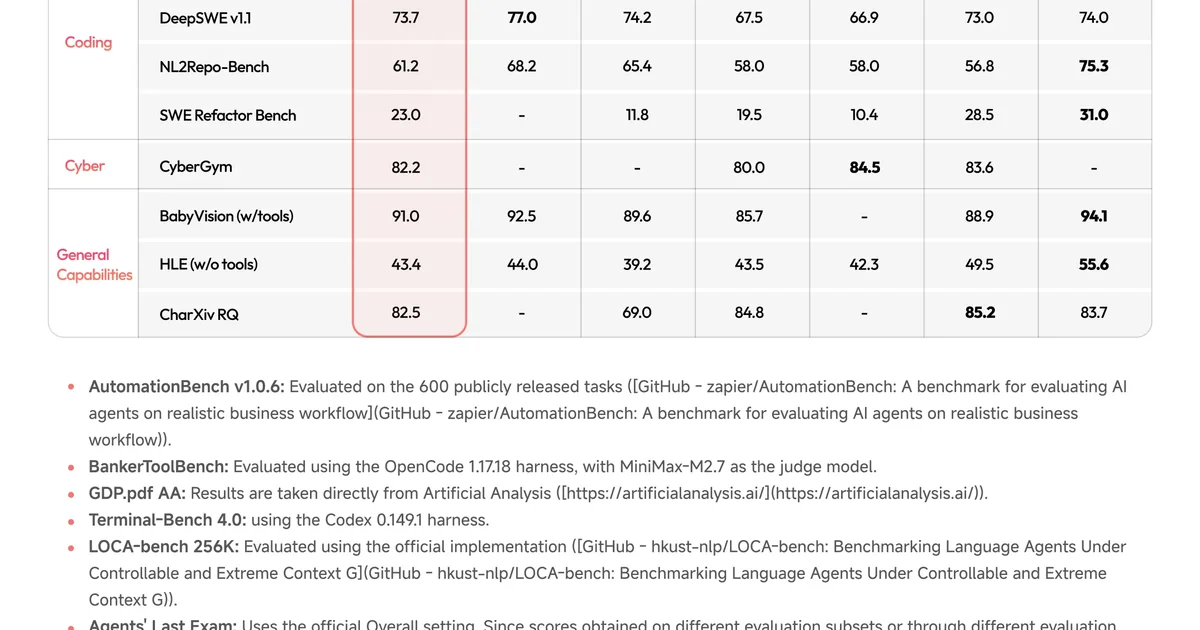
One of the most prominent published results is M3.1 Flash's performance on DeepSWE v1.1. MiniMax reports a 73.7% success rate. The benchmark evaluates software development tasks requiring the model to understand a codebase, make changes and verify the result. It goes beyond completing a few lines of code. The agent must maintain consistency across several actions. For developers, that distinction is important. An AI that suggests a code fragment may save a few minutes. An agent that reliably completes an entire bug fix could change how certain tasks are organized. However, strong results on standardized tests do not mean a model can independently maintain every production application. Real software repositories contain complicated dependencies, internal conventions and requirements that are not always represented in benchmarks. Outputs still need verification. MiniMax has not demonstrated that developers can abandon code review or automated testing when using M3.1 Flash. The more realistic opportunity is to accelerate selected activities under appropriate supervision.
The model is also designed to operate computers
Software engineering is not the only area MiniMax is targeting. The company emphasizes computer-use capabilities. These allow AI systems to interact with computing environments rather than simply generate written responses. An agent can examine an interface, decide what to do, use tools and continue based on the result. This creates opportunities for repetitive tasks. Businesses may want assistants that inspect documents, gather information or prepare reports across multiple applications. Individuals may want to automate processes that normally require switching between programs. MiniMax reports a score of 61.7 on OSWorld V2, a benchmark for computer operation. The company also reports 29.6 on Agents' Last Exam, which evaluates professional assignments. Those figures represent the performance claimed under the relevant testing conditions. They do not establish that M3.1 Flash can use every application without errors. Interfaces change. Windows appear in different locations. Some operations affect finances or modify important records. For such workflows, organizations need restricted permissions and appropriate human approval steps.
Cybersecurity is becoming another selling point
MiniMax also places considerable emphasis on cybersecurity. The company reports a score of approximately 82% on CyberGym. That benchmark evaluates certain tasks involving software vulnerabilities and their reproduction in defined environments. MiniMax says the model can assist specialists with code auditing, vulnerability identification, patch development and malicious software analysis. The company also mentions reverse engineering and security testing. Automation may help experts examine large codebases. However, two problems remain. The first is accuracy. A model can report vulnerabilities that do not exist or fail to recognize genuine weaknesses. The second concerns misuse. Capabilities useful for defensive security work may also support offensive research. A high score on CyberGym is not proof that a system is safe or reliable in every cybersecurity situation. MiniMax refers to additional internal evaluations. Those are not equivalent to comprehensive independent auditing. Professional security decisions should therefore remain subject to qualified human review.
Sparser computation helps reduce inference work
How does MiniMax explain the speed improvements? The company points to more aggressive sparsity during inference. In a large AI model, not every operation necessarily contributes equally to generating a particular response. Sparse approaches aim to reduce unnecessary computation by selecting the elements most relevant to the current processing step. The earlier MiniMax M3 family already used sparse attention techniques to handle long contexts more efficiently. M3.1 Flash continues that direction. The objective is to deliver more useful work without increasing computing requirements proportionally. That is particularly attractive for applications that call a model repeatedly. However, the advertised improvement should not be attributed entirely to one architectural component without additional evidence. The performance of an online AI service also depends on hardware, software optimization and deployment infrastructure. MiniMax describes an overall result. It does not provide an independent breakdown establishing the exact contribution of every optimization.
Space Bunny was an early version of M3.1 Flash
The launch also settles an interesting mystery surrounding public model testing. MiniMax has confirmed that Space Bunny, previously available anonymously through OpenRouter, was an early version of M3.1 Flash. Releasing a model without immediately disclosing its commercial identity can generate feedback before a formal product announcement. Community testing may reveal strengths and weaknesses across many different tasks. However, informal reactions do not replace controlled evaluation. MiniMax says Space Bunny processed more than 200 trillion tokens during its anonymous period. That is a substantial reported volume. It does not directly reveal the number of unique users, the success rate of their tasks or the precise nature of every workload. Large token volumes can result from repeated tests, lengthy contexts and automated activity. The disclosure establishes that an early form of M3.1 Flash had been exposed to users before the official release. The October 19 launch was therefore not the model's first appearance in testing environments.
A million-token context does not mean unlimited understanding
Documentation for the M3.1 Flash preview describes a context window of up to one million tokens. It also lists support for text, image and video inputs. Those capabilities fit the broader direction of the M3 family, which is designed to handle long and varied information. For developers, a larger context window may help with analyzing multiple files or extensive documents. For professional agents, it can retain more material during an assignment. But a large context window does not guarantee perfect understanding of everything inside it. Quality can vary depending on information placement, complexity and the tools involved. Reading a lengthy document does not guarantee that every relevant detail will be extracted correctly. Similarly, accepting video as input does not make M3.1 Flash a specialized video-generation model. Input modalities and generated output types are different capabilities. Large inputs can also increase processing time and token consumption. The cost of a workflow therefore still depends on the amount of information supplied.
The service is available, but the weights have not been released
MiniMax confirms three immediate access options for M3.1 Flash. Developers can use the MiniMax API. M Plan subscribers can access the model under their plan. It is also offered through MiniMax Code, the company's development environment. However, the model weights were not released as part of the October 19 announcement. MiniMax says they will become available later. That distinction matters. A model accessible through an API is not automatically one that organizations can download and run on their own servers. Online use requires sending requests to the provider's infrastructure under its applicable terms. Businesses handling private repositories or sensitive documents need to examine data retention, confidentiality and processing conditions. Geographic availability, commercial restrictions and usage limits may also matter. MiniMax has additionally announced plans for a more capable Pro model. The future announcement does not mean that version is already available for commercial use.
Competition increasingly revolves around performance per dollar
M3.1 Flash arrives in a crowded market for coding and agent-oriented AI models. Token pricing is no longer the only competitive factor. Developers also compare speed, tool use, task completion rates and total execution costs. SiliconANGLE notes that the model's input pricing is competitive with some Flash offerings from DeepSeek. The publication also points out that the performance results reported by competing developers have not all been checked independently. Differences in test configurations make direct comparisons more difficult. It would therefore be premature to declare one universal winner based only on launch materials. Use cases vary considerably. A business automating document classification has different requirements from a development team maintaining a complex application. Customer support, cybersecurity and administrative workflows introduce other constraints. The most useful comparison measures the complete cost of the same task while applying consistent quality standards. That is where MiniMax will need to demonstrate that its advertised advantages hold up.
What businesses should test before adopting M3.1 Flash
Organizations already using AI agents have a straightforward way to evaluate the new model. They can start by selecting tasks representative of their daily work. Those might include bug fixes, document analysis, report preparation or routine internal procedures. Each task should be assessed using several criteria. Total completion time matters. Successful outcomes are essential. The number of human interventions also needs to be recorded. Finally, all associated costs should be included, rather than model tokens alone. A cheap model that forces employees to repeat work may lose its financial advantage. Conversely, a fast and sufficiently reliable model may allow organizations to automate more tasks within the same budget. Businesses should also examine data confidentiality, tool access and the ability to interrupt or correct actions. That becomes especially important when agents can modify files, use accounts or make decisions with real-world consequences. Public demonstrations are useful for discovering a model. They are not a substitute for testing it on an organization's own workflows.
MiniMax is betting on the economics of agentic AI
M3.1 Flash is not simply another model accompanied by a new benchmark score. Its launch reflects an important shift in the AI industry. Models are no longer judged solely by the quality of their answers. They are increasingly assessed by their ability to finish work. That makes speed and computing cost more valuable. MiniMax promises meaningful improvements in both areas. The $0.15 per million input tokens price is published. Availability through the API and MiniMax Code is confirmed. The nearly threefold inference speed improvement, 70% cost reduction and benchmark results remain vendor-reported claims. Their wider relevance will need independent testing across different tasks and environments. The future release of the model weights will also be worth watching. For now, M3.1 Flash gives developers another available option for comparing AI agent performance and cost. Its true value will not be determined only by how quickly it responds. It will depend on how often it completes the right task without unnecessary retries or transferring the burden of correction back to the user. That is the standard against which MiniMax's promises should ultimately be measured.