
 By Adri
When an AI system generates an answer, attention usually focuses on its language model and the GPUs performing the underlying calculations. But a coding agent does not spend its entire working day generating tokens. It installs dependencies, searches files, launches commands and runs tests. Much of that work takes place on a central processor. When thousands of agents operate simultaneously, CPU performance becomes a strategic concern. That is exactly what Modal's latest engineering report explores. The US cloud infrastructure company published its initial evaluation of NVIDIA Vera on October 19. Vera is an Arm-based server processor designed for data centers and AI-related workloads. Modal found the results compelling enough to announce plans to add the architecture to its Sandboxes product. The change matters because the company historically relied entirely on x86 processors from Intel and AMD. Vera would introduce a third hardware option, along with a significant software transition. The reported performance improvement is substantial under specific conditions. Understanding those conditions is essential.
NVIDIA is moving into territory dominated by Intel and AMD
NVIDIA is best known for its graphics accelerators, which have become central to AI training and inference. However, the company is no longer limiting its data center ambitions to GPUs. Vera is a central processor based on Arm technology and custom NVIDIA cores. It can work alongside Rubin GPUs in integrated systems or operate in standalone CPU servers. The standalone option is particularly relevant to Modal. The company provides Linux execution environments where AI agents can run code and software tools. Not every operation requires a GPU. Compilation, file manipulation and many system commands rely heavily on CPU performance and memory access. Reuters reports that Modal CEO Erik Bernhardsson intends to introduce Vera without abandoning the company's existing suppliers. Intel and AMD servers will remain in use. The idea is to operate a mixed infrastructure and assign workloads to the hardware best suited to them. That approach acknowledges an important reality. A processor that performs exceptionally well on one type of workload may not be the best choice for every application.
Why agent sandboxes create unusual computing demands
Modal Sandboxes provides isolated environments in which AI agents can execute commands and manipulate files. These environments allow coding tasks and automated processes to run without unrestricted access to other workloads. One agent might compile an application while another searches a repository or runs a test suite. The challenge is that resource demand changes constantly. A sandbox may remain almost idle while waiting for a language model to generate its next instruction. Seconds later, the same sandbox may install dependencies and trigger a major CPU spike. Modal cites operations such as npm install and intensive grep searches. Some tasks can temporarily demand ten times their normal CPU resources. The challenge becomes greater when hundreds of containers and virtual machines share one server. Their workloads are heterogeneous and difficult to predict. The platform cannot know exactly what every AI agent will do next. That unpredictability is one reason why Modal wants processors capable of maintaining strong performance when many tasks compete for resources.
The noisy-neighbor problem in shared infrastructure
In multi-tenant computing environments, one workload can slow down others even when their users are unrelated. Engineers often call this the noisy-neighbor problem. Imagine a server hosting many AI agents. Most are waiting and consuming relatively little CPU capacity. Then several agents begin compiling code at almost the same moment. They compete for processor cores, caches and memory bandwidth. Other applications may experience increased latency. The problem is not simply the processor's maximum performance. It is how effectively the system distributes available resources among many concurrent requests. Modal already supports bursting, allowing users to reserve resources based on typical demand rather than their worst possible peaks. Temporary spikes can use spare capacity on the host. That can reduce the expense of keeping large reservations active at all times. However, it also exposes the platform to simultaneous demand spikes. A processor that handles contention more effectively could improve both customer performance and infrastructure utilization.
Up to double the throughput under heavy load
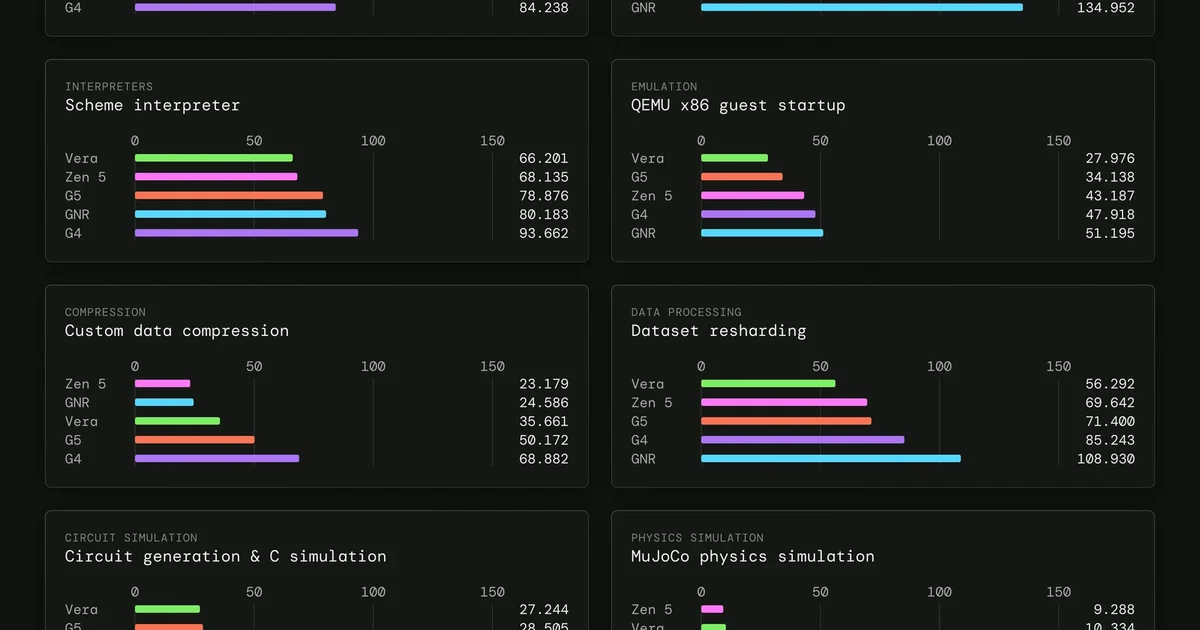
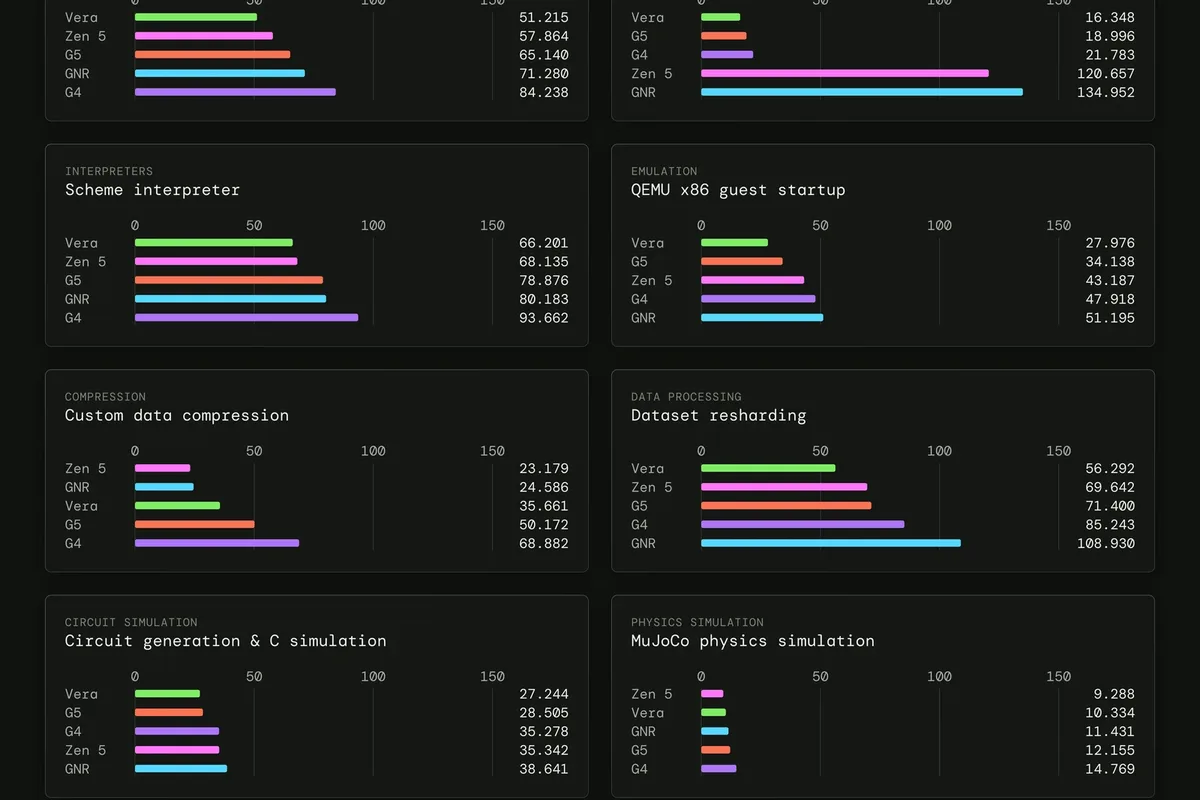
Modal developed its own benchmark to evaluate Vera. It is called Agentless Agent Bench. The name reflects its purpose. Rather than measuring every component of a live AI system, the benchmark isolates CPU work normally performed during agent execution. It includes fifty tasks and verifiers drawn from Terminal-Bench. The workloads cover compilation, Git operations, file searches, emulation and other processor-intensive activities. Network calls are removed, and the tasks run in prepared Docker containers. Modal then increases the number of concurrent workloads and measures how much work the server completes within a fixed period. That is where Vera reportedly stands out. The company observed up to twice the task throughput of a comparable Intel Granite Rapids x86 server. It also reports that individual task latency remained similar or sometimes improved despite the heavier load. The combination is interesting because throughput and latency often compete. Running more tasks simultaneously can increase total output while slowing each individual task. Modal says Vera is able to push that trade-off further than the alternatives in its tests. However, these are internal measurements made by a prospective user of the hardware, not a comprehensive independent laboratory comparison.
Double the throughput does not mean double the speed
This distinction is central to interpreting the results. Throughput describes the amount of work completed during a period. Latency describes how long an individual task takes to finish. A server completing two hundred operations while another completes one hundred has twice the throughput. That does not automatically mean each operation finishes in half the time. Modal's own results make this clear. When tasks are executed sequentially on an unloaded machine, Vera often performs well. But it is not consistently the fastest processor. The author of the report, Erik Dunteman, explains that the initial differences were not always large enough to be impressive. The advantage became much more significant when more workloads were added. Competing processors reached throughput plateaus, while Vera reportedly continued to process additional tasks efficiently. Modal's announcement therefore concerns increased sandbox throughput under contention. It is not evidence that every individual AI agent will complete every mission twice as quickly.
Memory bandwidth may explain Vera's advantage
Modal points to Vera's memory subsystem as a major reason for its results. A processor cannot work efficiently if its cores spend too much time waiting for data. When many processes run simultaneously, contention for memory and cache resources becomes important. NVIDIA designed Vera with 88 custom Olympus cores and 176 hardware threads. Its LPDDR5X memory subsystem can deliver up to 1.2TB/s of aggregate bandwidth, according to the manufacturer. The chip also uses cache-coherency and memory-management mechanisms designed for highly concurrent workloads. Those characteristics are relevant to servers running large numbers of sandboxes. Each environment executes different processes and manipulates its own data. An architecture capable of reducing memory-related stalls may keep more cores productive. Modal believes Vera allows it to pack more containers onto each core without experiencing the same degree of slowdown seen on certain alternatives. That explanation is consistent with the processor's design. However, an independent analysis has not isolated the exact contribution of every architectural component to Modal's observed performance.
NVIDIA wants a larger share of the server CPU market
Modal's decision also has significant business implications. For years, NVIDIA primarily supplied accelerators used alongside other companies' central processors. Intel and AMD remained major suppliers of general-purpose server CPUs, with additional competition from Arm-based designs. Vera represents a more direct challenge. NVIDIA can now supply central processors for work surrounding AI models. That includes orchestration, data processing, tool execution and certain reinforcement-learning operations. Reuters reports that NVIDIA is targeting at least $20 billion in Vera CPU sales during its current fiscal year. The company sees a much larger potential market for data center processors. Those financial ambitions are projections rather than sales already achieved. Still, they demonstrate that Vera is more than an accessory to the Rubin GPU platform. NVIDIA wants its own CPUs to become central components of agentic computing infrastructure. Modal's announced adoption is therefore an important commercial signal. A cloud provider previously committed to x86 now considers Arm integration worthwhile.
Moving from x86 to Arm requires software changes
Hardware advantages cannot be used without supporting software. Modal acknowledges that adding Arm represents a major engineering change. Its infrastructure and software images were historically designed around x86 processors. Programs compiled for x86 do not necessarily run natively on Arm. That can affect executables, libraries and other dependencies. Modal will need to adapt its infrastructure and image-building systems. Customers may also depend on software components that lack sufficiently tested Arm versions. Some workloads may require only recompilation. Others may need different tools or further changes. These compatibility considerations help explain why Modal is keeping Intel and AMD in its fleet. A mixed architecture approach can preserve support for existing applications while allowing compatible workloads to benefit from Vera. Processor selection may then become part of the platform's scheduling decisions. Different kinds of work can be directed toward the hardware that handles them most efficiently. That flexibility matters in a market where agent workloads are evolving quickly.
Faster CPU execution can also keep GPUs working
The potential benefit extends beyond coding sandboxes. Modal also supports reinforcement-learning workflows. Some training systems generate actions that must be executed and evaluated in separate environments. GPUs handle model computation. CPUs execute programs and perform various checks needed to evaluate results. When these stages are synchronized, expensive GPUs may have to wait while slower CPU tasks finish. Those delays have a financial cost. AI accelerators are expensive, and their efficiency depends on how much time they spend performing useful work. Reducing CPU bottlenecks can therefore improve overall infrastructure utilization. A processor that handles concurrent execution more efficiently may create benefits beyond the direct cost of its own compute time. However, those gains must be measured in complete training pipelines. Agentless Agent Bench intentionally isolates CPU operations. Its results do not establish a universal reduction in AI training expenses.
Modal is not abandoning Intel or AMD
Despite its enthusiasm for Vera, Modal is taking a measured approach. Erik Bernhardsson told Reuters that the company intends to retain a mixed processor fleet. Intel and AMD machines will continue operating. NVIDIA servers will be added when their performance justifies deployment. He also noted that competing CPU manufacturers are preparing newer generations. The published comparisons involve hardware available during Modal's testing period. They do not predict results against future processors that have not yet been evaluated. That strategy matters for cloud customers. A reliable infrastructure provider must optimize performance over time, rather than choose every component based on one benchmark. Server prices, power consumption, hardware availability and software compatibility can all affect the economics. The processor with the highest measured throughput is not necessarily the cheapest or best option for every workload. Modal will need to balance performance, operating expenses and reliability as it expands its hardware choices.
An announced rollout is not general availability
NVIDIA delivered an initial Vera server to Modal's San Francisco office during the week before the announcement. The hardware was used for early evaluation. Modal now plans to work with NVIDIA and cloud infrastructure partners to add Vera support to Sandboxes. That is a concrete step. However, the October 19 report does not provide a firm date for general customer availability. It would therefore be inaccurate to describe all Modal Sandboxes as already running on NVIDIA processors. The company still needs to complete software integration and organize broader capacity deployment. It must also establish reliability under real production conditions. A customer-facing cloud service has additional requirements beyond those covered by an isolated benchmark. Performance, availability and operating costs will need to be measured over time. That is when the commercial value of Vera can be evaluated more convincingly.
A growing infrastructure market is driving the transition
The announcement comes as AI infrastructure providers experience rapid growth. Reuters reports that Modal recently raised $750 million in an Accel-led funding round, valuing the company at $15.75 billion. Modal supplies infrastructure for both running AI models and executing the tools used by AI applications. That combination is increasingly important. A powerful agent needs reasoning capabilities, but it also needs somewhere to carry out the required work. NVIDIA wants to strengthen its position at the boundary between model computation and software execution. Vera does not need to replace every GPU or every existing CPU to find a significant market. It needs to demonstrate a meaningful advantage in workloads with substantial economic value. Modal's early results suggest that highly concurrent sandbox execution may be one such area. Whether the improvement will persist across larger customer deployments remains to be established.
Vera's real test will happen in production data centers
The claim of twice the task throughput is immediately attention-grabbing. But the more significant part of Modal's announcement lies behind the number. The company says Vera maintains high throughput when servers handle many competing execution environments. If that characteristic proves reliable at scale, it could help providers use each machine more effectively and reduce certain bottlenecks in agent-based applications. For developers, however, the benefit will not be determined by benchmark graphs alone. They will need to examine real task completion times, software compatibility, cost per successful operation and service reliability. For NVIDIA, the stakes are broader. The company wants to demonstrate that its central processors can become as strategically important to AI data centers as its graphics accelerators. Modal provides an interesting early example of adoption by a company historically dependent on rival CPU architectures. But the Arm transition must still be completed, and the performance claims need confirmation in production. One trend is already clear. As AI systems move from generating answers to executing long sequences of actions, the CPU is regaining importance. The next major competition in AI hardware will not concern only the most powerful GPUs. It will also involve servers capable of keeping thousands of agents working simultaneously without slowing one another down.