
 By Camille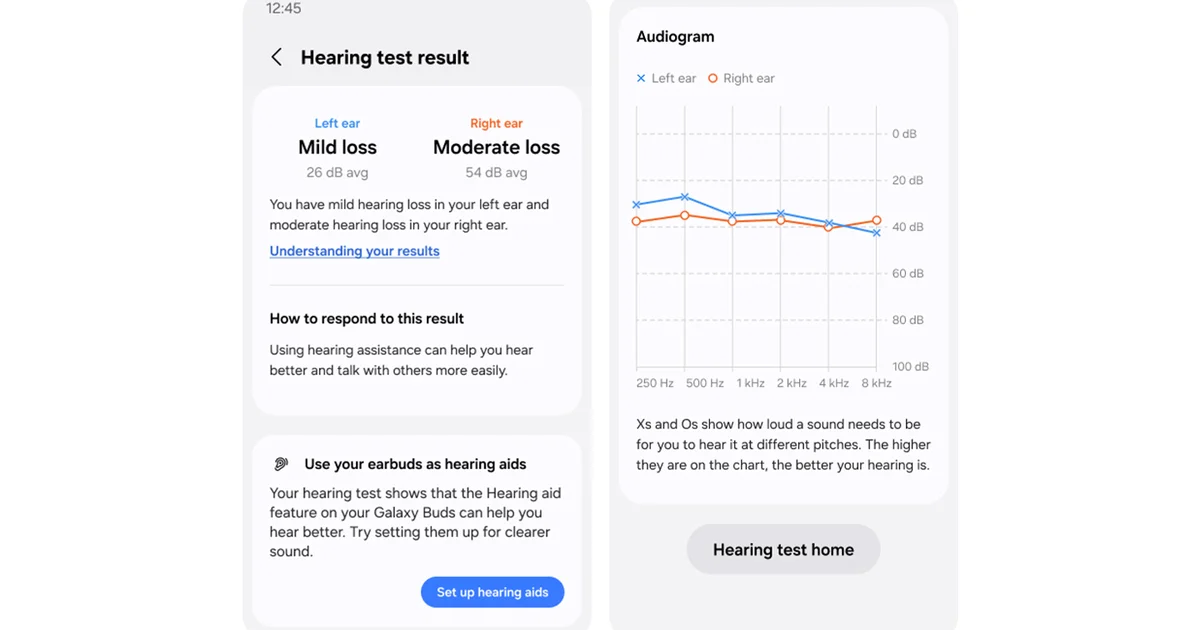
The FDA issued its 510(k) clearance for Samsung's Hearing Aid Feature on July 31, and Samsung publicly announced it on August 11. The software is intended for adults aged 18 or older with perceived mild-to-moderate hearing impairment.
Galaxy Buds3 Pro and Buds4 Pro are the two supported earbud models. Samsung plans to release Hearing Aid and its companion Hearing Test in the US and selected approved markets during the fourth quarter of 2026.
Full functionality also requires a compatible Galaxy device running One UI 8 or later. The medical feature is therefore built around a hardware-and-software combination rather than existing entirely inside an arbitrary Bluetooth earbud connection.
The five-minute test creates the input the hearing aid needs
Samsung Hearing Test plays pure tones into each ear independently and measures the user's response across frequency. The result is stored as an audiogram rather than a generic age-based sound preference.
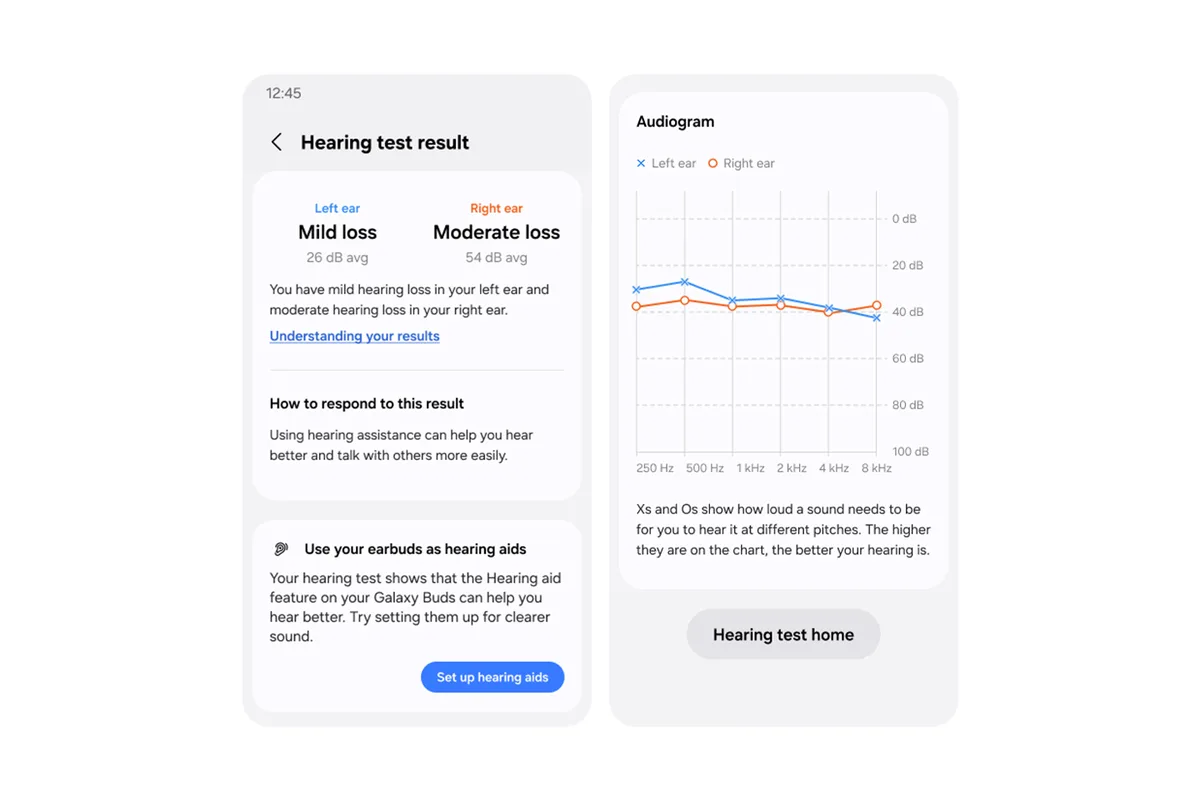
The interface can classify the measured result as normal, mild, moderate, severe or profound hearing loss. Hearing Aid itself has a narrower intended use: perceived mild-to-moderate impairment.
Samsung tested the audiogram system against clinical pure-tone audiometry performed by an audiologist. In a 367-participant validation study described in the FDA submission, the median absolute difference between Samsung's measured thresholds and the clinical reference was 3.75dB.
That distinction between the test and the aid matters. Hearing Test is a separate medical-software component that can provide the audiogram used as input by Hearing Aid.
The fitting algorithm comes from hearing care, not a music EQ
Once an audiogram exists, Samsung uses NAL-NL2 to calculate the amplification profile. The fitting procedure was developed by Australia's National Acoustic Laboratories and is widely used in professional hearing-aid fitting.
Rather than applying one volume boost across the spectrum, the system can vary gain according to the measured hearing thresholds, frequency and incoming sound level.
Users still have day-to-day controls. Samsung's interface exposes joint or independent ear volume adjustment, directional listening and background-noise reduction.
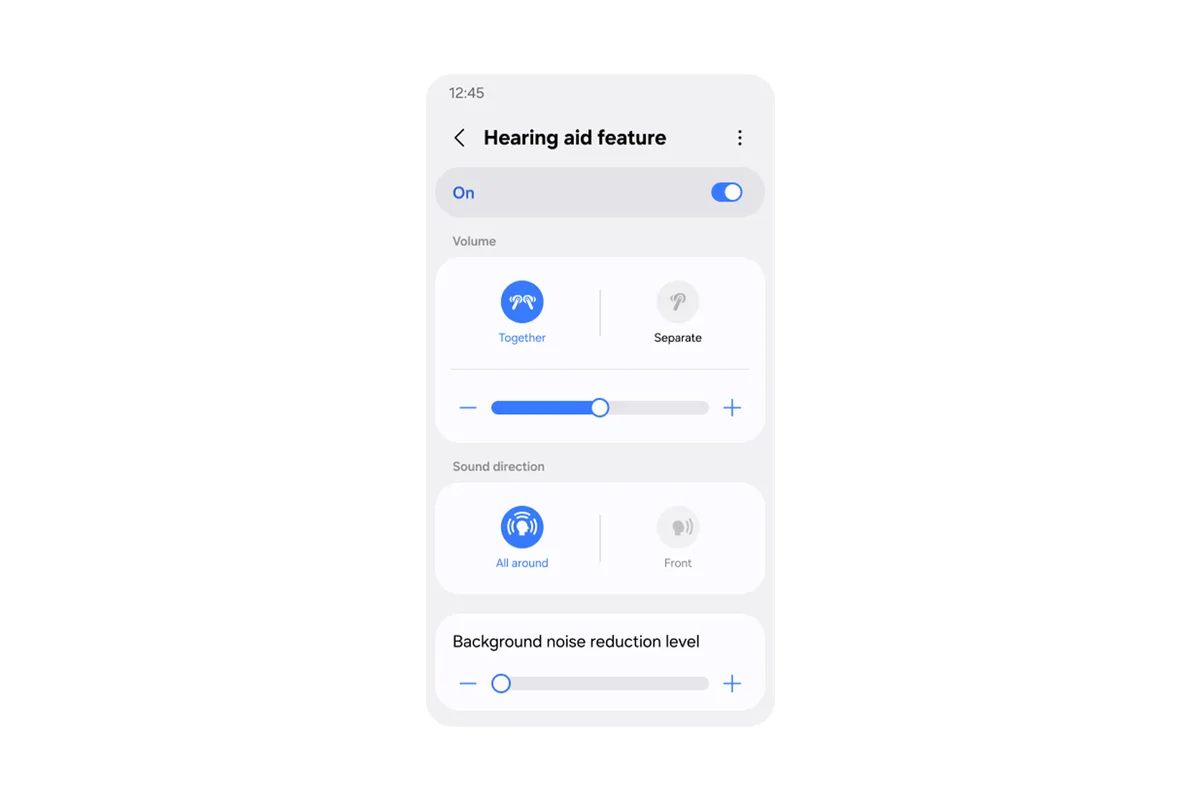
A forward-facing beamforming mode can emphasize sound coming from the direction of a conversation partner. Noise suppression then tries to reduce competing ambient information without simply sealing the wearer away from the environment.
The FDA filing reads very differently from a normal earbud specification sheet
Samsung describes Hearing Aid as two cooperating medical software applications. The mobile-device component handles onboarding, self-fitting, configuration and safety information. Software on the earbuds performs audio processing, amplification and playback.
Its submitted acoustic measurements include a maximum OSPL90 of 111.9dB SPL with input-controlled compression enabled and a full-on gain of 31.5dB.
The measured response bandwidth is 100Hz to 9,030Hz. Samsung reports total harmonic distortion at or below 1% for the applicable test frequencies, equivalent input noise of 24.9dB and system latency of 2.7ms.
Latency is particularly relevant for a hearable that mixes electronically processed sound with sound reaching the ear through other paths. Delayed amplification can create audible interactions long before latency becomes large enough to resemble the obvious lag of a video call.
Self-fitting was tested against an audiologist fitting
The OTC model depends on users being able to configure the device without a mandatory clinic appointment. Samsung's clinical study therefore compared self-fitting against a clinician-fitted reference rather than simply demonstrating that the earbuds could make sounds louder.
The prospective multi-center study enrolled 103 adults with mild-to-moderate hearing loss and ran for roughly 30 days.
One cohort used an audiogram generated by Samsung Hearing Test and fitted the Hearing Aid Feature themselves. The comparison cohort was fitted by a clinical audiologist using the NAL-NL2 procedure.
On the APHAB measure of perceived hearing-aid benefit, the self-fit group met the study's statistical non-inferiority criterion. QuickSIN speech-in-noise testing showed no meaningful difference between the two cohorts, while real-ear measurements produced similar gain trends at 50, 65 and 80dB SPL inputs.
The result supports the specific self-fitting system Samsung submitted. It should not be generalized into a claim that professional hearing care has become unnecessary. Samsung explicitly says the feature is not a substitute for professional diagnosis or treatment.
Samsung's regulatory comparison is Apple's Hearing Aid Feature
FDA clearance under the 510(k) pathway is not a general endorsement that one product is superior to other hearing aids. The agency determined that Samsung's device was substantially equivalent for its intended use to an appropriate legally marketed predicate.
Samsung's submission identifies that predicate directly: Apple Hearing Aid Feature, DEN230081.
The comparison covers intended use, self-fitting, the mobile operating platform, acoustic characteristics and clinical performance. Samsung runs on Android and Galaxy hardware rather than Apple's iOS platform, but the filing argues that the underlying hearing-aid functions are substantially equivalent.
This is one of the clearest signs that premium consumer earbuds are becoming a distinct class of medical-software platform rather than merely borrowing accessibility terminology.
The real upgrade over Ambient Sound is personalization with regulatory consequences
Samsung has been experimenting with hearing assistance for much longer than this clearance suggests. Galaxy Buds+ gained a Personal Sound Amplification Product feature in 2020, and Samsung published clinical validation work around that approach in 2021.
Modern Galaxy Buds already expose ambient-volume and accessibility controls. Hearing Aid adds a different chain: clinical-style threshold measurement, an audiogram, NAL-NL2 fitting, controlled amplification and an FDA-regulated intended use.
That makes Buds3 Pro and Buds4 Pro unusually multifunctional hardware. The same microphones and drivers used for music, calls and active noise cancellation can now serve a regulated hearing-assistance mode through different software.
They do not inherit every advantage of dedicated hearing aids in the process. Battery endurance, physical fit, all-day comfort, device compatibility and regional medical authorization remain separate considerations.
Samsung says the rollout starts in Q4 2026 in the US and selected approved markets. Availability will vary by country, earbud model and paired Galaxy device.