
 By Camille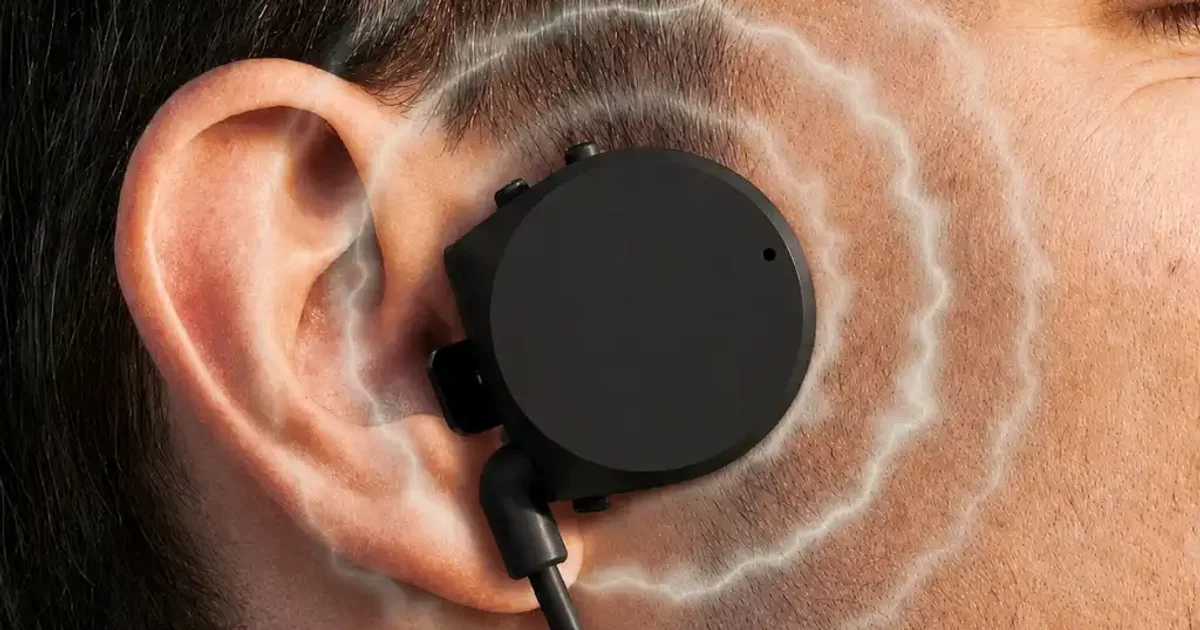
General-market availability began August 25 after a development cycle stretching back through crowdfunding, multiple hardware revisions and pandemic-era supply problems. Auricle says it has completed shipments to crowdfunding supporters and is now building commercial units in small batches in Denmark.
That history matters because the final hardware is not simply the old prototype entering production several years late. Auricle had to replace its original transducer after the component was discontinued, then rework the mechanics, calibration and manufacturing process around a different haptic driver.
The tragus is doing part of the acoustic work
awareONE clips onto the small piece of cartilage immediately in front of the ear canal. Three tip sizes are provided to change the fit.
Nothing seals the canal. Environmental sound reaches the ear naturally rather than being captured by microphones and recreated through a transparency mode.

There is consequently no active noise cancellation. Auricle includes earplugs for users who occasionally want passive attenuation instead of the normal open-ear arrangement.
The company positions the design for commuting, walking, cycling, office use and situations where being acoustically reachable is more important than isolation.
Cartilage conduction is not simply bone conduction moved a few centimeters
The underlying mechanism has a scientific literature outside Auricle. Researchers have studied cartilage conduction for years, and cartilage-conduction hearing aids have already reached clinical use in Japan.
The transmission path is more complicated than saying vibrations bypass the eardrum and travel straight to the cochlea. In normal ears, published research indicates that vibrating the tragus can make the cartilaginous part of the ear canal generate airborne sound inside the canal.
That pressure can then travel through the eardrum and ossicles much like conventional air-conducted sound. Bone-mediated and directly radiated airborne components can also contribute, with their relative importance changing across frequency and placement.
Studies have found the tragus particularly effective as a stimulation point, while higher frequencies can involve a larger contribution from direct acoustic radiation from the transducer itself.
PulseSense makes the low end intentionally tactile
Auricle adds a second idea on top of cartilage conduction. PulseSense uses haptic vibration so low-frequency content is physically felt at the contact point rather than relying only on perceived acoustic bass.

The production model uses dual PulseSense transducers with dual Class-D amplifiers. Auricle lists 48kHz audio processing and a three-processor architecture handling audio, control and low-latency DSP.
The manufacturer says its approach reaches a broader and more natural frequency response than conventional bone-conduction products. Its current public specifications do not include an independent frequency-response graph or a measurement set that would let that claim be quantified.
There is therefore a useful distinction between the technology and this particular implementation. Cartilage conduction is an established physical phenomenon. Whether awareONE sounds better than competing open-ear headphones remains a product-level question.
The wireless specifications are surprisingly conventional
Bluetooth 5.2 handles the connection, with aptX, AAC and SBC support. Calls use a MEMS microphone, and Auricle lists an iOS and Android companion app.
There is no advertised lossless codec or LE Audio support in the current specification.
The two sides are also connected to each other by a 41cm cable, so this is wireless from the source rather than a pair of independent true-wireless modules.
Total weight is 29g. Each side measures 33.6 by 34 by 19.5mm.
Maximum volume has a visible battery cost
Auricle rates playback at up to seven hours at normal listening levels. At maximum volume, the figure drops to approximately five hours.
A full USB-C charge takes around two hours. There is no charging case adding multiple portable top-ups.
IPX4 resistance covers sweat and splashes but not swimming or submersion.
Those specifications put awareONE behind some mainstream sports-oriented open-ear products on pure endurance. The design is prioritizing a different combination of fit, natural environmental hearing and tactile low-frequency output.
Reaching production may be the most significant milestone
Auricle describes itself as a boutique hardware company and says each awareONE is assembled and tested in Copenhagen. Small-batch manufacturing gives the team tighter control over revisions, although it is a very different industrial model from launching millions of conventional earbuds.
The company originally pursued the concept before open-ear audio became a large consumer category. By the time awareONE reached general availability, conventional open speakers, bone-conduction headsets and cartilage-conduction products from larger manufacturers were already on the market.
What Auricle now has is a commercially available implementation of a relatively uncommon mechanism combined with haptic bass. Independent listening tests and acoustic measurements can finally determine how much that difference matters outside a laboratory or demonstration.