
 By Kilam
Legacy Code is planned for Steam in 2027, and its newly opened store page provides a clearer explanation of what Room 127 is building technically. The developer is creating both the game and its proprietary physical simulation system, the Marionette Engine.
That engine is necessary because a Mechanimal has no fixed anatomy.
There is no practical way to author animation for every possible body
Creatures can combine arms, legs, motors, electric fans, televisions, chains, dentures, cacti and other components in wildly different configurations.
Manually preparing locomotion animation for every possible arrangement would be impossible. Room 127 instead uses physical simulation to generate behaviour from the constructed body.
Individual components carry their own properties and can affect balance, mass, reach and contact with the terrain.

The result is deliberately not completely predictable
The system is not intended to make every creation walk in the same clean, readable way. Part of the game comes from the difference between what the player intended to build and what physics actually produces.
Room 127 says a carefully planned Mechanimal may develop an entirely unexpected way of moving once the simulation begins.
Programmer Yasuta says the team actively tried to create combinations that would break the engine, yet the tested structures continued to produce some form of functioning creature.
Physics becomes a progression system
Those properties matter outside the construction interface. Mechanimals fight other creatures, collect their components and become physically larger as progression continues.
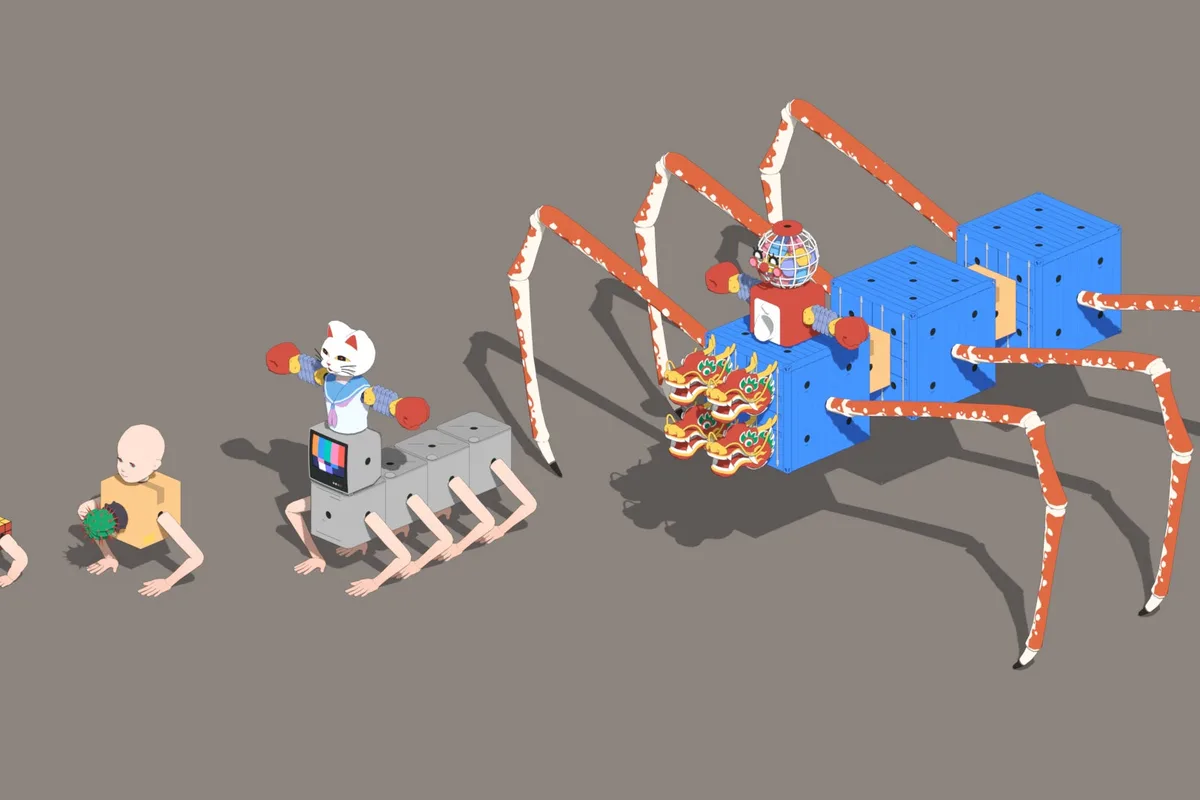
Additional legs may support more mass. Longer arms change actual attack reach. Heavier pieces can increase impact while also altering the balance of the complete body.
Optimising a build is therefore also a mechanical problem. Adding power can make the creature harder to move effectively.
Locomotion itself becomes emergent gameplay
Legacy Code shows environments including deserts, snowfields and ruins. Terrain cannot remain decorative when it has to interact with bodies whose exact shape is unknown until the player creates them.
A Mechanimal that behaves reliably on flat ground may respond differently to slopes and obstacles.
That interaction makes the project closer to a physics sandbox than a conventional creature editor.
Sense of Wonder Night recognised the system rather than the visual joke
Legacy Code was selected as one of eight finalists at Sense of Wonder Night 2026. Tokyo Game Show's own criteria explicitly identify physics engines as an example of technology that can enable experimental game experiences.
Legacy Code did not ultimately win the audience Grand Prix, but its finalist status reinforces that the physical simulation is the central idea being evaluated, not simply the strange appearance of the creatures.
Important technical questions remain unanswered
Room 127 has not published PC system requirements, performance targets or details about the CPU cost of its simulations.
That will be particularly interesting as Mechanimals can grow substantially larger over time and accumulate more components capable of interacting simultaneously.
Legacy Code is currently planned only for Steam in 2027. We will need a later build before finding out exactly how expensive a spider made from televisions and dentures is in milliseconds.