
 By Adri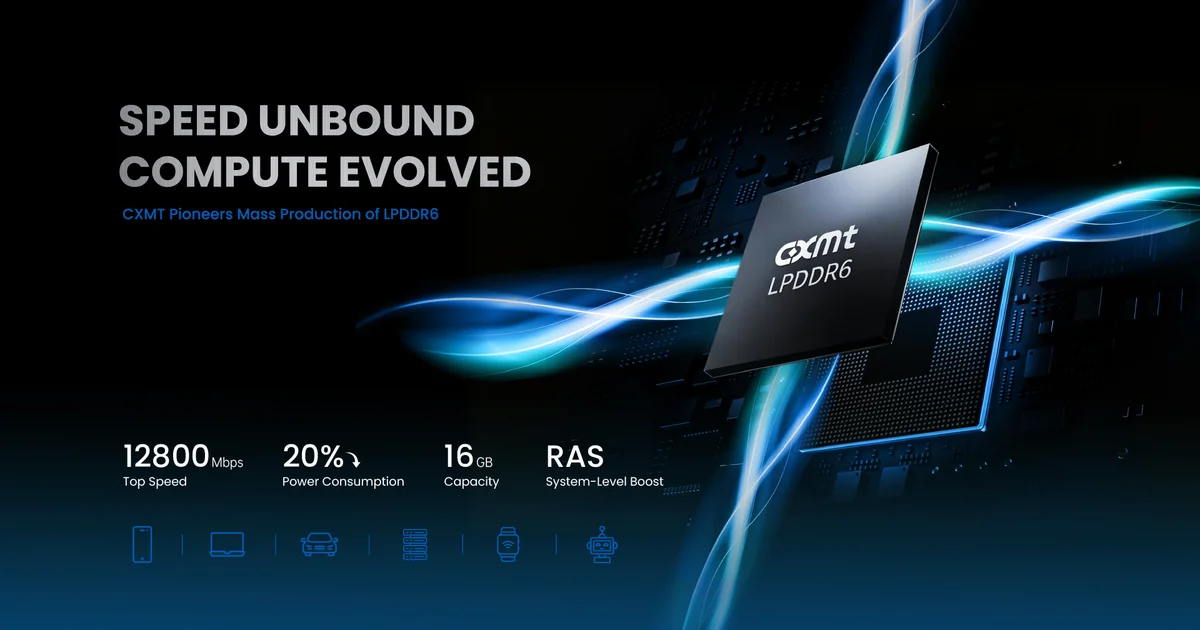
CXMT announced on September 7 that its LPDDR6 had entered mass production and was making its commercial debut inside the Xiaomi 18 Fold.
Xiaomi unveiled the phone on the same day in China.
Reuters confirms that the device combines Xiaomi's internally developed XRing O3 processor with DRAM supplied by CXMT.
Pricing starts at 10,999 yuan and rises to 14,999 yuan depending on configuration.
The memory may be the genuinely new part of the platform
CXMT's first mass-produced LPDDR6 package provides 16GB of capacity.
It is assembled from 16Gb dies and complies with the JEDEC LPDDR6 standard.
CXMT rates the memory itself for a maximum data rate of 12,800Mbps.
When paired with the Xiaomi 18 Fold's SoC, it operates at 10,667Mbps.
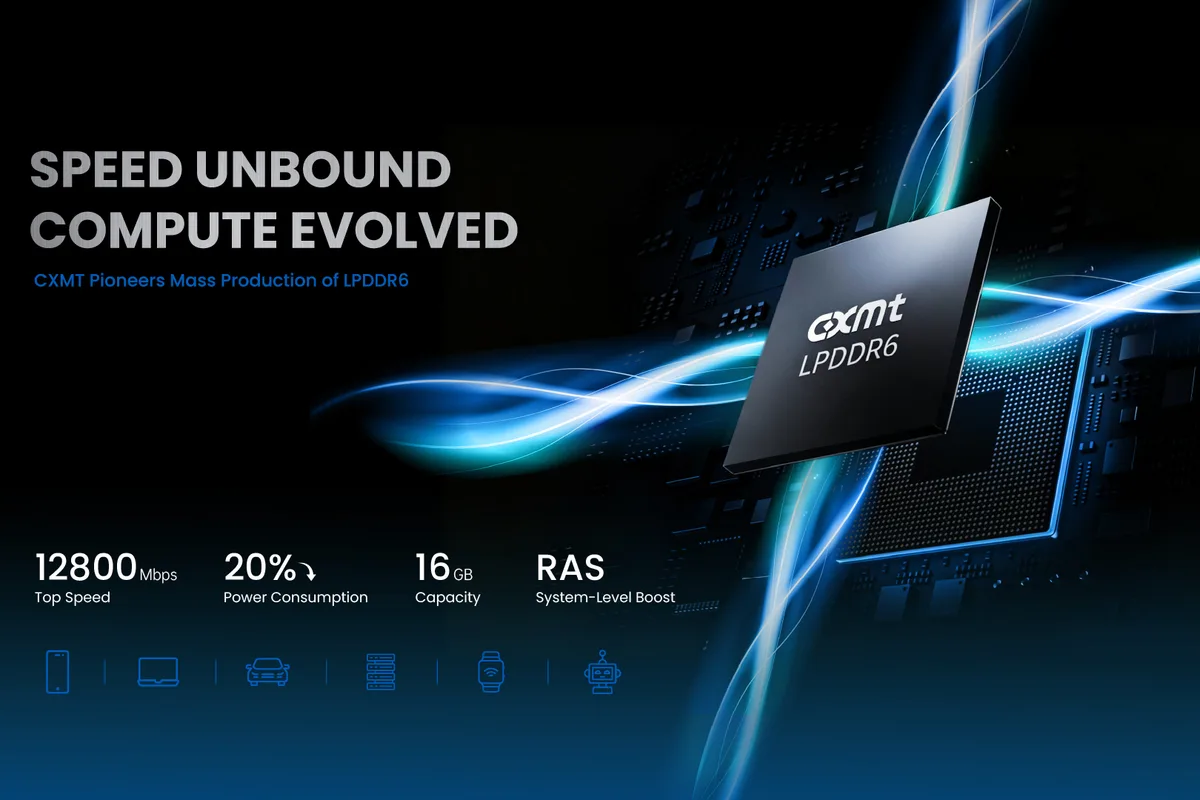
Those figures represent different limits: the peak capability CXMT specifies for the memory product and the operating rate selected for this particular SoC implementation.
That distinction matters because a memory device can support a higher ceiling than the controller or performance profile used by one commercial phone.
LPDDR6 is mainly about feeding more data to the compute blocks
A mobile processor does not perform its work entirely inside CPU, GPU and NPU execution units.
Performance also depends on how quickly those blocks can retrieve data from memory and return results.
That limitation becomes more visible as smartphones run larger local AI models, process heavier camera workloads and use increasingly capable GPUs.
Adding more arithmetic units eventually stops helping if those units spend too much time waiting for memory.
CXMT claims up to 60% more bandwidth
The company compares its peak LPDDR6 configuration with 10,667Mbps LPDDR5X and claims as much as a 60% bandwidth increase at the new product's maximum rate.
That figure comes from CXMT's internal testing and peak-bandwidth comparison.
It should not be interpreted as a guaranteed 60% performance improvement for the Xiaomi 18 Fold.
At the 10,667Mbps rate used with XRing O3, actual memory performance depends on the SoC's channel architecture, controller behavior and workload.
LPDDR6 changes the interface architecture as well as the speed
CXMT describes a dual-channel design with native 24-bit I/O in normal operation.
Its high-speed interface also supports per-pin calibration for pre-emphasis and Decision Feedback Equalization parameters.
Those mechanisms are intended to preserve signal integrity as transfer rates increase.
At sufficiently high speed, the electrical behavior of the traces between memory and SoC becomes part of the performance problem.
At more than 10Gbps, even the package becomes a signal-engineering problem
CXMT uses a 1,295-ball FBGA package for its LPDDR6.
The company compares that with the 496-ball package used by an earlier LPDDR5 generation and says total solder-ball area increases substantially.
The additional connections support the new interface, power delivery and signal requirements.
This part never appears prominently in a phone advertisement, but moving to a new memory generation is not simply a matter of placing faster DRAM cells inside an unchanged package.
CXMT also redesigned the package around heat
The memory vendor says it uses High-K EMC material to encapsulate the chip.
According to its internal measurements, the approach reduces die thermal resistance by roughly 40%.
The objective is to improve heat transfer during sustained high-bandwidth operation.
Mobile DRAM remains only one contributor to total phone power, but at these interface speeds thermal design, signaling and voltage become increasingly connected.
The power claim is 20% lower than the previous generation
CXMT says its LPDDR6 cuts power consumption by 20% compared with its LPDDR5X predecessor.
That figure also comes from the manufacturer's own testing.
The memory uses dual-rail DVFS to separate voltage domains and adds a dynamic efficiency mode that adjusts operation according to workload.
The effect on total smartphone battery life will depend on how often memory operates at each performance point and on the much larger power draw of the SoC, display and radios.
The reliability features have evolved too
CXMT lists a broader set of RAS mechanisms for the new generation.
Alongside Link ECC and On-Die ECC, LPDDR6 adds features including Per Row Activation Counting and Memory Built-In Self-Test.
PRAC is relevant to Rowhammer-class attacks.
Those attacks repeatedly activate DRAM rows in an attempt to create electrical disturbances capable of flipping bits in neighboring cells.
Tracking problematic activation behavior in the memory architecture itself provides another layer of protection rather than relying entirely on controls outside the DRAM.
For CXMT, the critical change is that this is no longer a prototype
CXMT announced mass production of LPDDR5X in October 2025.
Less than a year later, it now says LPDDR6 is shipping commercially in a flagship phone sold to consumers.
The pace is significant.
Moving from LPDDR5X to a first LPDDR6 flagship deployment narrows the generation gap that previously separated CXMT more visibly from the largest global mobile-memory suppliers.
It does not reveal production volume, yield, manufacturing cost or market share.
Those variables will determine whether one high-profile design win becomes a large-scale supply business.
The Xiaomi 18 Fold is an unusually strong showcase
Xiaomi chose its most premium foldable for the memory debut.
Reuters describes the 18 Fold as Xiaomi's most premium phone to date.
The device weighs 219 grams and measures 5.02mm thick when unfolded.
Xiaomi calls the design a “medium-fold solution”: compact enough to remain passport-sized when closed, but wide enough when opened to place three apps side by side.
For CXMT, appearing in that product sends a much stronger industrial signal than entering the market through a low-end handset.
The processor is no longer Qualcomm either
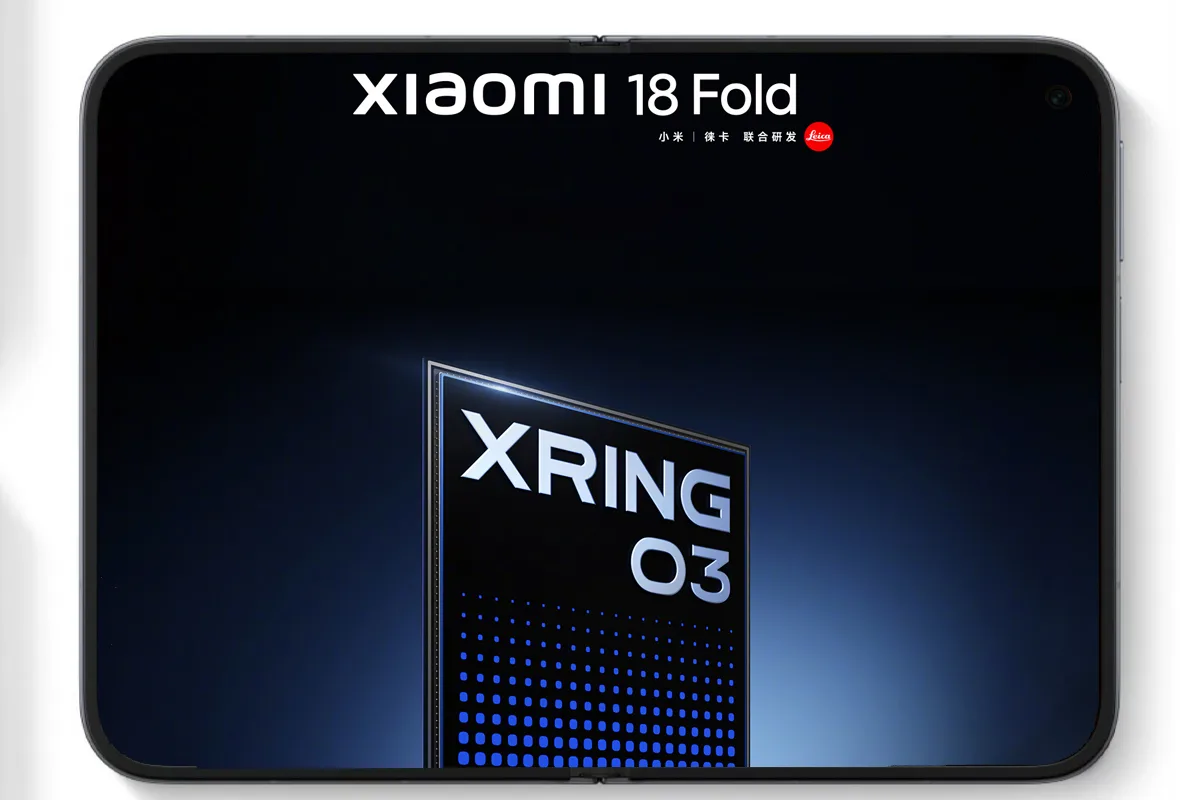
The second piece is XRing O3.
Xiaomi positions O3 as its new flagship AI-oriented smartphone SoC.
The Xiaomi 18 Fold is its first commercial device.
In August, Xiaomi also demonstrated an engineering platform pairing XRing O3 with a separate O100 AI accelerator for large on-device models.
That experimental platform should not be confused with the commercial phone.
O3 is confirmed for the 18 Fold; not every component or performance characteristic of the O100 prototype belongs to the retail handset.
Owning the SoC lets Xiaomi tune the memory relationship more directly
The strategic advantage is not simply replacing a Qualcomm logo with XRing and a Samsung or SK hynix logo with CXMT.
Designing the SoC gives Xiaomi greater control over the memory controller, frequency profiles, scheduling behavior and power-bandwidth tradeoffs.
CXMT, in turn, gains a commercial platform around which future memory products can be validated and optimized.
Co-design between components can become more important than where each individual logo originates.
Chinese design still does not mean a fully Chinese semiconductor supply chain
XRing O3 is developed by Xiaomi and the DRAM comes from CXMT.
That does not mean every manufacturing tool, EDA package, material, patent or process input required to create those chips is Chinese.
Modern semiconductor production remains globally fragmented.
Calling the phone technologically self-sufficient would therefore overstate what has changed.
The more precise development is still meaningful: two of a flagship smartphone's most strategically important components, its SoC and system memory, now come from Chinese vendors.
That already matters in a market built around very few memory suppliers
Global DRAM production has historically been dominated by Samsung, SK hynix and Micron.
That concentration leaves device manufacturers with limited alternatives when memory supply tightens or prices rise.
At the 18 Fold launch, Lei Jun explicitly acknowledged that memory is currently expensive.
An additional domestic supplier gives Xiaomi another procurement option.
It also gives CXMT access to a customer capable of substantial shipment volumes if yields and performance remain competitive.
LPDDR6 arrives as smartphones become much more memory-hungry
Mobile applications have consumed more RAM over time, but on-device AI changes the nature of the pressure.
A local model needs to keep weights, cache and intermediate data in memory while sharing the same pool with Android, applications, graphics and camera processing.
Capacity alone is therefore not the complete specification.
The rate at which CPU, GPU and NPU engines can move through those 16GB matters increasingly as well.
A faster NPU gains little if its execution units are regularly starved of data.
Memory bandwidth is gradually becoming an AI specification
AI PCs have already made memory bandwidth a much more visible marketing and architectural topic.
The same logic is moving into phones.
When local models contain billions of parameters, moving information can require as much architectural attention as performing the mathematical operations themselves.
LPDDR6 is designed to offer additional bandwidth while remaining inside the power envelope of battery-powered devices.
Xiaomi 18 Fold is one of the first commercial devices where that transition moves from roadmap material to a product on sale.
CXMT's numbers still need validation in real devices
The manufacturer publishes peak figures of 12,800Mbps, up to 60% higher bandwidth and 20% lower power consumption.
Those numbers come from CXMT.
They do not directly predict Xiaomi 18 Fold benchmark scores, battery life or AI throughput.
The phone's own SoC link is also operating below the component's advertised maximum.
Independent testing will need to examine sustained performance, power consumption and how Xiaomi actually exploits the memory in production workloads.
The next milestone is volume rather than another first
A world-first deployment is useful marketing.
For CXMT, the harder industrial test begins afterward.
Producing enough dies at strong yields, maintaining consistent specifications, winning additional customers and remaining competitive with the next products from Samsung, SK hynix and Micron is much more difficult than supplying one flagship launch.
CXMT already says it wants LPDDR6 to expand into smartphones, PCs, wearables, smart vehicles, edge servers and robotics.
That is an ambitious roadmap.
Xiaomi 18 Fold at least changes one part of the story: Chinese LPDDR6 is no longer merely being announced. It is now shipping in a commercial device.
For Xiaomi, the phone is almost as much a supply-chain demonstration as a foldable-design demonstration
The form factor gets the attention, but the XRing O3-CXMT pairing may matter for longer.
Xiaomi is trying to control more of its computing platform.
CXMT is trying to stop being a memory supplier visibly behind the leading generation.
The 18 Fold gives both strategies a commercial meeting point.
It does not make the supply chain independent from the rest of the world.
It does show that Chinese semiconductor companies are moving further into the components that directly determine a flagship phone's performance, power consumption and AI capability.