
 By Camille
Samsung published an engineering retrospective on September 9 explaining how weight has gradually been removed from its Galaxy Fold family.
The original Galaxy Fold weighed 276g in 2019. Galaxy Z Fold5 still came in at 253g, Fold6 reached 239g and Fold7 dropped to 215g.
Galaxy Z Fold8 now weighs 201g.
Samsung describes it as the world's lightest commercially available book-style foldable based on its own research as of July 22, 2026. That claim therefore depends on Samsung's stated comparison set rather than an independent industry certification.
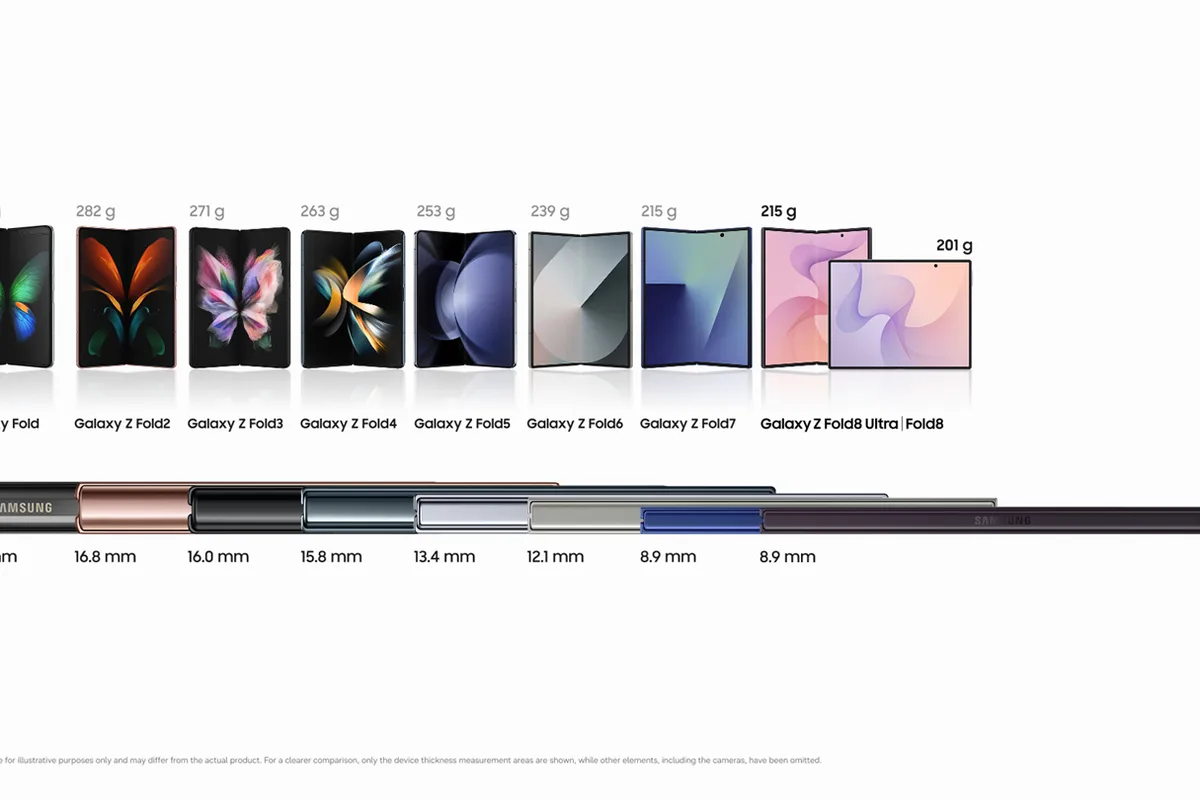
The most obvious change is that the weight is starting to leave the foldable category entirely
At 201g, Fold8 is no longer merely light for a large foldable.
It has moved into the weight range of many conventional flagship phones while still carrying an inner folding display, outer screen, hinge and structural components joining two halves of the device.
Samsung also specifies 9.7mm thickness when folded and 4.5mm when unfolded.
The engineering problem is therefore not simply removing material. Material has to disappear without allowing the display to deform, the hinge to lose stability or the chassis to become too flexible.
A foldable display is a stack of layers that cannot simply be shaved thinner
Samsung identifies the display structure as one of the first places where manufacturing precision becomes critical.
Its layers have to flex repeatedly while maintaining enough support to tolerate pressure when users interact with the screen.
The Fold8 generation uses what Samsung calls Flex Titanium.
Under the panel, the system includes a structural titanium plate and an extremely thin titanium-alloy film.
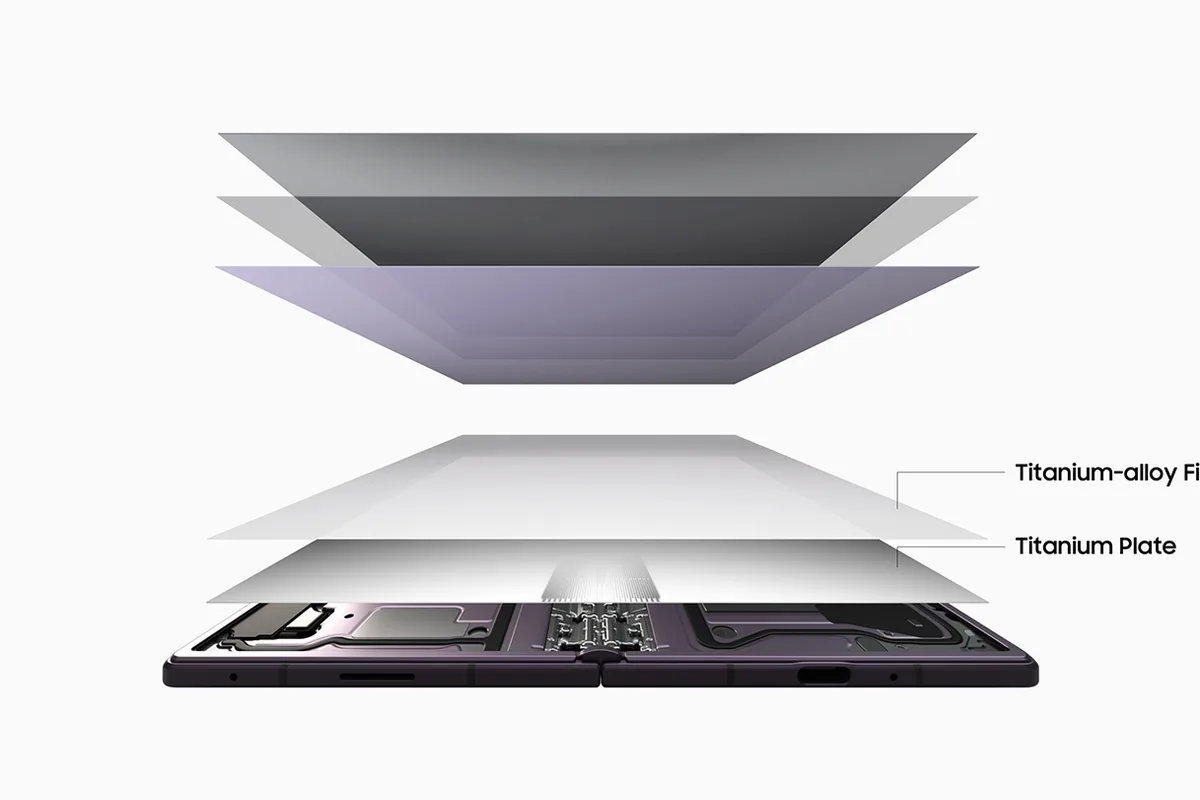
Samsung says the film is only tens of micrometers thick, roughly one-third the width of a human hair.
The aim is to retain strength, flexibility and elastic recovery through repeated folding while consuming substantially less space.
Some supporting metal structures get as thin as 0.15mm
The metal support underneath the display creates a different manufacturing problem.
Samsung says some plates are machined to around 0.2mm, with the thinnest areas reaching approximately 0.15mm.
At that scale, simply machining away more material stops being enough.
Thin metal can warp during manufacturing, and tiny dimensional changes can affect assembly accuracy or the flatness users see through the display.
Samsung says it refined machining sequences, tooling, cooling and process parameters to maintain the necessary shape.
Weight reduction therefore becomes partly a manufacturing-precision problem rather than just a material-selection problem.
The hinge has to get lighter without giving up its mechanical job
A foldable hinge does more than open and close the phone.
It helps distribute the forces created every time the device folds and unfolds across the surrounding structure.
Samsung therefore says it does not simply scale one hinge design down from generation to generation.
Each form factor requires its own balance of load distribution, strength, durability, internal volume and mass.
That explains why making a foldable thinner cannot be treated as a collection of unrelated component reductions.
Lighter materials may still need to move heat
Weight reduction quickly collides with thermal design.
A thinner phone has less internal volume available to spread heat from its processor, battery and charging system.
Samsung uses Advanced Armor Aluminum in the outer structure and says it has improved the thermal performance of graphite used inside the device.
It also uses clad metal in the rear internal structure, combining characteristics of multiple metals to reduce weight while maintaining the required thermal behavior.
The problem is therefore multidimensional: a lightweight part that forces engineers to add a heavier thermal solution somewhere else may not produce any net saving.
Eventually the large components stop being enough
Once the display, hinge and frame had been optimized, Samsung says engineers moved through almost the entire bill of materials.
Roughly 270 components and more than 180 categories of auxiliary parts were reviewed.
That included displays, hinges, cameras and circuit boards, but also antennas, brackets, tapes and fasteners.
Some changes were measured in 0.1 grams and 0.1 millimeters. In a few auxiliary components, Samsung says the savings went down to increments of 0.001 grams.
A thousandth of a gram is meaningless by itself.
Repeated across tens and eventually hundreds of parts, however, fractions accumulate into tenths and then complete grams that are no longer available from one obvious component redesign.
About fifteen categories of small parts disappeared completely
Samsung says around fifteen of the more than 180 auxiliary-part types previously used could be eliminated.
The roughly 170 remaining categories were then refined by trimming oversized areas, changing shapes, reducing dimensions and combining multiple parts into single structures where possible.
That is very different from replacing one heavy frame with an exotic lighter alloy.
It removes accumulated redundancy from successive generations of engineering.
Even the PCB was redesigned to recover fractions of internal space
Samsung also cites the main printed circuit board.
Unnecessary circuits were removed, component placement was revised and the overall footprint was minimized.
The MFC antenna was redesigned to reduce unnecessary overlap and interference with surrounding components.
Every millimeter recovered there can allow another bracket to shrink, another component to move or more room to appear elsewhere.
Inside something this densely packed, weight and volume effectively become the same engineering conversation.
The hard part is avoiding a weight-loss program built around deleting features
There is a very easy way to make a phone lighter: install a smaller battery, simplify the camera or accept less thermal capacity.
Samsung says it was trying to do the opposite.
Weight and space saved in structural systems were meant to be reinvested in capabilities users actually experience rather than simply disappearing from the product.
The standard Fold8 still carries a 4,800mAh battery, Snapdragon 8 Elite Gen 5 for Galaxy and dual 50MP rear cameras while weighing 201g.
That does not independently prove better battery life, thermals or durability in every workload. Those still need external testing.
It does show why final weight cannot be evaluated separately from the architecture around it.
Fold8 Ultra demonstrates the reinvestment idea even more clearly
Samsung uses Galaxy Z Fold8 Ultra as a separate example of the same engineering philosophy.
Fold8 Ultra and Fold7 both weigh 215g according to Samsung.
The Ultra nevertheless increases battery capacity from 4,400mAh to 5,000mAh.
Samsung estimates the larger battery itself added roughly six grams.
Engineers therefore had to find those six grams elsewhere in the phone to return to the same final weight.
The Ultra also increases graphite heat-dissipation volume by around 7% and carries a 200MP main camera plus a 50MP ultra-wide.
Those specifications belong to Fold8 Ultra rather than the standard Fold8, but the example illustrates Samsung's stated design method: save weight in one subsystem so it can be spent somewhere more useful.
Reducing weight eventually changes the manufacturing problem itself
Early in a product category, tens of grams may sometimes disappear through one major redesign.
After eight generations, the obvious margins become much smaller.
The work shifts toward machining tolerance, PCB topology, film thickness, bracket geometry and the exact amount of adhesive a joint actually requires.
Samsung's numbers make that transition unusually visible.
The path from 253g to 201g was not one 52-gram breakthrough. It was an accumulation of mechanical and manufacturing decisions across several generations.
201 grams is a marketing number, but it also marks a genuine shift for large foldables
Weight used to be one of the most immediate compromises of book-style foldables.
Their large inner displays generally meant accepting a device that was both thicker and substantially heavier than a conventional smartphone.
At 201g, that difference becomes much less obvious in a pocket or in one hand.
It does not erase the category's other compromises. Price, mechanical complexity, display creasing and repair costs remain separate issues.
But mass no longer has to be the characteristic that immediately rules out a large foldable.
And the way Samsung reached the number is ultimately more interesting than the record itself: once the large components have been optimized, the next gram may be hiding inside an antenna, a strip of tape or a thousandth of a gram removed from a fastener.