
 By Kilam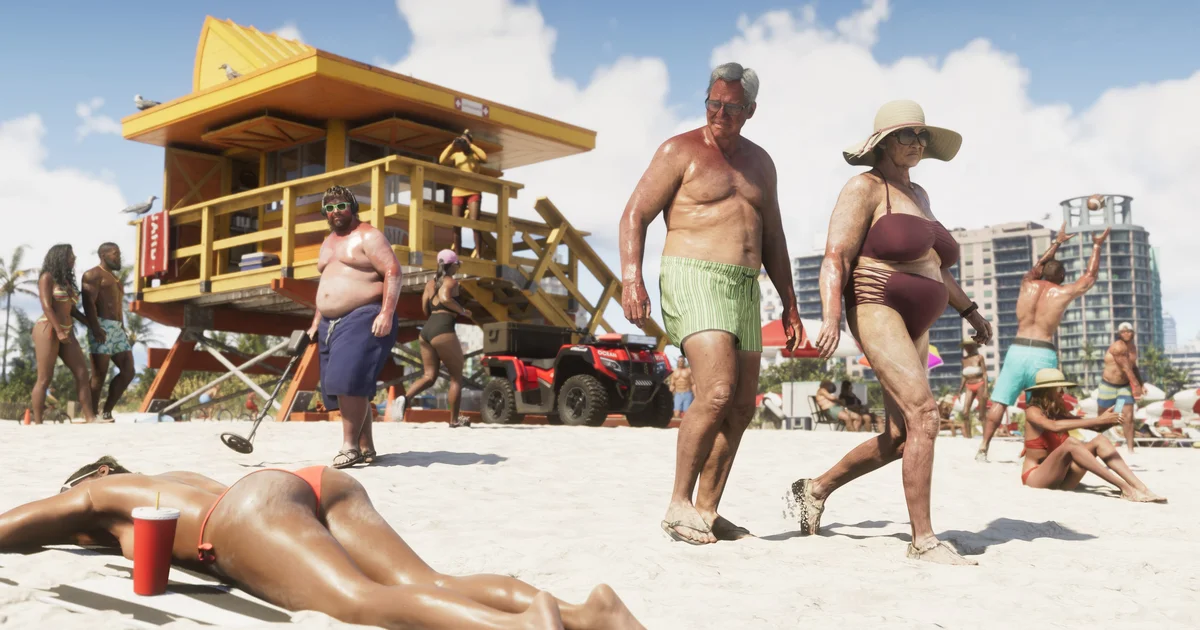
Digital Foundry separates its Extended Look breakdown into performance, lighting, simulation and open-world systems, and image quality.
The simulation section begins around 37 minutes into the analysis, after the more immediately visible discussion of ray tracing and shadows. The order is useful because GTA VI's most expensive-looking work is not necessarily the part with the most obvious graphics terminology attached to it.
A crowded beach is a workload, not just scenery
Vice Beach gives Rockstar an obvious showcase. The scene contains bodies of different ages and builds, varied clothing, tattoos and people performing different activities across the same stretch of sand.
Rockstar says it built new tools and pipelines specifically to create the most detailed and varied character population it has produced.
The company also has a Los Angeles branch working almost entirely on in-game pedestrians.
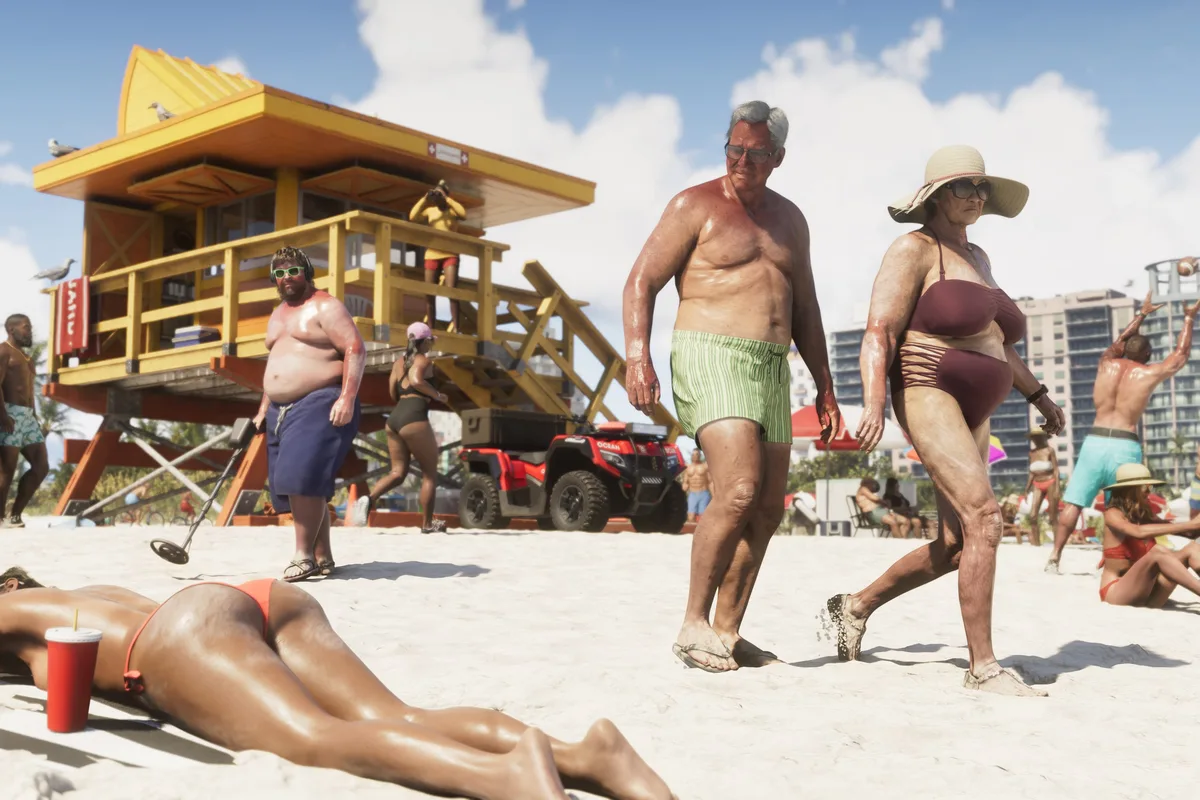
That staffing detail says something important about GTA VI's scale. Crowd density is not simply being generated by placing more copies of an existing NPC template into the frame.
Rendering a person is not the same as simulating one
A video cannot reveal how much AI work happens behind every pedestrian. Open-world engines routinely simplify behavior with distance and visibility, and Digital Foundry does not have Rockstar's CPU profiler.
Rockstar's own description nevertheless points beyond appearance. Senior character art director Jamie-Lee Lloyd says authenticity comes from the combination of how characters look, move, interact and express themselves.
The studio also describes Leonida as more reactive to player behavior. Walking through the street carrying a rifle is one example Rockstar has given of an action the surrounding city should acknowledge.
How deeply that reaction propagates through AI and police systems remains unannounced.
Traffic never gets to stop working either
Cars add another persistent system. Navigation, collision, vehicle physics and reactions to disruption all have to operate while pedestrians and the rest of the open world continue updating.
Rockstar's vehicle-handling team includes actual racing drivers, according to the company's Dazed interview.
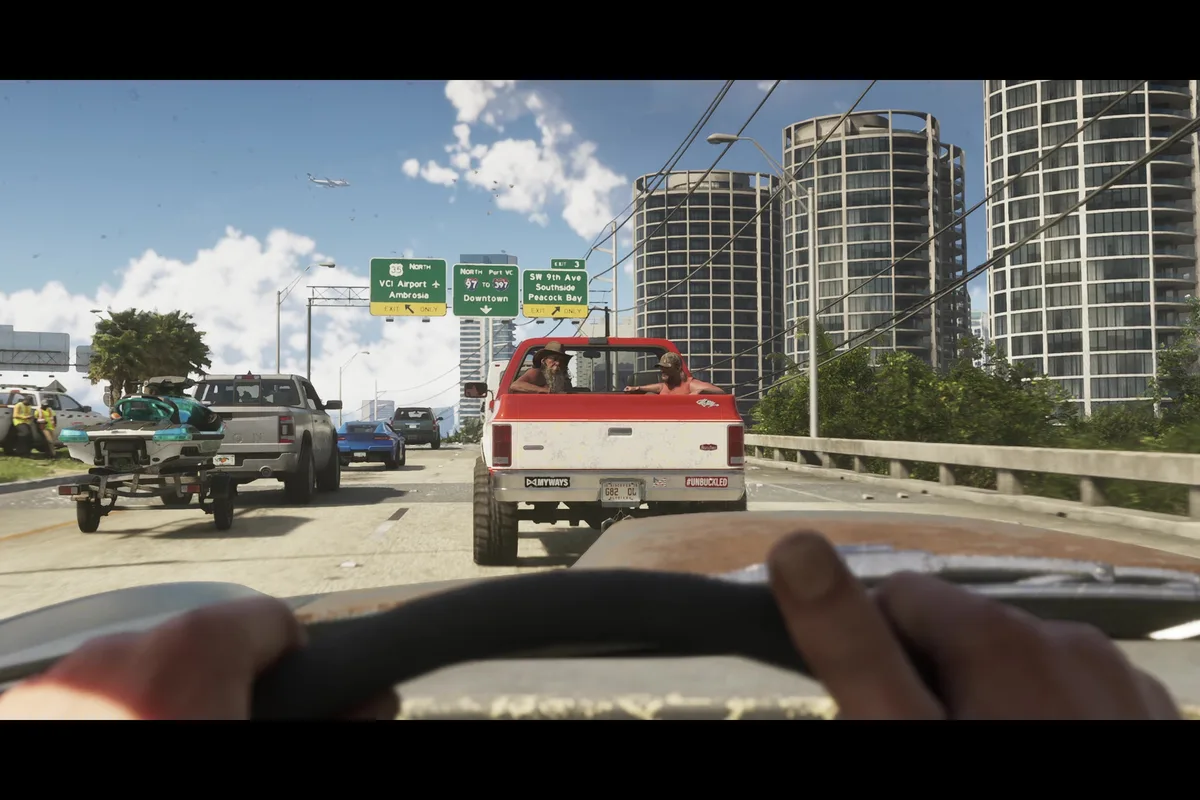
That does not make GTA VI a racing simulator. It does show that one of the game's most common background systems has its own specialized development effort.
This is where 30fps becomes harder to solve with more GPU power
GTA VI currently targets 30fps on consoles, and Digital Foundry has repeatedly argued that CPU workload may be the reason 60fps is difficult.
A 30fps frame budget gives the machine about 33.3 milliseconds. At 60fps that drops to roughly 16.7 milliseconds.
A faster GPU can render more pixels or heavier effects. It does not automatically halve the time required for world simulation, physics, traffic logic or character behavior.
That is why additional GPU power on hardware such as PS5 Pro does not guarantee a 60fps GTA VI mode.
Crowd density can be scaled, but players would notice
There are obvious theoretical ways to reduce CPU work. A game can lower pedestrian density, shorten simulation distances or update distant characters less frequently.
Rockstar has announced none of those options for GTA VI.
They would also change something much more visible than an internal-resolution adjustment. A substantially emptier Vice Beach is a different city, even if both versions use identical lighting.
Ray tracing is expensive in a more conventional way
Digital Foundry also identifies costly rendering features including ray-traced global illumination and RT reflections in parts of the Extended Look, alongside conventional shadow-map techniques.
Those features clearly consume GPU resources.
They are easier to think of as graphical variables, though. Lighting quality can be adjusted without necessarily altering the number of people standing on a street or the systems that make those people react.
The expensive part may be everything that keeps running off-camera
Rockstar says the overall GTA VI team has more than doubled since Red Dead Redemption 2. The recent development details show how some of that expansion has been distributed across pedestrians, vehicles, fashion, animation, local research and other specialized systems.
Digital Foundry cannot yet assign a millisecond cost to any of them. Proper CPU analysis will require final code and ideally a PC release where processor limits can be isolated from console hardware.
For now, the Extended Look changes what is worth watching. GTA VI's technical ambition is visible in its reflections, but it may be measured more accurately by how many things Vice City continues to calculate while the player is looking somewhere else.
Grand Theft Auto VI launches November 19, 2026 on PlayStation 5 and Xbox Series X|S.