 By Camille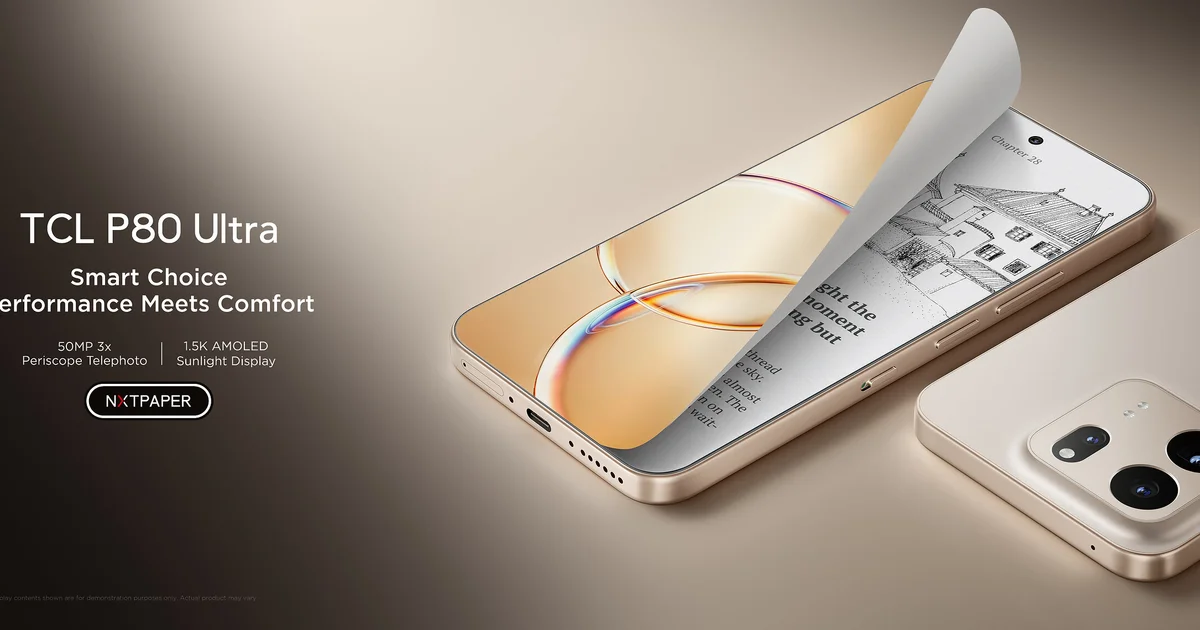
NXTPAPER is not electronic ink
TCL introduced the P80 family at IFA 2026 with three models: P80, P80 Pro and P80 Ultra.
P80 Ultra is the most ambitious of the three and shares its defining technology with P80 Pro.
NXTPAPER now runs on an AMOLED display.
The first European configurations use 8GB of physical RAM with either 256GB or 512GB of storage.
Launch pricing in several European markets starts around €549 for 256GB and €599 for 512GB.
The display remains a conventional fast AMOLED underneath
Despite the paper-oriented branding, P80 Ultra does not use E Ink or another bistable display technology.
It remains an AMOLED panel capable of full-color video, HDR content and 120Hz motion.
NXTPAPER is a collection of optical, hardware and software treatments surrounding that panel.
TCL uses them to reduce reflections and short-wavelength blue-light exposure and to create reading-oriented modes without giving up normal smartphone display performance.
It is a 6.83-inch 2772 x 1280 panel
Screen size is 6.83 inches.
Resolution is 2772 x 1280, which TCL markets as 1.5K.
Refresh rate reaches 120Hz.
The company also claims up to 100% DCI-P3 color coverage and black side borders as narrow as approximately 1.38mm.
This is not a reading-first panel that sacrifices multimedia quality.
The matte surface attacks reflections directly
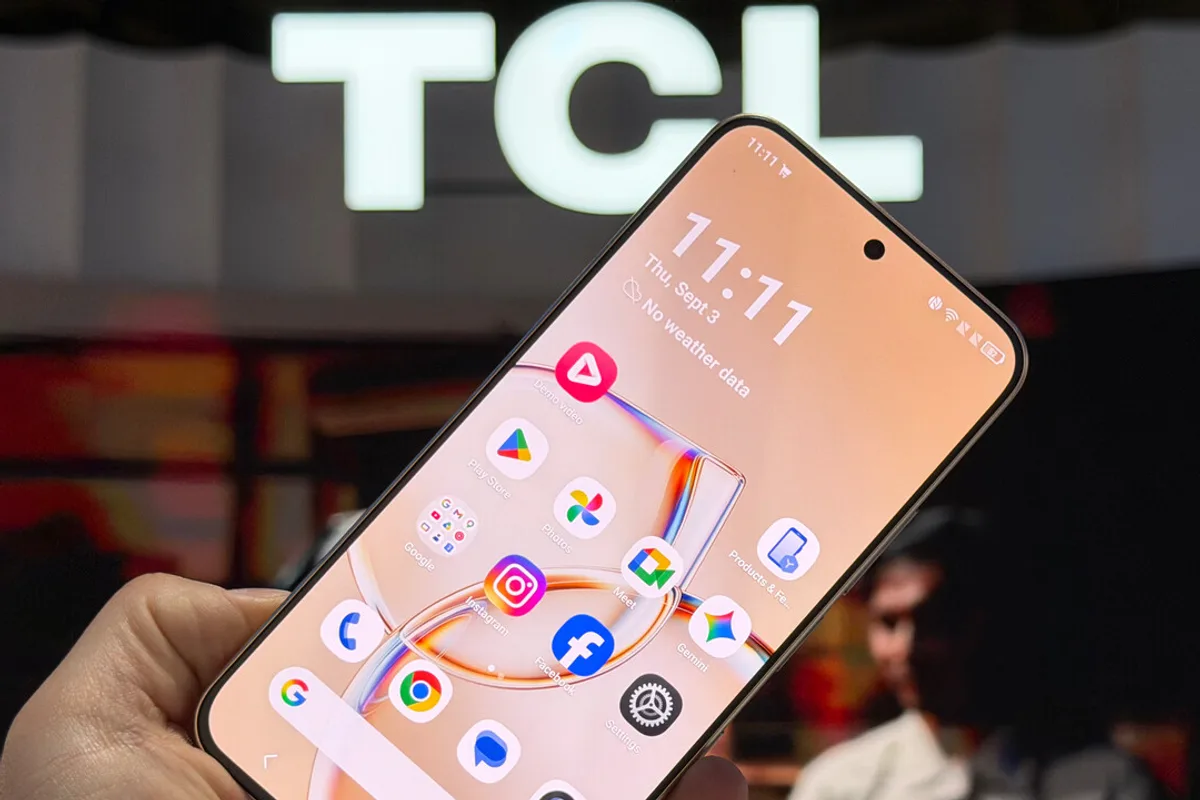
The most immediately visible difference is the anti-glare surface.
TCL uses a nano-structured treatment designed to diffuse ambient light instead of reflecting it as a sharp mirror image.
On a conventional glossy OLED, a window or overhead lamp can appear directly on top of the content.
A more matte surface spreads that reflection into a softer bright area.
It cannot eliminate every reflection, but it can make displayed text and images easier to distinguish in bright environments.
3,200 nits does not mean 3,200 nits across the entire panel
TCL advertises peak brightness of up to 3,200 nits.
As with other OLED phones, that is a peak-condition figure rather than permanent full-screen luminance.
Outdoor readability is also strongly affected by reflections.
A somewhat dimmer screen with substantially lower surface glare can sometimes be easier to read than a brighter glossy one.
That is one of the core ideas behind NXTPAPER AMOLED.
Circular polarization changes how emitted light is managed
The display system also uses circular-polarization technology.
TCL says the goal is to make the characteristics of emitted light more closely resemble natural-light behavior.
The company significantly increased the circular-polarization rate when it introduced this generation of NXTPAPER AMOLED.
Claims around eye fatigue should still be treated cautiously because comfort also depends on brightness, viewing duration, distance and individual sensitivity.
The polarization layer is nevertheless a hardware change rather than merely a warm software filter.
Blue-light reduction also happens at the hardware level
NXTPAPER reduces the proportion of short-wavelength blue light emitted by the panel.
TCL has advertised levels below roughly 3% under its reference conditions for this generation.
The key distinction is that the reduction is not achieved solely by making the entire screen orange through a night mode.
TCL is attempting to alter the panel's spectral output while preserving normal-looking colors in its standard mode.
Independent measurements will still be needed to verify the exact commercial-device behavior.
Color temperature can shift with the time of day
Brightness and color temperature can adapt to ambient conditions.
A circadian setting also changes the screen gradually across the day, remaining cooler in daylight and warmer toward evening.
That software behavior itself is not unique.
Many modern phones provide similar night-display functions.
What distinguishes P80 Ultra is the combination of those controls with its anti-glare surface and other hardware-level optical changes.
A dedicated physical key switches display personalities
A NXTPAPER button sits on the phone's frame.
It provides quick access to the standard display and reading-oriented modes.
Paper Mode keeps color but offers several paper-inspired profiles with adjustable tone.
The objective is not to perfectly replicate printed paper.
It is to make long-form text less visually aggressive without manually rebuilding several display settings.
Max Ink turns the interface monochrome and can restrict apps
Max Ink Mode goes further by switching to a monochrome presentation.
It can also limit access to selected apps to reduce distractions during reading.
The mode can lower energy use by reducing some activity and simplifying the experience.
The display remains AMOLED, however.
Unlike true E Ink, it still requires continuous power to maintain an image.
This therefore does not turn the P80 Ultra into a Kindle running Android
Electronic paper has fundamentally different physical behavior.
It can retain static content using extremely little energy and looks different under strong ambient light.
P80 Ultra does not reproduce those properties simply by becoming monochrome.
Instead, it tries to borrow some of an e-reader's ergonomic advantages while retaining smooth video, full color, gaming and HDR.
It is a less radical compromise and a far more versatile one.
Dimensity 7400 Elite puts performance below true 2026 flagships
MediaTek's Dimensity 7400 Elite powers the phone.
The 4nm platform uses Cortex-A78 and Cortex-A55 CPU cores alongside Mali-G615 MC2 graphics.
P80 Ultra is therefore not designed to challenge Snapdragon 8 Elite Gen 5 or Apple A20 Pro devices on raw compute.
At around €550, it is better understood as an upper-midrange phone whose hardware budget goes toward the display, camera system and battery.
8GB plus 16GB does not mean 24GB of physical RAM
TCL advertises 8GB of RAM with as much as 16GB of RAM expansion.
Only the first 8GB is physical memory.
The expansion feature reserves part of internal storage for virtual memory.
That can help with some background-app behavior but cannot match the latency and bandwidth of another 16GB of real LPDDR memory.
Calling the device a 24GB RAM phone would therefore be misleading.
Battery capacity is 5,800mAh
P80 Ultra contains a 5,800mAh battery.
Wired charging reaches 45W.
A compatible power adapter is not necessarily included in European retail packaging.
Capacity is generous without reaching the 7,000mAh and 8,000mAh batteries appearing in some 2026 rivals.
The tradeoff allows the phone to remain around 8.3mm thick and roughly 197g in European configurations.
The periscope camera is the main reason to choose Ultra over Pro
P80 Pro uses essentially the same NXTPAPER AMOLED display and processing platform.
P80 Ultra adds a dedicated 50MP periscope telephoto camera.
It provides 3x optical magnification with both optical and electronic stabilization.
TCL also advertises 6x “lossless” zoom by taking advantage of the 50MP sensor's resolution.
That 6x figure is not a second optical focal length.
It relies on sensor cropping and image processing from the 3x module.
The main camera uses a 1/1.56-inch sensor
The primary camera also uses a 50MP sensor.
Its sensor size is 1/1.56 inch with 1.0-micron native pixels.
Four-to-one pixel binning can combine those into effective 2.0-micron pixels in relevant modes.
The lens has an f/1.88 aperture.
Both OIS and EIS are supported.
An 8MP autofocus ultrawide and a 32MP front camera complete the system.
Ultra is essentially a P80 Pro that can reach farther
The choice between the two is unusually straightforward.
P80 Ultra and P80 Pro share the 6.83-inch 1.5K NXTPAPER AMOLED display, Dimensity 7400 Elite, 5,800mAh battery, 45W charging and storage options up to 512GB.
Ultra's main justification for the extra cost is the 3x periscope.
Someone who mostly uses the primary camera can get much of the same experience from P80 Pro.
Portrait, street and distant-subject photographers have a much clearer reason to move up.
IP68 and stereo speakers round out a balanced specification
The phone carries an IP68 dust- and water-resistance rating under controlled test conditions.
TCL also references selected durability tests performed under MIL-STD-810H procedures.
That does not make the phone a military device or mean it passed every procedure in the standard.
Stereo speakers support DTS processing.
eSIM is also available depending on market configuration.
Gemini and Circle to Search are useful but not TCL's real differentiators
Google Gemini and Circle to Search are part of the software package.
Depending on region, TCL also offers real-time translation, writing assistance, captions and smart voice-note functions.
Some of those capabilities depend on language, software version and internet connectivity.
They are also becoming common across Android phones in 2026.
P80 Ultra remains much more distinctive for its display engineering and telephoto hardware.
A roughly €549 starting price makes the experiment much easier to justify
TCL could easily have reserved its first commercial NXTPAPER AMOLED implementation for an expensive technology showcase.
Instead, several European markets launch the 256GB P80 Ultra at around €549.
The 512GB configuration sits around €599.
At that level, the compromises make sense.
The processor is not the fastest available and charging stops at 45W, but the phone still provides a real periscope lens and a display treatment few competitors offer.
P80 Ultra does not replace an e-reader; it attacks one of OLED's oldest weaknesses
The most convincing part of NXTPAPER AMOLED may not be its monochrome mode.
A smartphone cannot reproduce E Ink's extremely low static-image power use simply by draining color from the interface.
The more everyday advantage is simpler.
Modern OLED panels are bright, fast and high-contrast, but their glossy surfaces can become mirrors under windows and outdoor light.
TCL is trying to preserve OLED's strengths while attacking that weakness through surface engineering instead of simply adding more peak brightness.
That makes P80 Ultra more interesting than a phone with a gimmicky “reader” button.
NXTPAPER is no longer trying to replace AMOLED. For the first time, it is trying to make AMOLED nicer to look at.