
 By Adri
The P9 and P7 were unveiled at Gamescom on August 26 as Samsung's first new P-series portable SSDs built around USB4.
P9 is rated for sequential reads of up to 4,000MB/s and writes of up to 3,800MB/s. Samsung compares it directly with the 4TB T9, whose USB 3.2 Gen 2x2 interface tops out at an advertised 2,000MB/s for both reads and writes.
That is a meaningful improvement when the workload is actually moving large sequential files. It says much less about small random transfers, application behavior or sustained performance after a long write. Samsung's launch material does not yet provide enough independent-style testing to answer those questions.
8TB is the specification that makes P9 unusual
Samsung calls the P9 the world's first 8TB USB4 portable SSD capable of speeds up to 4,000MB/s. Capacity is available in 1TB, 2TB, 4TB and 8TB versions.
The company is aiming the largest models at media production rather than ordinary backup. Samsung says P9 has enough sustained write performance for direct 12K recording and workloads involving large RAW files and ultra-high-resolution video.
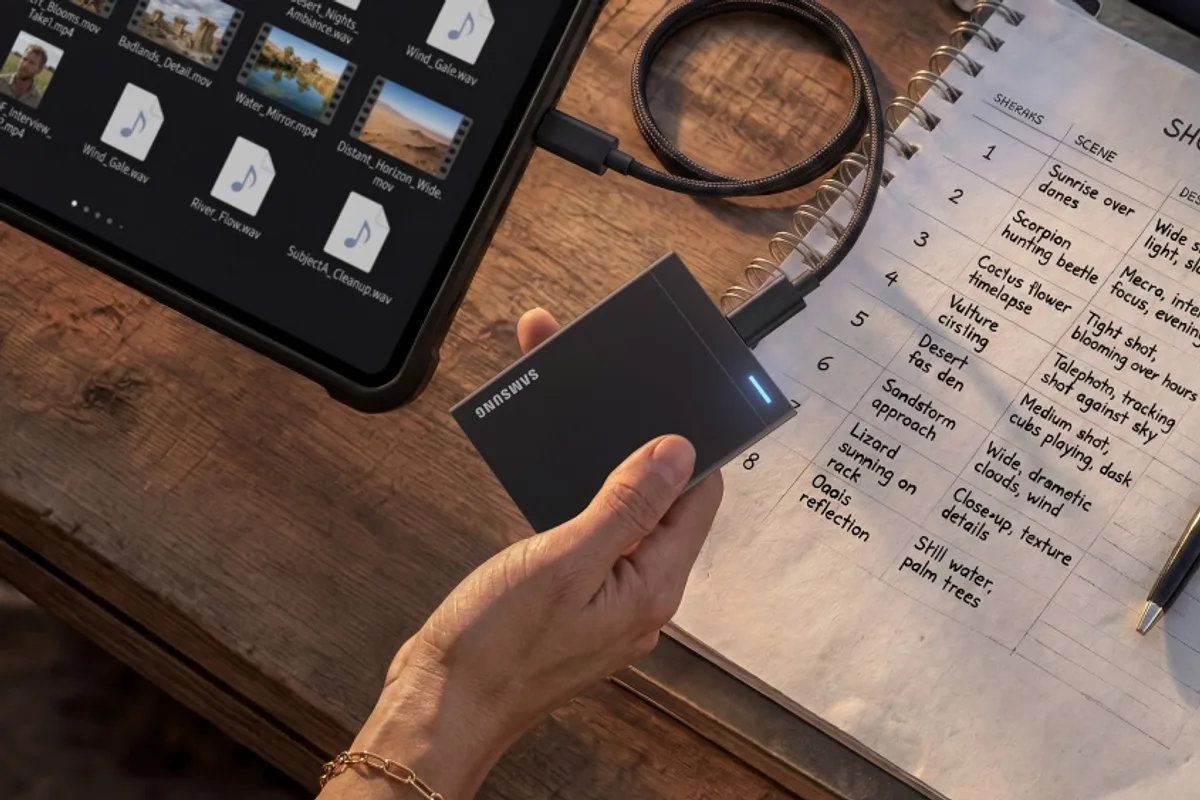
That claim needs context once independent testing begins. A 12K frame size does not define one fixed storage bitrate; codec, compression, frame rate and recording format can change the write requirement dramatically.
Still, combining several terabytes of capacity with multi-gigabyte-per-second transfers makes practical sense on a production machine that repeatedly ingests or edits very large files.
The capacity ladder gets expensive quickly
U.S. MSRP starts at $339.99 for the 1TB P9. The 2TB model is $649.99, 4TB is $1,349.99 and 8TB reaches $2,699.99.
At the upper end, this is no longer an impulse upgrade for a laptop. Samsung is pricing around workflows where time spent copying terabytes of material is expensive enough that faster external storage can justify a premium.
Users also need an appropriately fast host connection to see the headline performance. A USB-C-shaped port is not, by itself, a guarantee that the system can feed a USB4 SSD at P9's maximum rate.
P7 has USB4 too, but Samsung has not published the same performance numbers
P7 is positioned below P9 and is intended to work across PCs, notebooks, phones, cameras and game consoles. Samsung emphasizes portability and compatibility rather than a professional recording workload.
One specification is conspicuously absent from the launch release: Samsung does not provide a precise maximum sequential read or write figure for P7. USB4 support alone is not enough reason to assume it performs identically to P9.
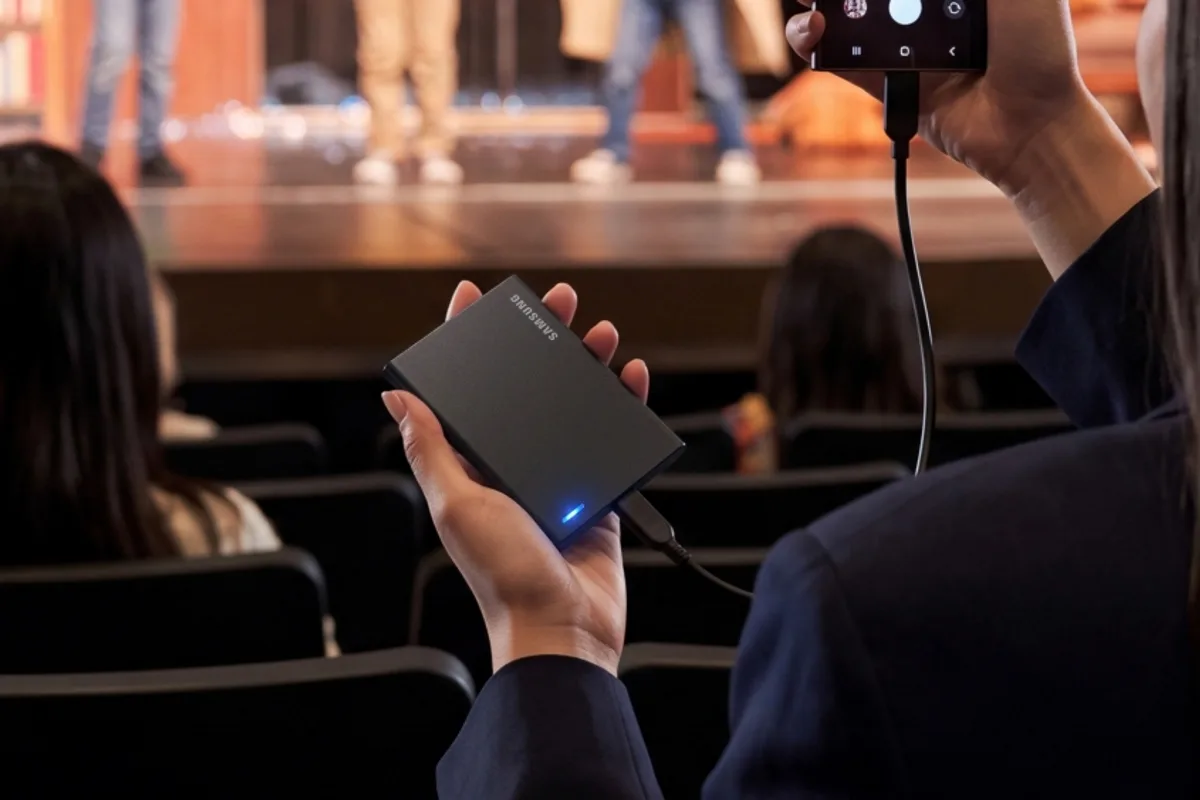
The published durability story is clearer. Samsung says P7 passed two-meter drop testing plus shock and vibration tests, which is more relevant to a drive carried between cameras, laptops and mobile devices than another benchmark number.
P7 costs $289.99 at 1TB, $549.99 at 2TB, $1,149.99 at 4TB and $2,289.99 at 8TB.
Twice the sequential speed does not make T9 obsolete
A 2,000MB/s portable SSD is still far faster than many everyday storage workloads require. The P9 advantage grows with file size and transfer frequency.
For occasional backups and game libraries, interface speed may be less important than price or capacity. A video workflow that repeatedly moves hundreds of gigabytes has a much easier case for USB4.
That split also explains Samsung's product positioning: P9 is the performance model, while P7 is being sold as the more broadly useful option rather than a cheaper copy with identical published specifications.
Global rollout begins August 31. Samsung notes that capacity availability can vary by market and that some versions may arrive later.