
 By Kilam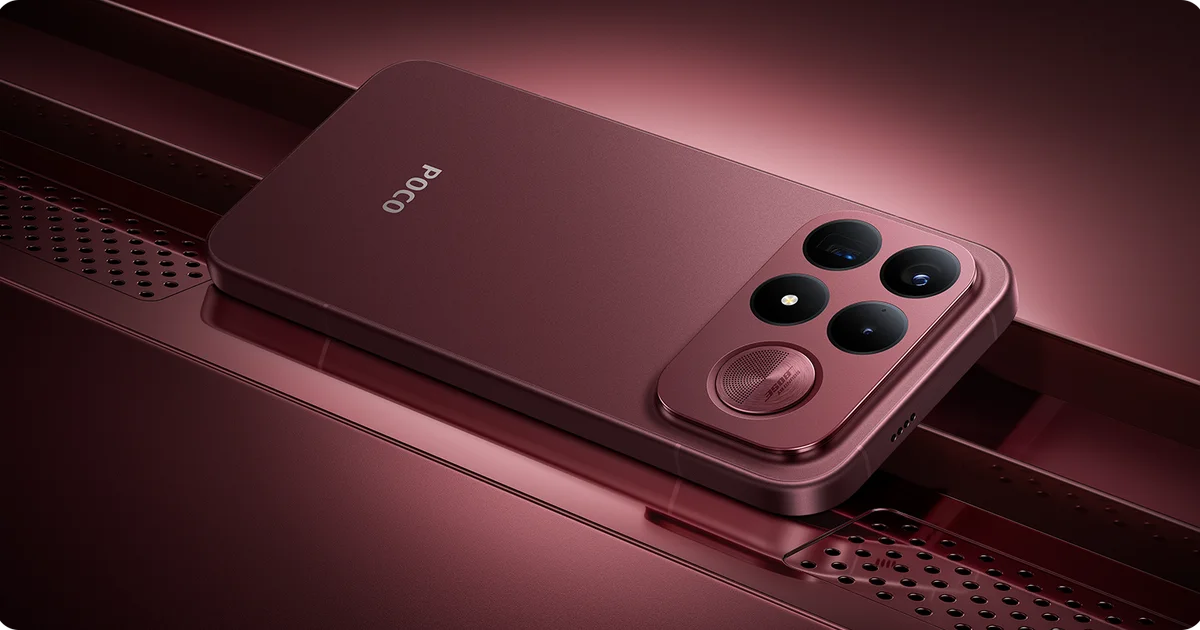
The display goes all the way to 185Hz
POCO F9 Ultra uses a 6.9-inch AMOLED panel with a 2,608 x 1,200 resolution.
Its maximum refresh rate is 185Hz.
That means the panel itself can physically present as many as 185 display updates every second when the software uses that mode.
It is an unusually high figure when 120Hz remains common across premium smartphones.
Display refresh rate, however, is not the same thing as the number of frames a game engine renders.
185Hz does not automatically mean 185 native frames per second
POCO also advertises gaming at up to 185 FPS across more than twenty titles depending on region and software support.
There is more than one way to reach that output.
Some games can operate natively at very high frame rates.
In other scenarios, VisionBoost D8 uses frame interpolation to create additional images between frames rendered by the game.
The display can therefore look smoother without Snapdragon having rendered 185 complete game frames every second.
VisionBoost D8 behaves like a specialized second graphics processor
The phone contains a separate 12nm VisionBoost D8 chipset.
It does not replace the Snapdragon's Adreno GPU.
Instead, it handles graphics-enhancement workloads around the main rendering pipeline.
POCO uses it for super resolution, intelligent frame-rate enhancement and game HDR in supported titles.
Pretrained AI models are used to reconstruct additional image detail.
The strategy follows the same broad direction as modern PC and console graphics: render less expensive source data, then use specialized hardware to reconstruct or supplement the final output.
AI Super Resolution still has a compatibility list
Those D8 functions do not work universally.
POCO currently lists AI Super Resolution support for titles including Call of Duty, Genshin Impact, Honkai: Star Rail, Mobile Legends: Bang Bang and PUBG Mobile.
Compatibility can expand through software updates.
That dependence matters because specialized reconstruction hardware is only useful when games and software can actually feed it the information it needs.
POCO also claims genuinely native 165 FPS gaming
Not every high-frame-rate result relies on generated images.
POCO publishes internal data for games running natively at 165 FPS.
One hour-long test averaged roughly 164.5 FPS.
For its 185 FPS scenario, POCO reports approximately 184.6 FPS average output and 4.96W of power consumption.
Those are manufacturer laboratory figures.
Independent testing under different ambient temperatures will matter more for understanding sustained behavior.
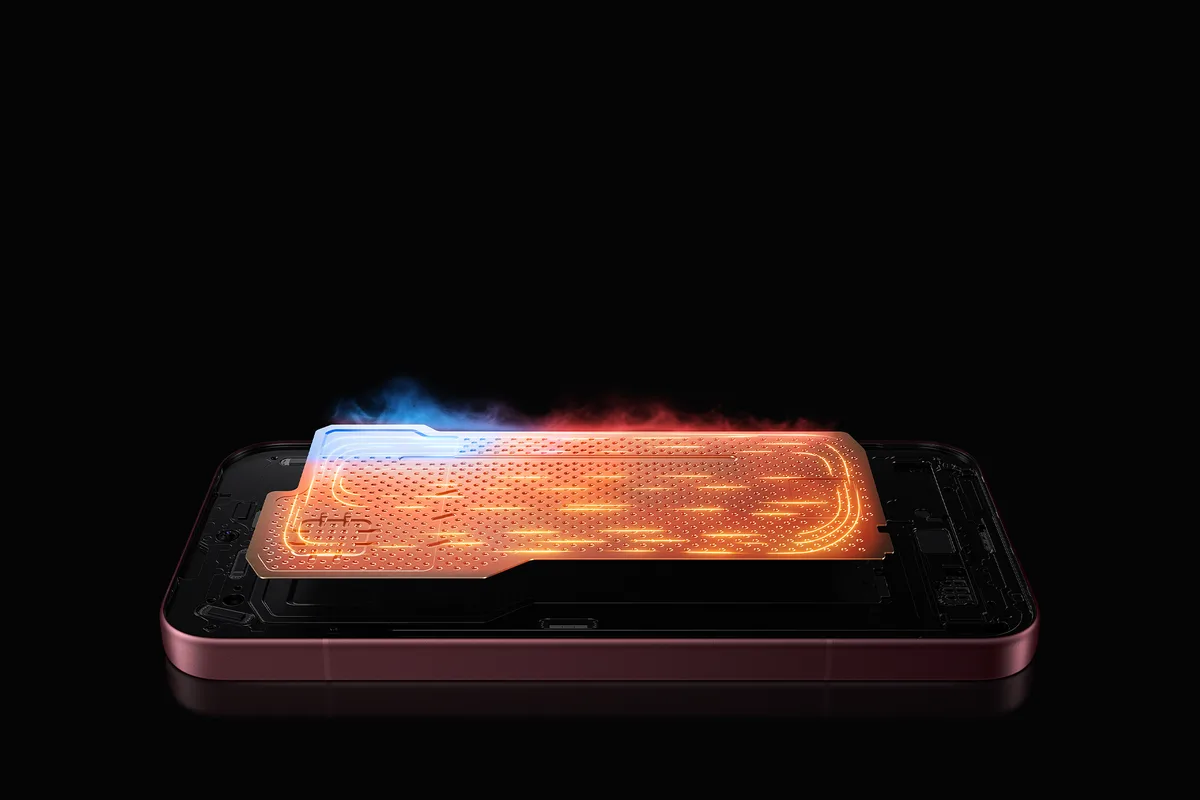
Cooling uses a liquid loop rather than only a conventional vapor chamber
Sustaining those frame rates quickly becomes a thermal problem.
POCO's 3D IceLoop system uses what the company describes as a 6,300mm² LHP area.
Its internal design separates vapor and liquid into a directional heat-transfer loop.
A raised section above the chipset improves thermal contact with the SoC area.
POCO claims this structure can reduce SoC temperature by as much as 3°C in its testing.
A 17,820mm² graphite layer spreads heat across a larger part of the chassis.
Snapdragon 8 Elite Gen 5 reaches 4.6GHz
The main processor is Qualcomm's Snapdragon 8 Elite Gen 5.
It is manufactured on TSMC's 3nm N3P process and uses an all-big-core CPU layout.
Two Prime cores reach up to 4.6GHz, while six Performance cores run as high as 3.62GHz.
POCO reports an AnTuTu V11 score of 4,165,108 under its own laboratory conditions.
A synthetic score measures one controlled workload rather than every real application.
For a gaming phone, performance after thirty or sixty minutes is more informative than a peak result obtained from a cold device.
LPDDR5X-9600 and UFS 4.1 surround the flagship SoC
Configurations include 12GB of RAM with 256GB storage, 16GB with 512GB and 16GB with 1TB.
The LPDDR5X memory operates at up to 9,600Mbps.
Storage uses UFS 4.1.
That prevents a flagship processor from being paired with significantly slower memory or storage when loading large games and moving between demanding apps.
An 8,050mAh battery changes the equation more than a few hundred extra megahertz
Battery capacity reaches 8,050mAh.
POCO describes it as the largest battery ever fitted to its F series.
The company claims as much as two days of battery life under its usage model.
Actual endurance will vary dramatically with workload.
Running a game at high refresh rates with the chipset under sustained load is very different from two days of messaging, streaming and standby.
The capacity is nevertheless large enough to provide much more headroom for long gaming sessions than a conventional 5,000mAh flagship battery.
Charging reaches 100W wired and 50W wireless
Wired HyperCharge peaks at 100W.
POCO quotes roughly 50 minutes for a complete charge in its testing.
Wireless charging reaches 50W and is rated for approximately 50% in 37 minutes.
A 100W power adapter is not necessarily included in the box in every market.
Reverse charging reaches up to 27W over cable and 22.5W wirelessly.
With an 8,050mAh battery, the phone can realistically lend meaningful power to another device without immediately sacrificing its own day.
The 10,000-nit figure applies to only 1% of the panel
Another enormous headline number is 10,000 nits.
That peak applies to a 1% area of the screen.
Across 25% of the panel, POCO quotes up to 4,500 nits.
High Brightness Mode is rated at 2,200 nits, while typical brightness is 850 nits.
Those figures provide a more useful picture of real outdoor and HDR behavior than the tiny-area 10,000-nit maximum on its own.
The new M11 panel is also designed around efficiency
POCO says the M11 light-emitting material improves luminous efficiency by 20% over its previous implementation.
The company also claims a 5% improvement in panel lifespan.
Brightness can fall as low as 1 nit, with full-range DC dimming.
The screen supports 68 billion colors and the DCI-P3 gamut.
Normal multi-touch sampling reaches 480Hz, while an instantaneous gaming mode can peak at 4,800Hz in supported scenarios.
The phone genuinely contains three speakers
The Sound by Bose branding is not only a software preset.
POCO combines two symmetrical 1115D stereo speakers with a separate 1620 subwoofer.
That gives the phone a miniature 2.1 audio architecture.
Bose contributes to tuning, with Dynamic and Balanced profiles available.
The system also applies different compensation across multiple volume levels rather than relying on one tuning curve at every loudness.
For gaming, that can matter more than raw maximum volume because directional footsteps, gunfire layers and low-frequency effects all compete for limited acoustic space.
POCO no longer treats cameras as an afterthought
The main camera uses a 200MP sensor with an f/1.68 aperture and optical stabilization.
A 50MP periscope camera provides a 120mm-equivalent 5x telephoto view and also includes OIS.
It can focus at roughly 30cm for telemacro photography.
The ultrawide camera is another 50MP unit with a 17mm-equivalent field of view.
The front camera uses a 32MP sensor.
That is a much more complete camera system than the secondary sensors historically attached to many gaming-oriented phones simply to fill specification tables.
At 235 grams, the huge battery is not free
F9 Ultra is approximately 8.74mm thick and weighs 235 grams.
It is not a lightweight phone.
The 8,050mAh battery, cooling loop, periscope camera and additional speaker hardware all compete for space inside the chassis.
POCO also uses a metal frame, fiberglass-reinforced rear structure and an IP68 water- and dust-resistance rating.
There is a lot of hardware here, and the owner will feel some of it in a pocket.
POCO's list price has moved far beyond its old budget image
In France, the 12GB + 256GB F9 Ultra carries a recommended retail price of €1,103.
The 16GB + 512GB model is listed at €1,203, while 16GB + 1TB rises to €1,403.
Launch promotions reduce those prices to €829.90, €899.90 and €1,199.90 respectively.
Those discounts dramatically change the value argument.
Above €1,100 at list price, POCO can no longer explain every compromise simply by saying its phone is cheaper than the flagships it targets.
185 FPS is interesting precisely because not every frame is native
The most instructive part of F9 Ultra may not be its enormous battery.
It is POCO's decision to combine a powerful GPU with a second chip dedicated to reconstructing and interpolating graphics.
Mobile gaming is following the same path as PC graphics: displayed smoothness is becoming increasingly separate from the number of frames a game engine genuinely renders.
That does not make frame generation inherently misleading.
A well-generated intermediate frame can noticeably improve motion while reducing the amount of work the main processor performs.
It does mean the numbers require more careful reading.
POCO F9 Ultra really does have a 185Hz display. It can really produce a 185 FPS viewing experience. The more useful questions are how many of those frames come directly from the game, how many come from VisionBoost D8 and how long an 8,050mAh battery can keep the entire system running.