
 By Adri
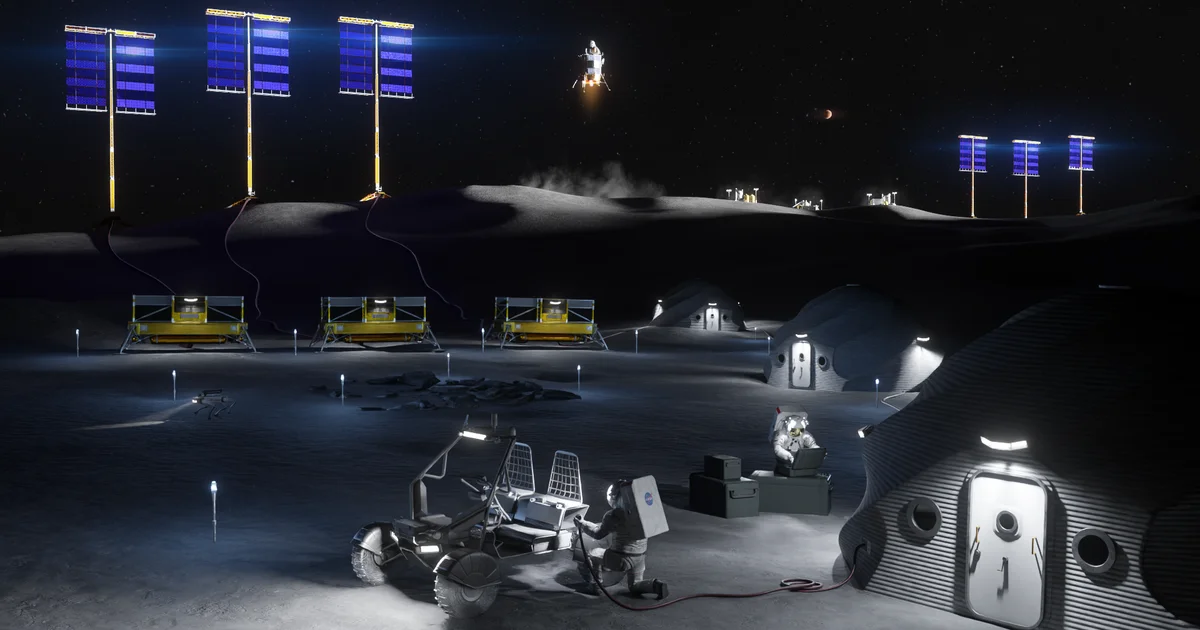
A permanent presence on the Moon requires more than a spacecraft capable of landing astronauts.
Equipment must arrive before crews need it. Power systems have to survive the environment. Communication links must remain available, and exploration vehicles need reliable ways to move across unfamiliar terrain.
Those requirements are increasingly shaping NASA's Moon Base program.
At Kennedy Space Center on November 7, the agency announced a series of procurement decisions and mission developments intended to support operations near the lunar south pole.
The largest headline concerns a $10 billion contracting framework for commercial lunar deliveries.
But the technical significance extends beyond that figure.
NASA is developing a nuclear-powered reconnaissance rover, arranging orbital transportation demonstrations and preparing the first components of a lunar power and communications system.
Together, these initiatives describe the infrastructure required before human surface operations can become routine.
Eight companies join the next generation of lunar cargo contracts
NASA selected eight companies under the second generation of its Commercial Lunar Payload Services initiative, known as CLPS 2.
The selected providers are Blue Origin, Firefly Aerospace, Intuitive Machines, ispace US, Lockheed Martin Space, Northrop Grumman Space Systems, SpaceX and Voyager Technologies.
They will be eligible to compete for future task orders to deliver NASA science, technology and infrastructure payloads to the lunar surface.
The framework is designed to last ten years and uses a multiple-award indefinite-delivery, indefinite-quantity structure.
That arrangement allows NASA to place orders over time without specifying every mission when the master contract is established.
The combined maximum contract value is $10 billion.
This is a ceiling, not a guaranteed payment.
It does not mean NASA has already committed $10 billion to completed missions or divided that amount equally among the eight companies.
Actual expenditure will depend on the task orders issued and the services delivered.
The structure is intended to give NASA access to different landing capabilities and multiple commercial providers.
That flexibility could become important as the payloads required for Moon Base increase in complexity.
NASA also expands the existing CLPS contract
The agency has increased the ceiling of its original CLPS framework from $2.6 billion to $4.2 billion.
The existing contract will remain in place through November 2028.
An additional five-year period will allow the completion of awarded lunar deliveries through November 2033.
That creates an overlap between existing commercial lunar missions and the next contracting generation.
NASA can continue work already underway while opening new opportunities under CLPS 2.
The increased ceiling is additional contracting capacity rather than confirmation of an immediate equivalent increase in expenditure.
The agency is attempting to maintain continuity while expanding the range of lunar missions it can purchase.
PROMISE will explore regions that sunlight cannot reach
One of the most technically interesting announcements concerns a six-wheeled rover named PROMISE.
The name stands for Polar Rover for Observation, Mapping, and In-Situ Exploration.
NASA intends to send it to the lunar south pole to study surface conditions, investigate potential resources and gather information for future exploration infrastructure.
The agency is targeting a launch in late 2028 and planning an approximately eighteen-month mission.
PROMISE will use nuclear power, allowing operations during long lunar nights and within permanently shadowed regions.
These environments are especially challenging for vehicles that rely entirely on solar energy.
Without sunlight, solar panels cannot directly recharge their power systems.
An independent power source can therefore extend the amount of time a rover spends operating in darkness.
This is particularly relevant near the lunar south pole, where some permanently shadowed regions are believed to contain water ice.
PROMISE is intended as a robotic scout rather than a vehicle for transporting astronauts.
Its purpose is to collect scientific and engineering information before more complex human operations begin.
A one-meter drill will investigate lunar resources
The rover will carry a drill capable of reaching approximately one meter beneath the surface.
It will collect and examine regolith, the loose layer of dust and broken rock covering the Moon.
NASA wants to learn more about the distribution and characteristics of ice and other potentially useful materials.
Water could become an important resource for future human exploration.
It could support crew activities and potentially be processed into useful substances for life-support systems or propulsion.
But the presence of ice signatures does not establish that a particular site contains material that can be extracted efficiently.
Direct measurements are required to understand its location, concentration and physical form.
PROMISE will carry spectrometers to examine material composition, along with temperature and radiation sensors and visible-light cameras.
These instruments will provide information about local conditions and potential landing sites.
The mission is a scientific prospecting effort, not the deployment of a completed industrial resource-extraction system.
Mars rover technology will provide a starting point
NASA's Jet Propulsion Laboratory will manage and build PROMISE.
The agency plans to reuse spare flight hardware and engineering test models developed for the Curiosity and Perseverance Mars rover programs.
That does not mean an existing Mars rover can simply be transferred to the Moon without modification.
The lunar environment presents different thermal, mechanical and operational challenges.
The Moon lacks a substantial atmosphere, experiences extreme temperatures and has abrasive surface dust.
NASA says it has evaluated the compatibility of the selected hardware with the lunar south pole environment.
Using established components and operational knowledge should reduce some development costs and shorten integration and testing.
It also provides engineers with experience gained from years of robotic exploration.
However, the new mission still requires its own qualification and validation.
Hardware that worked on Mars does not automatically guarantee success in every lunar condition.
PROMISE will test a new generation of space computing
PROMISE is also intended to demonstrate advanced onboard computing.
NASA plans to include its High Performance Spaceflight Computing technology, designed to deliver greater processing capabilities while tolerating the radiation environment of space.
The rover will also test autonomy sensors and algorithms.
These systems could help it navigate difficult terrain and perform parts of its mission with less dependence on detailed commands from Earth.
Communication delays and operational constraints make onboard decision-making valuable during remote exploration.
A rover that can interpret some local conditions without awaiting every instruction may be able to operate more efficiently.
The actual autonomy and computing performance of PROMISE remain to be demonstrated.
NASA has announced the technologies it intends to test, not final results from an operational lunar mission.
Blue Origin receives a $94 million rover delivery contract
The mission also requires an independent landing system.
NASA awarded Blue Origin a $94 million base contract to deliver PROMISE using its Mark 1 lunar lander.
The contract includes an additional option worth $140 million, subject to the relevant conditions and performance.
The option should not be counted as an amount that has necessarily been exercised.
The award expands work announced in May 2026 to deliver two lunar terrain vehicles.
Blue Origin is therefore becoming an important provider for the early transportation requirements of Moon Base.
However, contract selection does not guarantee an on-time landing.
The schedule will depend on successful integration, testing, launch preparation and execution.
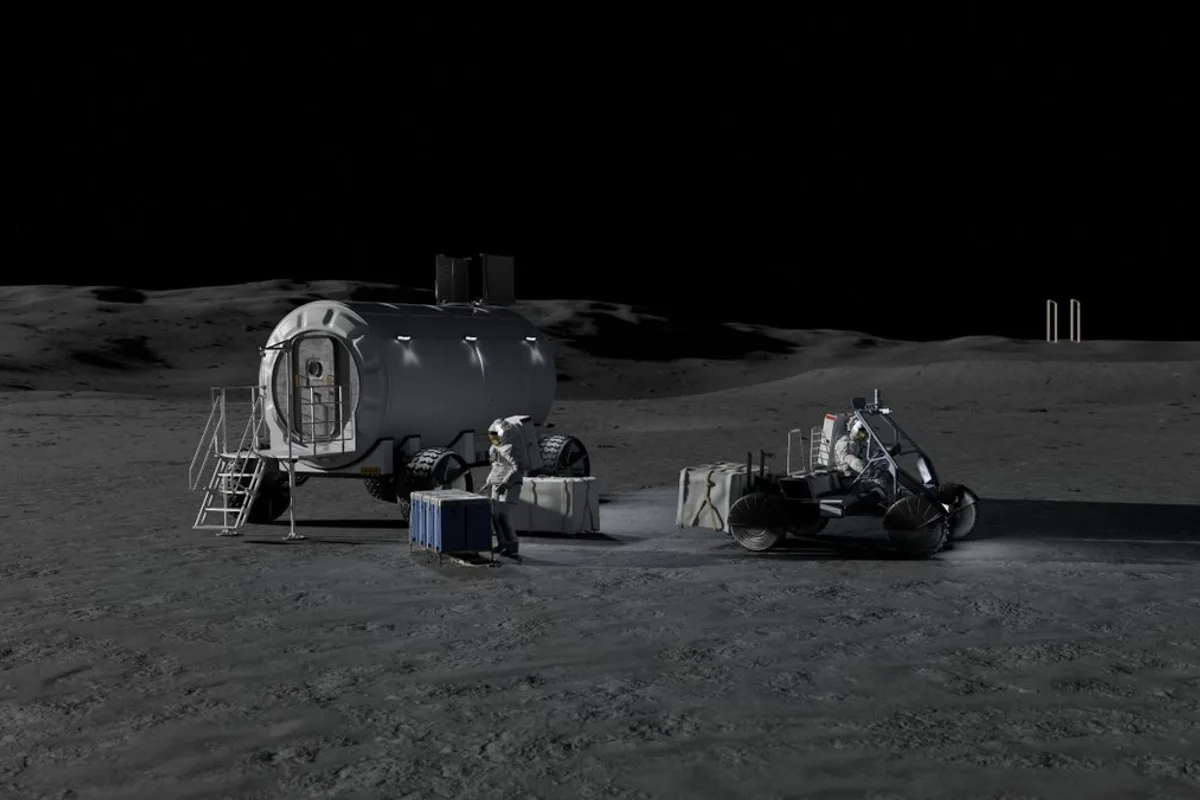
Conceptual artwork illustrates future lunar surface mobility. It does not depict the PROMISE rover.
Approximately $1.3 billion in additional transportation orders
NASA also announced six task orders under its Venture-Class Acquisition of Dedicated and Rideshare program, or VADR.
The orders have a combined value of approximately $1.3 billion.
They were awarded to Arrow Science and Technology, Blue Origin and Impulse Space.
The missions will explore launch, navigation and orbital transportation capabilities required for future lunar deliveries.
The VADR framework has its own ten-year maximum value of $5 billion.
These figures refer to different aspects of the same contracting structure.
The $1.3 billion represents the newly announced task orders, while $5 billion is the overall contract ceiling.
The amounts should not be added together as independent spending commitments.
The transportation demonstrations are intended to improve the reliability and flexibility of missions between Earth and the Moon.
Orbital transfer vehicles could carry more cargo
Getting a spacecraft away from Earth is only one step in a lunar delivery.
Some missions require additional orbital changes and transportation before a lander can begin its final descent.
NASA is examining orbital transfer vehicles, or OTVs, to handle portions of those journeys.
Such vehicles could provide additional flexibility when moving payloads between different orbits.
The announced demonstrations will investigate navigation, communications and orbital operations.
They include the CAPSTONE 02 spacecraft, which is intended to test proximity maneuvers and navigation around the Moon.
Other missions will examine commercial orbital transfer capabilities in cislunar space.
The aim is to support future missions carrying more equipment and infrastructure.
These benefits remain objectives for demonstration flights rather than capabilities already proven across a regular commercial lunar freight network.
MoonFall drones will survey terrain before astronauts arrive
The transportation awards also support NASA's MoonFall lunar drones.
These robotic systems are intended to examine areas that conventional wheeled rovers may struggle to reach.
Lunar terrain includes slopes, craters, loose surface material and obstacles that can restrict ground vehicles.
Alternative robotic mobility could help survey locations before astronauts attempt to operate nearby.
The resulting information may improve landing-site selection and surface mission planning.
MoonFall should not be described as an operational lunar drone network.
The newly announced work is intended to support future transportation and technology demonstrations.
Its scientific and engineering value will depend on the data collected during actual operations.
SpaceX will demonstrate lunar communications with Starship
Another announcement concerns a cislunar communications deployment demonstration.
NASA selected SpaceX to transport communications satellites into cislunar space using Starship in 2028.
The mission is intended to inform future communications network development for Moon Base.
Astronauts, robotic vehicles and mission controllers will need reliable ways to exchange information.
A more extensive communications architecture could support simultaneous missions and improve operational flexibility.
However, the selected Starship mission is a demonstration rather than a completed operational network.
NASA has not provided guaranteed commercial service performance for the future lunar communications architecture in this announcement.
The planned mission remains subject to successful spacecraft development and mission execution.
miniCAST begins the work of powering a lunar outpost
Energy infrastructure is another essential component of permanent surface operations.
NASA plans to purchase commercial components for a system called Mini-Communications and Solar Tower, or miniCAST.
It will combine solar power generation, energy storage and communications capabilities.
The agency selected Honeybee Robotics, a Blue Origin company, for energy storage.
Redwire will contribute power-generation technology, while Yank Technologies is responsible for wireless power-transfer hardware.
Engineers at Marshall Space Flight Center will assemble and test the components before their intended delivery to the lunar surface.
The agency expects the initial work to begin within months.
Importantly, the first phase involves components rather than a fully integrated lunar power network.
NASA plans a separate solicitation for complete power systems, anticipated in early 2027.
This illustrates the staged nature of the Moon Base program.
The agency is procuring individual technologies before assembling and validating larger systems.
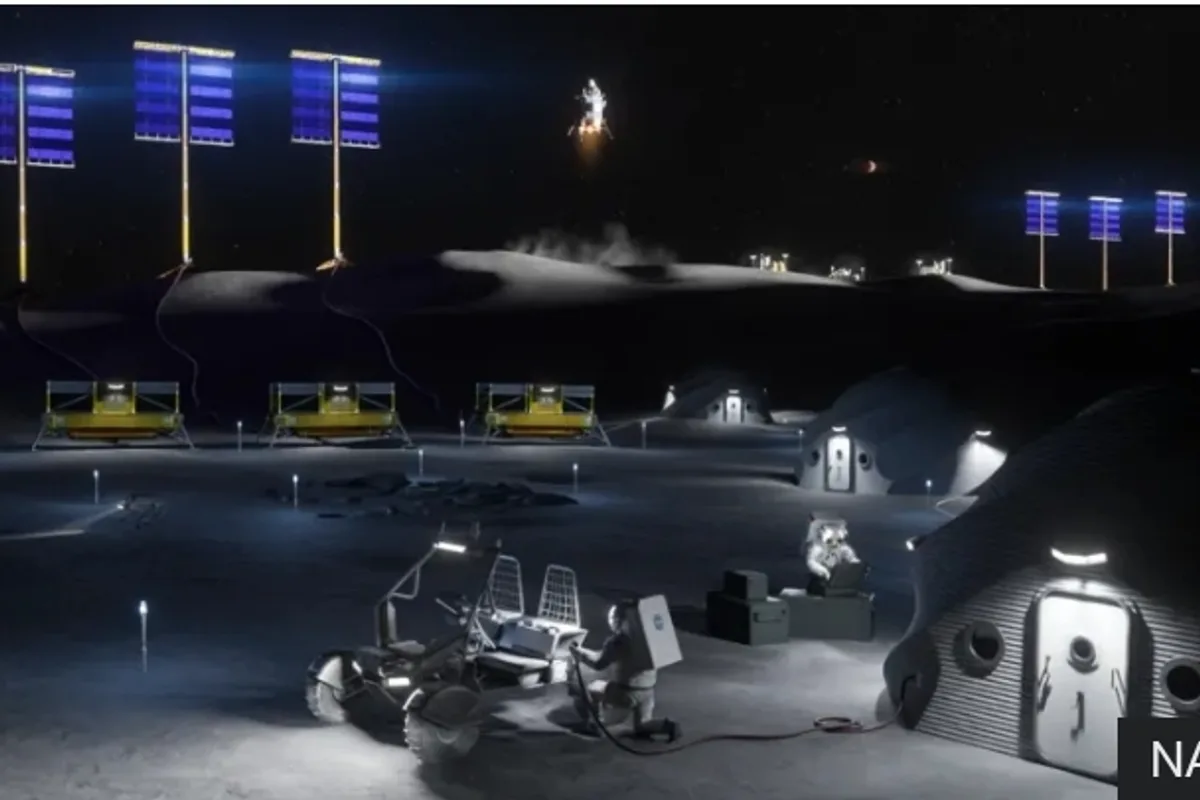
Artist's concept of lunar infrastructure incorporating habitats, mobility and solar power. The announced miniCAST components have not yet been deployed.
Why NASA is concentrating on the lunar south pole
The south pole offers scientific opportunities alongside significant environmental challenges.
Some permanently shadowed regions may preserve water ice.
Other locations have illumination characteristics that could be useful for future surface operations.
But terrain, temperature variations and communications constraints make the region technically demanding.
Orbital observations help identify potential sites, yet they cannot fully replace measurements from the surface.
Robotic exploration can improve knowledge of soil conditions, available resources and environmental hazards.
NASA's combination of rovers, drones and scientific instruments is intended to reduce uncertainty before long-duration human operations.
Selecting suitable locations will involve balancing resource access, safety, communications and engineering constraints.
The results of those investigations could influence where future infrastructure is actually installed.
Commercial competition creates flexibility but not certainty
The decision to involve eight companies reflects NASA's reliance on commercial providers.
Having multiple potential suppliers can create competition and offer alternatives when missions require different delivery capabilities.
It may also reduce dependence on the performance of a single lander design.
However, coordinating multiple providers introduces its own challenges.
Payloads must meet mass, interface, communications and environmental requirements.
Each commercial delivery still requires successful launch, navigation and landing operations.
Selection under CLPS 2 does not establish that every company's proposed architecture is already flight-proven.
NASA's strategy relies on multiple missions and lessons learned during execution.
The value of the approach will depend on whether those missions produce reliable deliveries at acceptable cost.
A long-term lunar base is still a work in progress
The November 7 announcements represent concrete steps in the development of NASA's lunar infrastructure.
Eight commercial providers have been selected for the new CLPS 2 framework.
The existing CLPS ceiling has been increased, PROMISE is moving forward and Blue Origin has received a contract to deliver it.
Additional transportation orders support orbital demonstrations, while SpaceX has been selected for a communications mission.
The miniCAST project begins work on components required for surface power and communications.
These are meaningful developments, but they do not establish that a permanent inhabited lunar outpost has already been built.
The $10 billion CLPS 2 ceiling is not the total confirmed cost of Moon Base.
Habitats, life-support systems, crewed missions, electrical infrastructure and sustained operations involve other programs and financial commitments.
NASA must also demonstrate that the various vehicles and services can operate together reliably.
The immediate milestones concern implementation of the newly awarded work and the preparation of missions planned for 2028.
Their results will provide a more meaningful measure of progress than contracting ceilings alone.
The longer-term ambition is to establish a transportation and infrastructure network that can support repeated exploration and eventually sustained human activity.
NASA is beginning to purchase and develop many of the pieces required for that system.
The challenge now is to turn those separate pieces into an operational lunar environment that people can safely depend on.