
 By Camille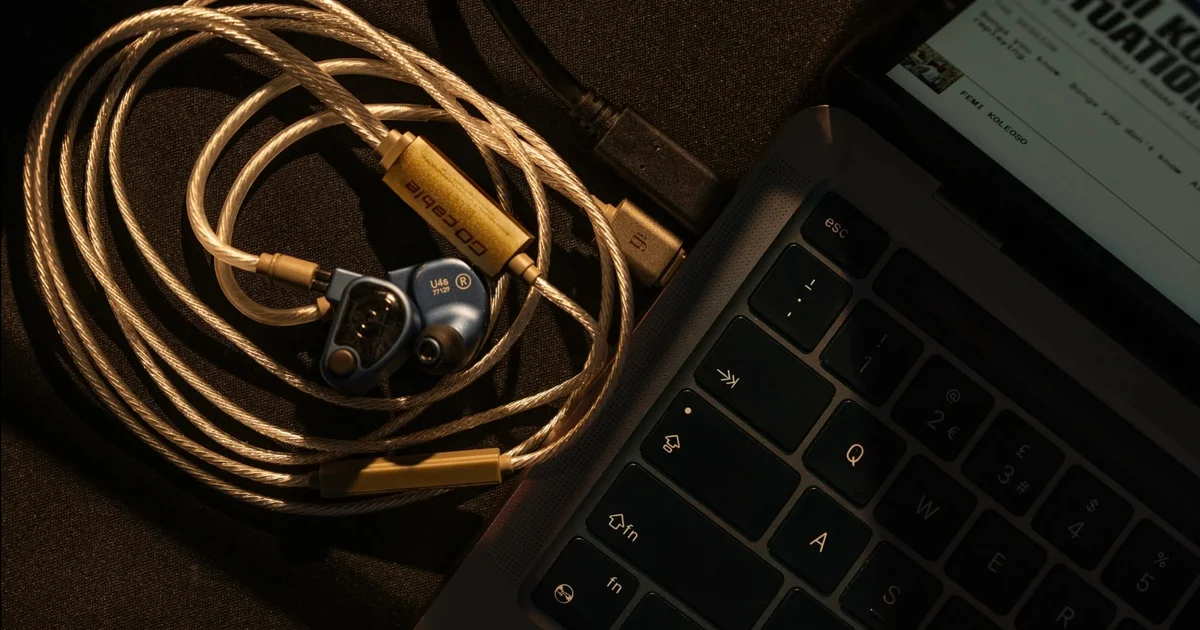
The DAC is no longer a separate object
GO Cable starts with a very ordinary modern-phone problem: no analogue headphone output.
The usual solution is a USB-C dongle sitting between the phone and the existing IEM cable. iFi combines those two pieces.
Digital audio enters through USB-C, passes through the integrated converter and amplifier, then leaves through two 0.78mm 2-pin analogue connectors attached directly to the earphones.
There is no intermediate 3.5mm connection and no separate DAC hanging from another cable.
ESS Sabre handles PCM 384kHz and DSD256
The cable uses an ESS Sabre DAC, although iFi has not specified the exact chip model.
It supports PCM playback up to 384kHz and DSD256, comfortably beyond the requirements of most current streaming services.
iFi also exposes Dynamic Range Enhancement and THD Compensation features within the DAC.
The first is designed to increase contrast between quieter and louder passages, while the second attempts to reduce harmonic distortion.
Those remain manufacturer claims until the cable is independently measured and compared.
Seventy milliwatts into 32 ohms makes the intended use obvious
Output is specified at at least 1.5V or 70mW into 32 ohms. At 300 ohms, iFi quotes at least 2V and 14mW.
Output impedance stays below 1 ohm, which is useful with sensitive multi-driver IEMs whose frequency response can change when paired with a high-impedance source.
This is not an amplifier designed to power demanding full-size planar headphones.
The dual 2-pin connectors make the intended audience quite clear: wired in-ear monitors.
The earphones remain interchangeable
Using standard 0.78mm 2-pin connectors means the digital cable is not permanently tied to one pair of IEMs.
Owners can move it between compatible earphones without buying the DAC and amp section again.
MMCX-equipped models are not directly compatible, however.
GO Cable therefore covers a large part of the enthusiast IEM market rather than every detachable-cable earphone.
The entire thing weighs 16 grams
The cable is 1.37 metres long and weighs 16 grams.
Its conductors use silver-plated OFHC copper. iFi also describes the enclosure as water resistant, although the current product specification does not list a formal IP rating.
Power consumption is quoted at about 0.3W with no signal and below 1W at maximum operation.
There is no internal battery, so that power comes directly from the connected phone, tablet, computer or console.
The cable also replaces an ordinary headset remote
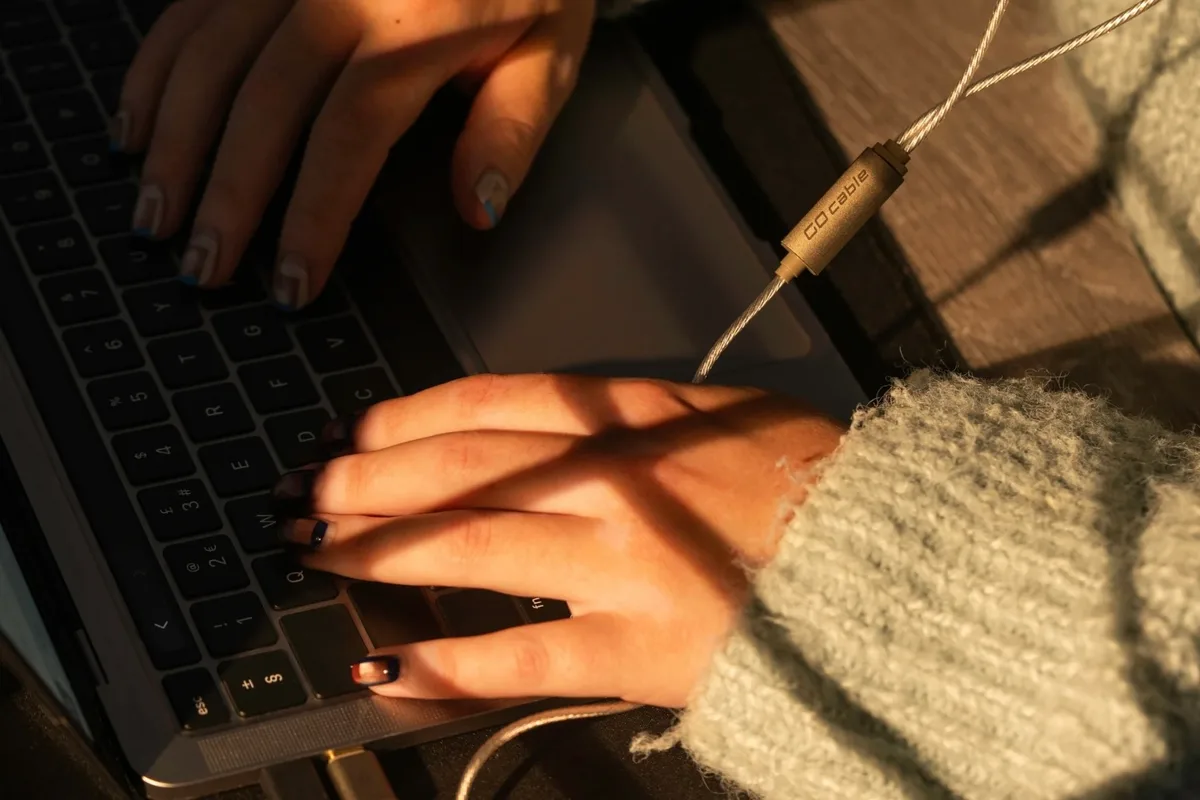
An inline controller handles volume, playback and track skipping.
An echo-cancelling microphone is built in for voice calls.
That matters because many enthusiast IEM cables omit microphones entirely in pursuit of simpler audio-focused construction.
iFi is trying to make GO Cable behave like an everyday headset cable rather than something intended only for dedicated listening sessions.
Nintendo Switch 2 is explicitly part of the pitch
Portable gaming hardware is another target. iFi lists Nintendo Switch 2 compatibility and support for its GameChat feature.
The integrated microphone can therefore handle voice communication while USB-C carries the game audio.
iFi also points to devices such as Steam Deck and ROG Ally.
The use case makes sense: wired IEMs already offer low latency for handheld gaming, while an integrated USB DAC avoids carrying another box.
It gives up flexibility to make the hardware disappear
Compared with a larger iFi dongle, GO Cable has a deliberately minimal specification.
There is no 3.5mm socket, no 4.4mm balanced output and no high-power mode for more demanding headphones.
Seventy milliwatts at 32 ohms is also far below the output available from some premium portable DACs.
That is partly the point. iFi is trading universal connectivity and maximum output for fewer plugs, less weight and one fewer object to carry.
It costs $79, or $99 with IEMs
GO Cable is priced at $79, €79 and £79 depending on market.
A $99 / €99 / £99 Starter Kit adds iFi's AIRO Astra IEMs.
The Astra uses a 6mm titanium-plated dynamic driver and connects directly to the cable's 2-pin outputs.
That bundle is aimed at buyers who do not already own compatible detachable-cable earphones.
The useful trick is removing a step
GO Cable does not invent the USB DAC, and integrated digital cables are not a completely new idea.
Its appeal is how little of the traditional chain remains visible.
The phone outputs digital audio. The cable converts and amplifies it. The IEM receives analogue audio at the other end.
A separate DAC still makes more sense for listeners who constantly change headphones or need significantly more power.
For someone who uses the same pair of 2-pin IEMs most of the time, the best dongle may be the one that effectively disappears.