 By Adri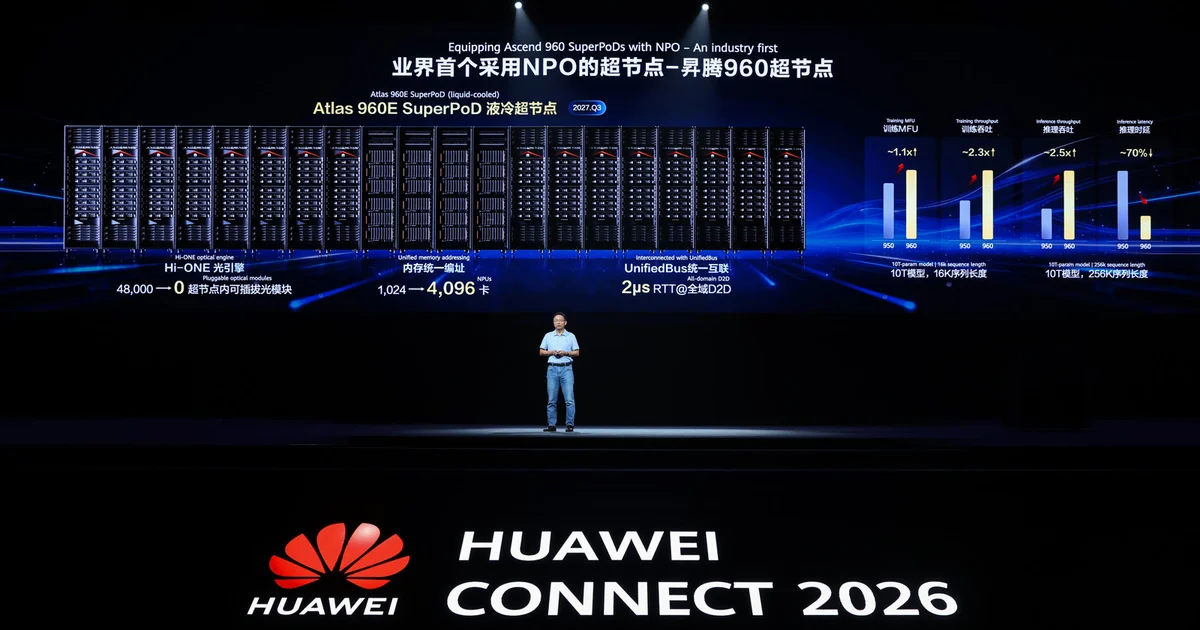
Huawei is short on capacity before a major international expansion even begins
At HUAWEI CONNECT 2026 in Shanghai, rotating chairman Eric Xu said Huawei currently cannot manufacture enough AI computing equipment to satisfy domestic Chinese demand.
That shortage has an immediate consequence. Huawei is not planning a full-scale international expansion of Ascend hardware for now. The company continues to supply some overseas markets where demand is strong, but volumes remain limited.
That is an important shift for China's AI hardware market. Huawei is no longer only trying to demonstrate that a domestic alternative to foreign accelerators can exist. It is now dealing with more demand than it can currently manufacture for.
Ascend 960DT is arriving three quarters early
Huawei is accelerating the next generation of its roadmap. Ascend 960DT, primarily intended for AI model training, is now scheduled to be ready in the first quarter of 2027, three quarters earlier than originally planned.
Ascend 960PR, focused more heavily on inference, is expected in the third quarter of 2027, one quarter ahead of its previous schedule.
Huawei then intends to maintain an annual cadence, with Ascend 970 in 2028 and Ascend 980 in 2029. Instead of depending on one dramatic generation to eliminate the gap in a single step, Huawei is trying to establish a predictable cycle of architectural upgrades.
Huawei's most important weapon may not be a single Ascend chip
This is where the strategy becomes more technically interesting. Huawei knows that comparing one Ascend accelerator directly with Nvidia's fastest hardware only describes part of the problem. It is therefore moving a significant part of the competition from individual silicon to the architecture of the entire computing system.
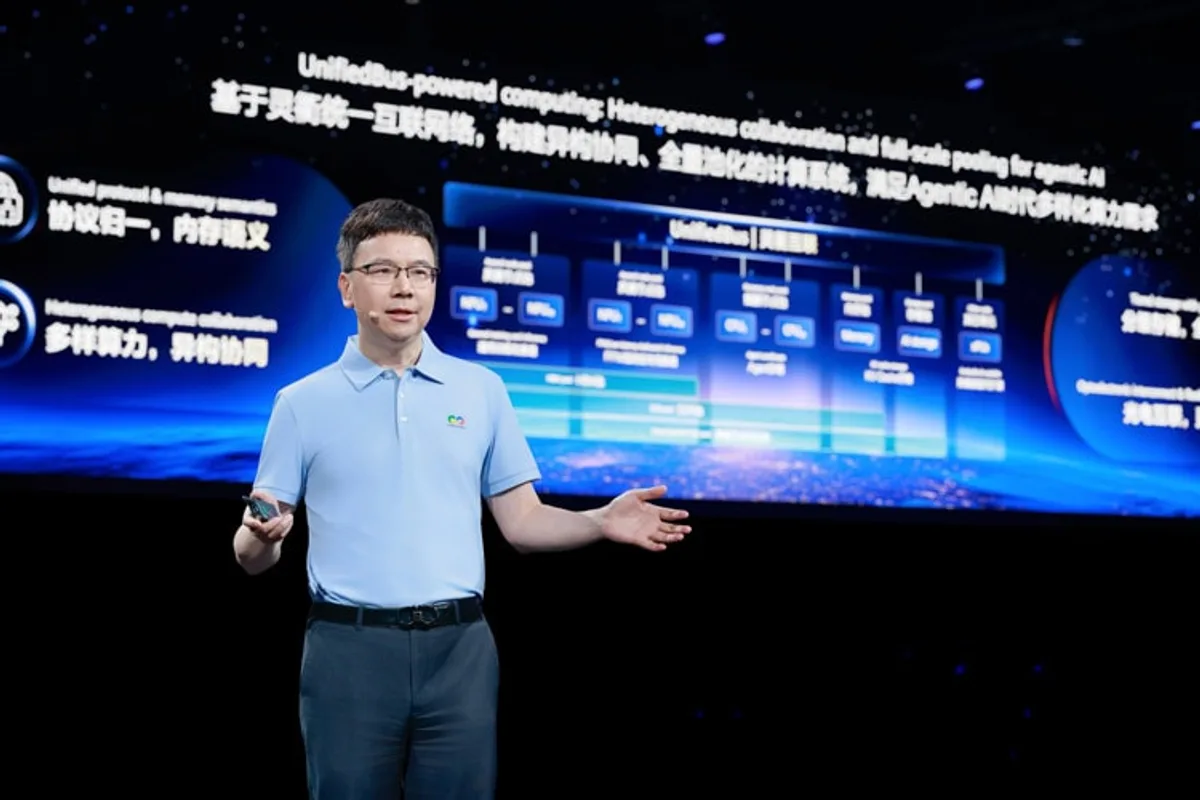
The Atlas 960E SuperPoD can connect as many as 4,096 NPUs. Huawei's UnifiedBus interconnect links processors, memory, storage and networking while providing unified memory addressing across the system.
The objective is straightforward: an enormous cluster is only useful when its accelerators spend their time computing rather than waiting for data from neighboring machines. Huawei says communication between systems can consume more than 40% of training time in some conventional large-scale architectures.
At that point, improving how accelerators communicate can matter almost as much as making each individual accelerator faster.
Peerium extends the concept toward one million processors
Huawei also introduced Peerium, a computing architecture based on nested parallelism, unified memory addressing and peer-to-peer interconnection.
The headline number is enormous: Huawei wants the architecture to scale to as many as one million processors operating as a coordinated computing system. That does not mean Huawei has already deployed a million-Ascend machine. Architectural scale targets and real-world installations need to remain separate.
Smaller systems are already moving beyond presentations. Huawei says an Atlas 950 SuperCluster containing 256,000 computing cards is being deployed, while the newer Atlas 960 systems using near-packaged optical interconnects remain under testing.
Huawei also needs to weaken CUDA's software advantage
Hardware is only one side of Nvidia's position. CUDA has had years to become a deeply established software platform for AI training and inference, creating a significant ecosystem advantage around Nvidia accelerators.
Reuters reports that Huawei says more than 5,200 developers are now active each month on Ascend software and more than 40 AI models have been trained directly on its computing platform. Those figures show ecosystem activity, but they do not establish that Ascend has already reached CUDA's maturity or compatibility.
Huawei is therefore pushing CANN, its software stack for Ascend, toward a more open development model and working with additional open-source frameworks and communities. If major laboratories are going to move real workloads onto Ascend, software compatibility may matter just as much as the raw performance promised by the 960 generation.
The claim that Ascend has passed Nvidia in China remains Huawei's estimate
Eric Xu said he believes Ascend now has a larger share of China's AI accelerator market than Nvidia. That statement needs an important qualifier: Huawei did not provide market-share data supporting it.
Xu also acknowledged that reliable figures for Nvidia's share of the Chinese market are difficult to obtain. The claim should therefore not be treated as an independently established ranking.
The wider environment nevertheless creates room for domestic alternatives. US export restrictions have constrained access to some of Nvidia's most advanced AI hardware in China, while Huawei has been building a hardware and software ecosystem specifically aimed at serving that domestic demand.
The competition is shifting from the chip to the entire data center
Huawei's technical direction is ultimately straightforward. It is not only trying to build a faster accelerator. It is trying to build a system where limitations at the individual chip level can be offset through scale, interconnect bandwidth, shared memory and software orchestration.
That does not eliminate manufacturing constraints, power requirements or software challenges. It does explain why UnifiedBus, SuperPoDs and Peerium are receiving almost as much attention as the Ascend processors themselves.
The more revealing comparison in 2027 may therefore not be a simple benchmark between one Ascend 960DT and one Nvidia accelerator. What matters will be how many chips Huawei can actually manufacture, how efficiently they operate together at scale, and how many major Chinese AI developers genuinely move model training onto the platform.