
 By Camille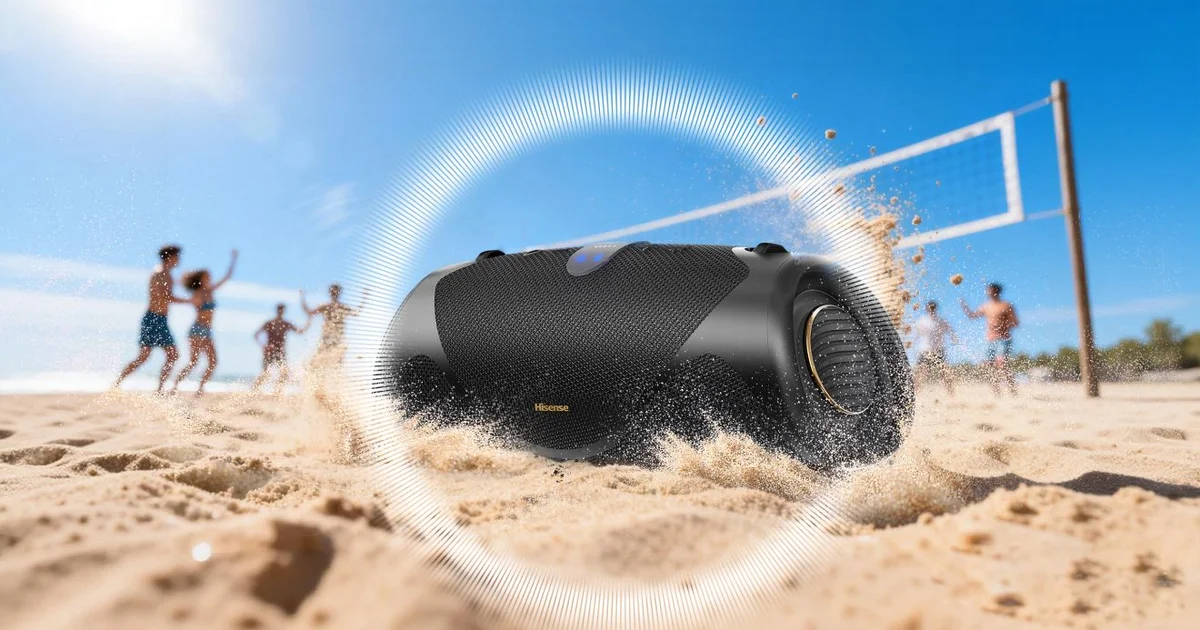
Three sizes avoid pretending one speaker fits every job
Hisense has divided the lineup cleanly. FlexBoom is the compact portable model, WeBoom fills the middle, and VoyageBoom moves much closer to the portable-party-speaker category.
Hisense France quotes maximum output figures of 80W, 140W and 360W respectively, with indicative prices of €99, €149 and €299.
Those wattage numbers need context. Some U.S. coverage lists 40W, 70W and 180W instead, exactly half the French maximum figures, indicating different rated-versus-maximum output conventions.
That makes comparing these speakers on the largest wattage number particularly unhelpful.
FlexBoom is the genuinely portable one
FlexBoom is designed for everyday movement rather than running an entire party. Hisense lists 80W maximum output in France, two drivers and up to 20 hours of playback.
A ten-minute quick charge is rated for roughly two additional hours under the company’s test conditions.
IP67 certification provides complete dust protection and resistance to temporary water immersion within the limits of the standard.
Auracast is arguably the more forward-looking feature. It allows compatible Bluetooth devices to receive the same broadcast without relying entirely on a proprietary Hisense speaker network.
WeBoom adds battery capacity, lighting and more low-frequency hardware
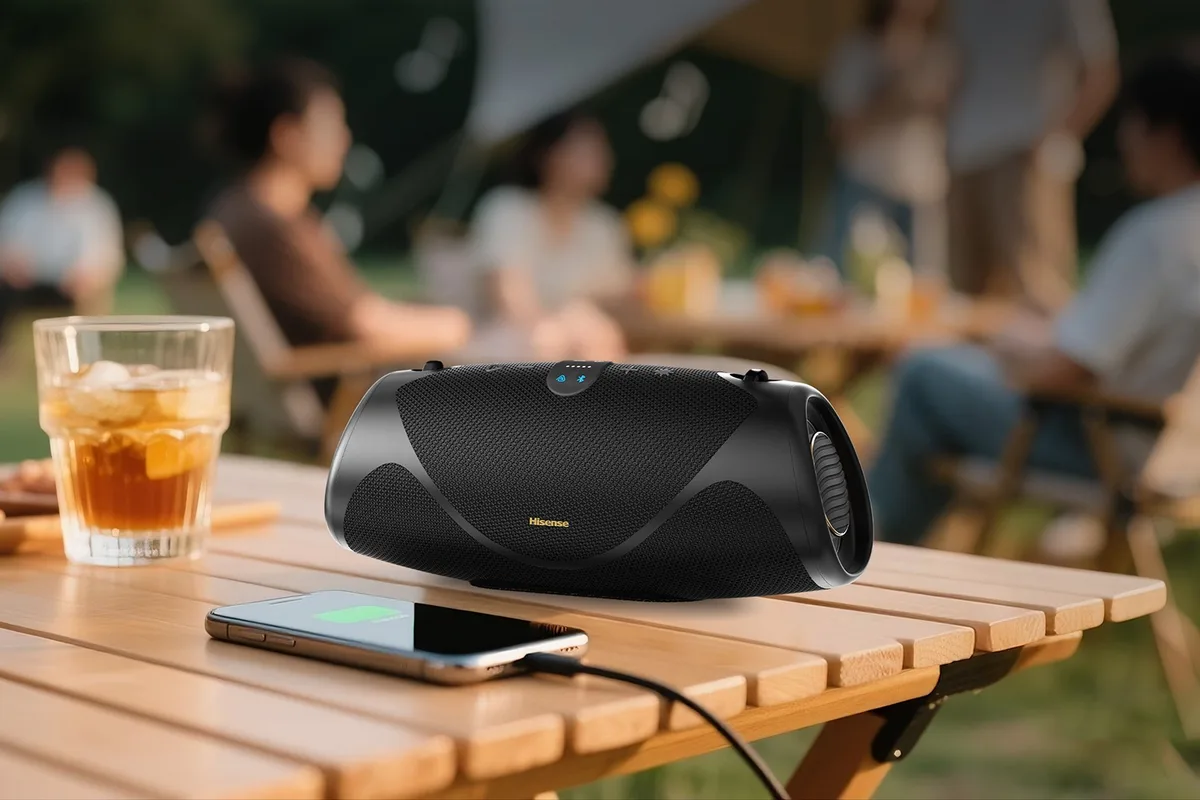
WeBoom moves to a quoted 140W maximum output in Hisense’s European material and uses a more bass-focused acoustic layout.
Regional product descriptions vary slightly in how they label the individual drivers, but Hisense consistently positions WeBoom as the middle model with multiple bass drivers and passive radiators.
Battery life rises to a claimed 24 hours. Ten minutes of charging can provide around two hours of playback, while a full charge is quoted at roughly three and a half hours.
The battery can also charge a phone or tablet over USB, a feature that makes considerably more sense on a larger speaker with energy to spare.
ConnectLife controls the lighting and sound settings
WeBoom also introduces lighting effects that react to music.
Customization runs through ConnectLife, the same app Hisense already uses across several categories of connected products.
That integration matters strategically. These speakers are not being treated purely as isolated Bluetooth accessories; Hisense is gradually pulling portable audio into the same software ecosystem as the rest of its hardware.
The app also provides access to sound and EQ adjustments.
VoyageBoom is a much more serious piece of hardware
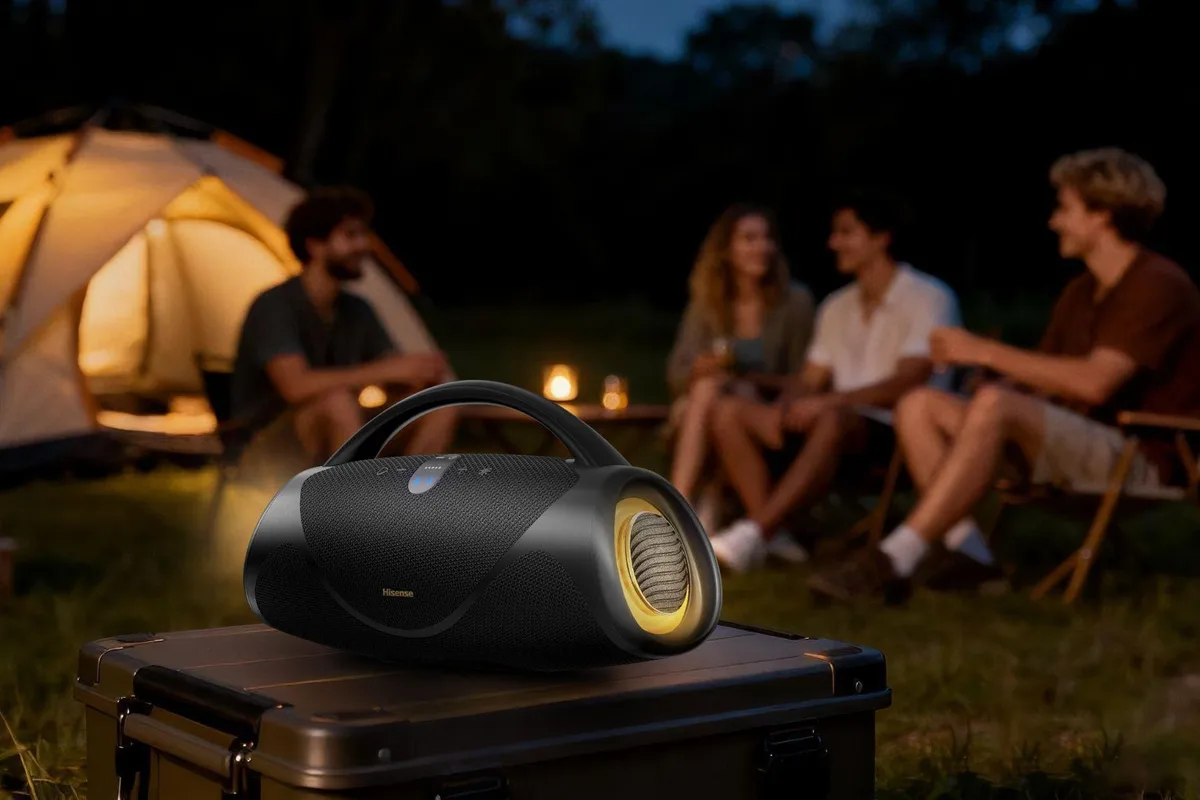
VoyageBoom is considerably larger. Hisense France advertises up to 360W maximum output with a multi-driver system including dedicated bass hardware.
The German specification highlights an integrated 7.4-by-4.5-inch subwoofer and a two-stage Bass Boost function.
At approximately 6.5kg, it remains portable thanks to the handle, but this is no longer something most people casually throw into a backpack.
Battery life is again rated at up to 24 hours.
Its biggest output figure is tied to AC power
The headline 360W figure also needs to be understood in the context of power delivery.
VoyageBoom supports mains operation as well as battery power, and Hisense’s German material explicitly refers to up to 360W AC output.
That means buyers should not assume identical maximum power when the unit is running from its internal battery.
This is common for party speakers: battery mode prioritizes useful running time, while plugging into the wall releases additional output headroom.
A guitar input pushes it toward party-speaker territory
VoyageBoom adds microphone and guitar connectivity alongside an analogue audio input.
That significantly broadens its use beyond ordinary Bluetooth playback. Karaoke, small performances and accompaniment become possible without a separate audio system.
Its battery can also work as a power bank, while lighting effects remain configurable through ConnectLife.
Hisense even includes a Campfire Glow mode intended to create a softer lighting atmosphere rather than a conventional multicolor party effect.
IP67 across the range matters more than the lights
All three Boom models carry an IP67 rating.
For products intended for gardens, beaches and travel, that is one of the most practically important specifications on the sheet.
Portable speakers are far more likely than living-room hi-fi to encounter sand, sudden rain or the edge of a swimming pool.
A laboratory water-resistance rating still should not be treated as an invitation to deliberately operate the speaker underwater.
Auracast avoids locking group playback entirely to Hisense
FlexBoom, WeBoom and VoyageBoom all support Auracast, the Bluetooth LE Audio broadcast technology.
Its long-term appeal is interoperability: a source can transmit to multiple compatible receivers without relying solely on a brand-specific wireless protocol.
Hisense also provides more traditional TWS pairing on relevant models for creating a stereo pair.
Auracast is potentially the more significant feature if adoption continues, because future group playback does not necessarily require every speaker to carry the same logo.
Hisense also wants these speakers beside its projectors
WeBoom includes a Movie Night mode that Hisense promotes for straightforward projector pairing with synchronized audio.
That illustrates the broader strategy. Hisense already has a substantial projector business, so a portable speaker can become an extension of that installed base instead of competing as a completely standalone accessory.
It is not an obvious substitute for a dedicated soundbar or multichannel system, but portable audio can be far more convenient for temporary or outdoor projection.
The real competition is JBL, not the living-room soundbar
Hisense is entering one of the most crowded parts of consumer audio. JBL covers almost every portable size, Sony has multiple competing formats, Ultimate Ears built its name on rugged wireless speakers, and LG is pushing its Xboom family hard.
Specification sheets will not settle those comparisons. At high volume, dynamic compression, distortion and the way DSP gradually reduces bass output matter far more than a maximum wattage figure.
The same applies to 20- or 24-hour battery claims, which will change with playback volume, bass modes, lighting and power-bank use.
Hisense has at least avoided a timid first move. FlexBoom enters at €99, while VoyageBoom has enough connectivity and output ambition to target parties rather than background listening.
Audio is becoming a real part of the Hisense ecosystem
The wider context is what makes the Boom range notable.
Hisense is expanding its soundbar lineup, investing more heavily in TV and projector audio, and now using ConnectLife with portable speakers as well.
Sound is gradually becoming more than an accessory category sitting beside the company’s displays.
The harder part comes next: making a €99 or €299 speaker sound good enough that people recognize the Hisense badge on an audio grille as readily as they do on a television.