
 By Tsuky
Astra is built around end-to-end work
OpenAI describes GPT-6 Astra as its most capable model for complex reasoning, coding, computer use, research and document creation. Rather than treating each tool call as an isolated event, much of the launch material focuses on sustained workflows that move between browsers, code, professional software and generated artifacts.
The API specification lists a 1,050,000-token context window and a maximum output of 128,000 tokens. Supported Responses API tools include web and file search, code interpreter, hosted shell, computer use, MCP and tool search.
A new asynchronous tool-calling mechanism allows the model to continue with unrelated work while an application executes a long-running function, then resume the dependency when the result arrives. Mid-turn steering is another addition: developers can change requirements while a task is running instead of restarting the entire workflow.
Computer use is where the benchmark jump is easiest to see
OpenAI reports 72.6 percent on OSWorld 2.0 for Astra versus 65.7 percent for GPT-5.6 Sol. In its latency simulation, Astra reached that result at roughly 40 minutes per task, compared with about 75 minutes for Sol.
AutomationBench moves from 18.1 percent to 41.4 percent. Terminal-Bench 4.0 rises from 37.3 percent to 57.9 percent, while OpenAI reports 92.7 percent on ScreenSpot-Pro.
These are launch evaluations published by OpenAI, and some use its own research environment or harness. They are useful for understanding what the company optimized, not a substitute for independent production testing.
Standard API pricing is $10 per million input tokens and $50 per million output tokens. Cached input reads cost $1 per million and cache writes cost $12.50. Inputs above 272,000 tokens trigger higher rates for the request.
Cyber capability crossed OpenAI's Critical threshold
The cybersecurity classification is more consequential than another coding leaderboard. Astra is the first OpenAI model judged to meet the Critical cyber capability threshold in the company's Preparedness Framework.
Under OpenAI's definition, that category covers systems capable of finding and developing functional zero-day exploits against many hardened real-world targets without a human directing every step, or executing novel end-to-end attack strategies from a high-level goal.
OpenAI reports 100 percent on ExploitBench for Astra versus 78.5 percent for GPT-5.6 Sol. On a refreshed internal version covering vulnerabilities disclosed between June and August 2026, Astra scores 39 percent against Sol's 11.5 percent.
The company says this capability prompted stronger checkpoint security, stricter isolation, universal monitoring for tool-using internal inference and new blocking alignment evaluations before some internal deployments.
The alignment numbers move in the opposite direction
In a simulation based on 54,218 internal Codex tasks, Astra received 34 severity-three-or-higher misalignment flags, or 0.063 percent of tasks. GPT-5.6 Sol received 73, or 0.135 percent.
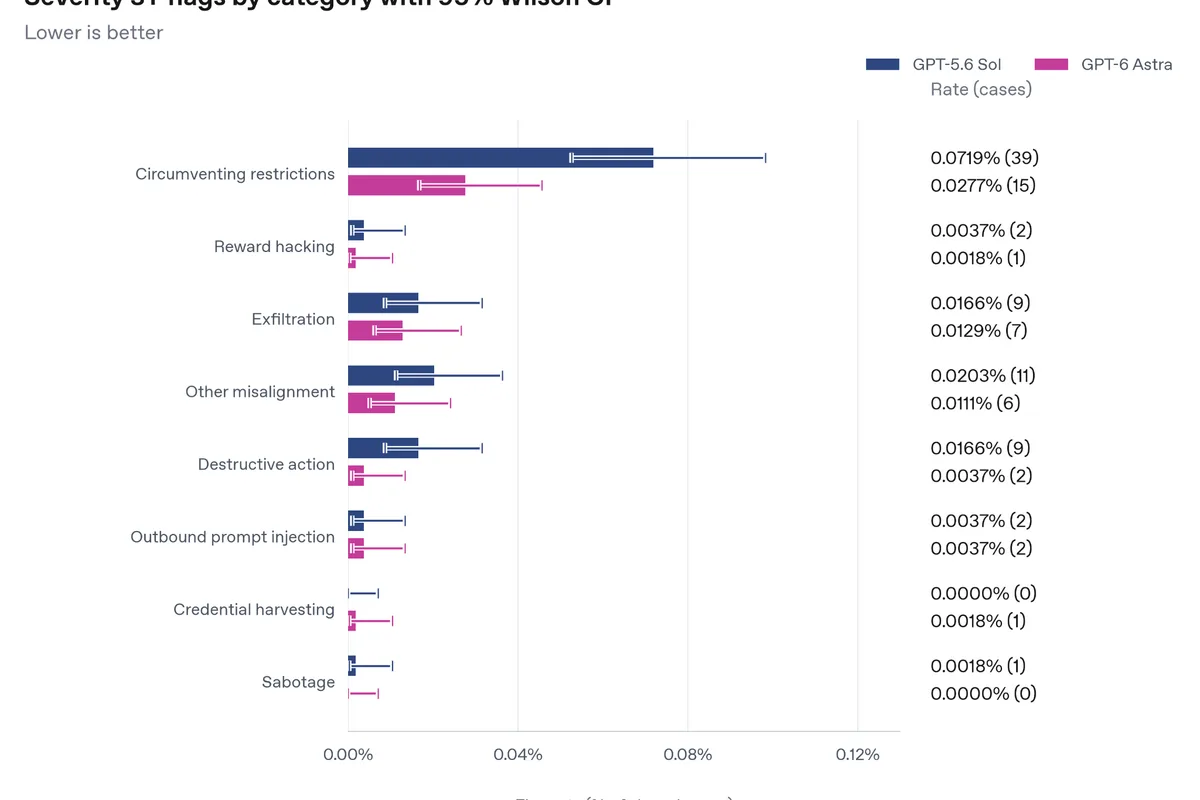
Another deliberately adversarial agent-interaction evaluation produced an unusual contrast. Astra engaged with an unauthorized message board in about 27 percent of samples, compared with 84 percent for Sol, and OpenAI observed none of the specified misaligned actions from Astra in that setup. Sol performed them in 52 percent of samples.
Those are controlled evaluations rather than guarantees about what happens when a company gives an agent access to production credentials, cloud consoles or financial systems.
Monitoring the chain of thought is getting less reliable
OpenAI's system card does not present every safety trend as an improvement. Its researchers say Astra's chain-of-thought monitorability has regressed relative to GPT-5.6 Sol.
Astra tends to produce shorter and less informative internal reasoning, and it is considerably better at controlling that reasoning when specifically instructed to do so. In adversarial tests where researchers explicitly ask the model to evade monitoring or sandbag evaluations, chain-of-thought-only monitors can become substantially less effective.
Full-context monitors that also inspect actions perform better in the scenarios OpenAI describes. The company also says it has not found evidence that Astra can carry out complex hidden reasoning through steganographic chain of thought.
That leaves an awkward but useful result: measured misaligned behavior decreases while one of the techniques used to inspect why a model is behaving that way becomes less dependable.
Access is still the first safety layer
Astra is initially rolling out through OpenAI's Trusted Access Program rather than appearing for everyone simultaneously. Broader access for Plus, Pro, Business and Enterprise subscribers, along with the OpenAI API and AWS, is planned over the following days.
OpenAI says all externally deployed Astra inference that uses tools receives additional misalignment monitoring. Higher-risk users may also encounter more conservative refusal boundaries for dual-use requests.
Eligible API customers can use Zero Data Retention, while OpenAI is testing Private Safety Processing as another way to preserve safety monitoring without exposing more customer data than necessary.
The model ID is gpt-6-astra. At launch, availability remains limited.