
 By Kilam
E-Day went gold on September 17, and The Coalition used the milestone to publish its launch PC matrix after continued optimization work following the summer multiplayer beta.
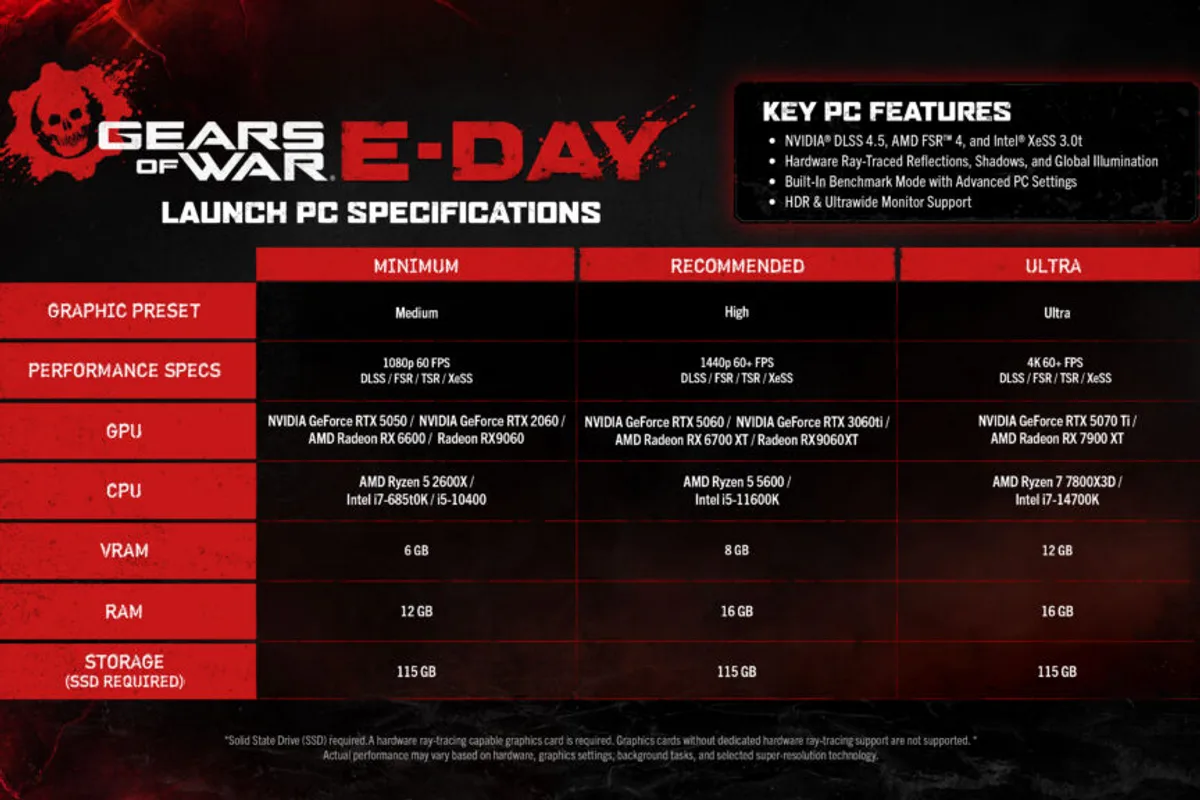
Minimum is now defined as 1080p at 60 fps using the Medium preset. Recommended targets 1440p at 60 fps on High. Ultra aims at 4K and 60 fps.
The 1080p floor starts with an RTX 2060 or RX 6600 class GPU
CPU options at minimum include the Ryzen 5 2600X, Core i7-6850K and Core i5-10400. The GPU list includes the RTX 5050, RTX 2060, Radeon RX 6600 and RX 9060.
The tier requires 12 GB of system memory and 6 GB of VRAM. More importantly, hardware ray tracing support is mandatory.
That requirement cuts off older GTX cards even where raw raster performance might otherwise have looked competitive enough on paper.
1440p/60 lands in sensible mid-range territory
The recommended tier moves to a Ryzen 5 5600 or Core i5-11600K, with GPU examples including the RTX 5060, RTX 3060 Ti, Radeon RX 6700 XT and RX 9060 XT.
System memory rises to 16 GB and VRAM to 8 GB. For an Unreal Engine 5 title using hardware-accelerated lighting, reflections and shadows, that is a relatively approachable 1440p target.
Ultra is where the requirements jump
The 4K/60 Ultra tier asks for a Ryzen 7 7800X3D or Core i7-14700K and either an RTX 5070 Ti or Radeon RX 7900 XT. VRAM rises to 12 GB.
Those parts are unsurprising for maximum settings at 4K. The footnote underneath the performance targets is more interesting.
None of the listed 60 fps targets are presented as pure native rendering
The Coalition lists DLSS, FSR, TSR or XeSS alongside all three target tiers. Minimum 1080p/60 therefore should not be read automatically as native 1080p rendering, and the same caveat applies to 1440p and 4K.
That is increasingly normal for modern Unreal Engine 5 rendering pipelines, particularly when hardware ray tracing is part of the baseline. It still matters when comparing requirement charts: reconstructed 4K/60 and native 4K/60 are very different workloads.
E-Day also supports DLSS 4.5, Dynamic Multi Frame Generation on compatible NVIDIA hardware, Super Resolution, Reflex, AMD FSR, Unreal Engine TSR and Intel XeSS.
The SSD requirement drops to 115 GB
The final launch table lists 115 GB of SSD storage across all three tiers. An SSD remains mandatory. Earlier store requirements had listed 130 GB.
The PC version also includes an integrated benchmark, HDR support, ultrawide output and advanced graphics controls. The underlying game has been rebuilt in Unreal Engine 5 rather than carrying over the previous Gears production stack.
Pre-installation begins September 29 at 15:00 UTC, Premium access starts October 1 and worldwide release follows October 6.
That is when the published matrix gets replaced by something more useful: independent measurements.