
 By Adri
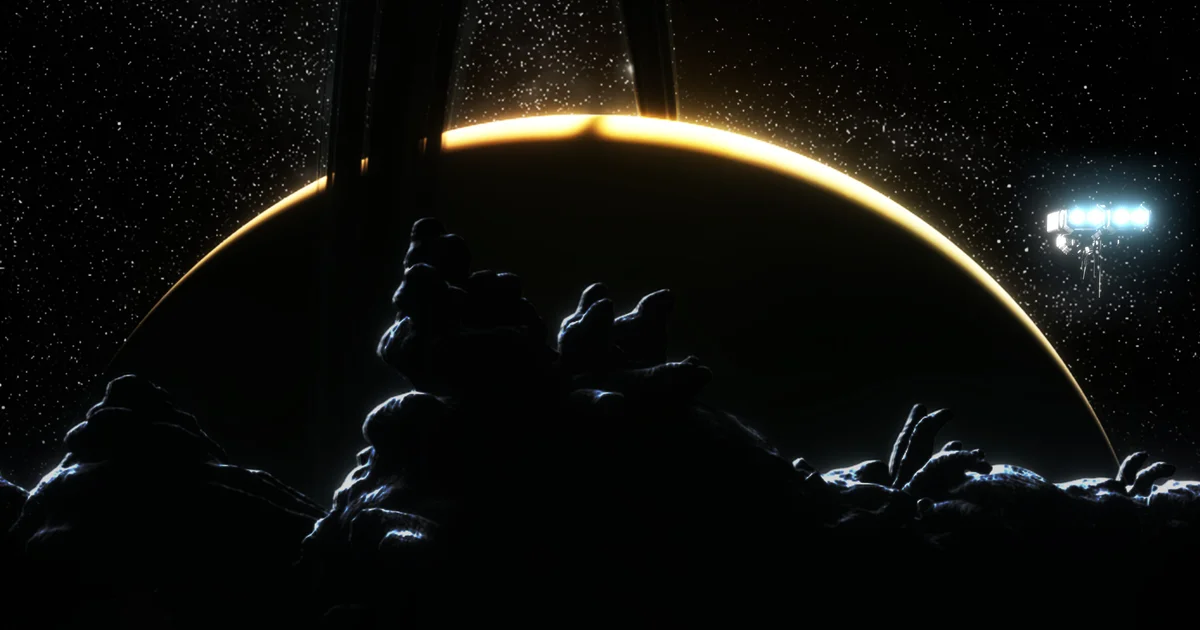
Retro graphics are not simply large pixels. Two games rendered at a low resolution can look radically different depending on their geometry, lighting and the way textures are projected onto surfaces.
That distinction is central to Derelikt's approach.
In a technical presentation published on PlayStation Blog on November 2, creator Philipp Jensen of Visuwyg explained how he developed the game's distinctive appearance.
Derelikt is scheduled to launch November 13 on PS5 and PC.
Its goal is not to emulate original PlayStation hardware directly, but to reproduce the visual characteristics associated with that generation of games.
Why low resolution alone is not enough
Games on the original PlayStation shared several recognizable graphical characteristics.
Texture resolution was frequently limited, characters were built from relatively simple polygon models and lighting relied on techniques less complex than those found in contemporary game engines.
However, one particularly distinctive feature involved the behavior of textures during movement.
Certain surfaces appeared to warp, slide or wobble as the camera changed position.
These artifacts were partly related to the methods used to project textures onto geometry.
Today, those imperfections can be reproduced deliberately.
The result should not be confused with a simple post-processing filter placed over an otherwise modern image.
Derelikt changes texture behavior, lighting and geometry to achieve a consistent visual style.
Affine texture warping becomes an artistic choice
The developer explicitly identifies affine texture warping as one of his techniques.
The term describes distortion associated with how texture coordinates are interpolated across polygons.
Modern perspective-correct rendering generally keeps textures more stable when surfaces are viewed from different angles.
Affine interpolation does not account for perspective in the same way.
As a result, it can produce visible distortions, particularly across large surfaces or sharply angled triangles.
On the original PlayStation, that behavior contributed to the distinctive appearance of three-dimensional environments.
Derelikt deliberately recreates the effect.
The artistic appeal is recognizable: moving the camera produces some of the instability associated with games from that period.
However, excessive distortion can also harm readability.
The developer has therefore implemented another technique to control its intensity.
Dynamic subdivision reduces the distortion
Jensen explains that affine distortion is moderated through dynamic geometry subdivision.
The principle involves dividing certain surfaces into smaller polygons.
When triangles cover less space, interpolation errors can become less noticeable across each individual section.
This allows the game to retain the desired visual character while reducing its most distracting consequences.
The creator notes that comparable methods were employed by technically ambitious developers late in the original PlayStation generation.
Derelikt is therefore not merely reproducing the most obvious limitations of old hardware.
It is also drawing on the compromises developers used to improve the appearance of their games.
That distinction matters.
A superficial imitation recreates visible defects.
A more technically informed approach also reproduces methods used to manage those defects.
Vertex-color lighting
Another confirmed technique is vertex-color lighting.
This approach relies on color information assigned to the vertices of three-dimensional models.
By interpolating those values across surfaces, developers can create lighting variations without necessarily employing the more complex lighting methods of modern engines.
The technique contributed to the visual identity of many older games.
It can produce visible lighting transitions, especially on models with relatively simple geometry.
In a horror game, those transitions can become useful presentation tools.
A localized light source, dark corridor or partially illuminated silhouette may create a strong sense of danger.
Visuwyg has chosen this type of rendering rather than pursuing consistently photorealistic lighting.
The studio also uses hand-painted textures.
Together, those techniques provide control over surface appearance while maintaining consistency with the visual references of the late 1990s.
CGI cutscenes inspired by the CD-ROM era
Narrative sequences are another part of Visuwyg's work.
Derelikt features prerendered computer-generated cutscenes designed to resemble videos from the original PlayStation era.
At the time, these sequences allowed games to display models and animations far more detailed than those available during ordinary gameplay.
The difference in visual quality between a cinematic and an interactive scene became a familiar feature of CD-ROM games.
Derelikt intentionally adopts that aesthetic.
The intention is not to suggest that its cinematics were actually rendered on a 1990s workstation.
Instead, the goal is to recover their visual language, composition and characteristic texture.
The result contributes to the illusion of a forgotten game rediscovered in the archives of a defunct studio.
Some retro effects can be disabled
Jensen also explains that certain visual effects can be enabled or disabled.
That decision shows the project is not intended to impose every historical graphical limitation on players.
Those who find particular distortions or image treatments distracting may be able to adjust aspects of the presentation to suit their preferences.
However, the developer does not provide an exhaustive list of individual settings in his article.
It would therefore be premature to promise separate controls for every graphical effect.
The approach nevertheless illustrates an important difference between recreating historical rendering and reproducing every limitation of older hardware.
Modern systems can provide multiple variations of the same artistic style.
Preserving the aesthetic does not necessarily require preserving every original restriction.
Visual style is not a performance benchmark
Recreating original PlayStation graphics provides no direct information about Derelikt's performance on PS5.
Simple character models or deliberately modest textures do not automatically guarantee a particular frame rate.
Performance also depends on engine behavior, visual effects, enemy AI, data processing and numerous other factors.
The PlayStation Blog presentation does not provide measured resolution or frame-rate targets.
It would therefore be inaccurate to promise universal 4K or 120 FPS performance based solely on the game's retro appearance.
Likewise, Derelikt does not actually run on an original PlayStation. It recreates the machine's rendering characteristics on contemporary platforms.
That distinction is essential to understanding the project.
Retro presentation supports modern FPS design
Derelikt is intended to be more than a graphical demonstration.
Its gameplay combines exploration, fast combat, resource management, conversations and puzzles.
The setting is a research outpost constructed on an asteroid near Saturn, with an atmosphere inspired by classic sci-fi horror.
The developer cites Alien Resurrection, Doom 3 and System Shock 2 as influences.
Those references concern both presentation and level design, along with how the games maintain tension.
The Steam listing advertises twelve levels and a structure containing some Metroidvania-inspired elements.
Players may therefore revisit locations and use newly obtained equipment to reach previously inaccessible areas.
The final result will need to be evaluated according to how well that modern design works alongside its historical visual language.
PS1 aesthetics can reinforce a sense of unease, but they cannot replace successful progression or carefully balanced encounters.
The technical test arrives November 13
Derelikt is scheduled to launch November 13, 2026, on PlayStation 5 and PC.
Its creator has been developing the project since late 2021.
The official presentation demonstrates a deliberate effort to recreate several graphical techniques associated with the late 1990s.
Hand-painted textures, vertex lighting and dynamic subdivision give the approach more substance than a simple retro filter.
However, the final release will be needed to establish how these choices behave in practice and whether the customization options offer an appropriate balance between historical accuracy and playing comfort.
Derelikt's most interesting quality may ultimately be its paradox: using modern hardware not to eliminate the imperfections of an earlier console generation, but to reconstruct them precisely enough that they become intentional artistic decisions.