
 By Camille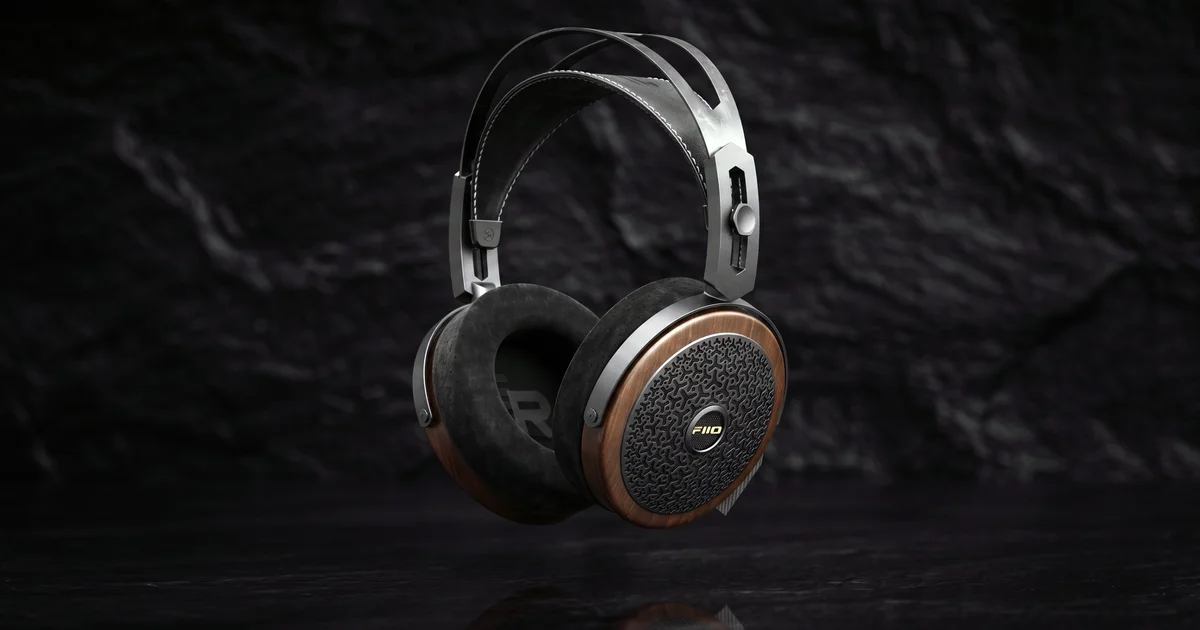
The diaphragm drops from 6 microns to 800 nanometers
FT15 follows the FT5 in FiiO's large open-back planar line, but the moving surface has changed substantially. The previous-generation diaphragm was 6 microns thick. The FT15 brings that down to 800 nanometers.
FiiO calculates an 86.7% reduction. The engineering goal is straightforward: reducing moving mass can let the diaphragm react more quickly to a changing signal, provided it remains rigid enough to avoid uncontrolled deformation.
That is where the full-surface diamond coating comes in. FiiO uses a vapor-deposition process to add stiffness while preserving the extremely low mass of the underlying film.
The company says the design reduces high-frequency breakup, improves transient response and contributes to a specified frequency range extending to 40kHz. Those remain manufacturer claims until the headphone receives independent measurement and listening tests.
A 101mm planar driver creates 6,443.5 square millimeters of radiating area
The driver itself measures 101mm, with FiiO quoting an effective radiating area of 6,443.5mm². That is 35% larger than the FT5's active area.
A planar magnetic driver works differently from a conventional dynamic headphone driver. Conductive traces are spread across a very thin diaphragm, and magnetic force acts over much of that surface rather than through one conventional voice coil attached to a cone or dome.
FT15 uses custom-shaped magnets and a patented magnetic circuit designed to make the field more uniform. In principle, that lets different parts of the diaphragm move with more similar force and reduces nonlinear breakup.
FiiO links the larger surface to stronger low-frequency scale and a broader soundstage. The open-back construction itself is also part of that presentation, because the rear of the driver is not sealed inside a closed cup.
The 28nm specification does not mean there is a processor inside
FiiO also advertises a “28nm chip-grade manufacturing process” for the conductive coil. That wording can sound rather more electronic than the product actually is.
The number refers to the precision process used to electroplate the conductive traces onto the diaphragm. FiiO says the method improves bonding and makes the coil less likely to separate or fail after prolonged vibration.
There is no 28nm processor running inside the FT15. The headphone is completely passive.
Twenty-four ohms may be the specification people actually appreciate
Large planar headphones have historically had a reputation for demanding substantial amplification. FiiO is deliberately moving in the opposite direction with a 24-ohm impedance and 95dB/mW sensitivity at 1kHz.
The company says FT15 can work from portable players, desktop systems and appropriately capable USB DAC dongles.

That does not make every headphone output equally good, but it lowers the barrier to entry. A $500 planar headphone is easier to justify if it does not immediately require another expensive desktop amplifier.
425 grams is light for this design, not light in absolute terms
FiiO describes the FT15 as a lightweight planar design. At about 425 grams without its cable, it is reasonably restrained for a headphone carrying large magnets and 101mm drivers.
A carbon-fiber headband helps manage mass, while the earcup structure uses North American FAS-grade black walnut. Natural grain variation means individual pairs will not look completely identical.
It is still a 425-gram object sitting on a listener's head. Actual comfort will depend on weight distribution, clamping pressure and the pads rather than the number alone.
Two sets of pads are included. Suede pads come pre-installed, while protein-leather pads provide an alternative tuning option.
Even the cable gets a liquid-nitrogen story
The supplied balanced cable uses 6N monocrystalline copper. FiiO says the conductors undergo more than 100 hours of cryogenic treatment at -192°C.
The company argues that the process relieves internal stress in the metal and improves signal transmission.
That claim should be kept separate from directly measurable driver specifications. FiiO has not provided independent comparative evidence here demonstrating an audible improvement from cryogenic cable treatment.
Connectivity is at least practical. The cable terminates in 4.4mm balanced, with 6.35mm and four-pin XLR adapters included. Dual 3.5mm connectors attach to the headphones.
Open-back still means staying home
FT15 is a fully open-back headphone. That construction fits the audiophile goal of an airy presentation, but it also means very little isolation.
People nearby will hear some of the music, while room noise remains audible to the listener. There is no ANC, wireless connection or microphone.
Its easy-to-drive specification can make the system around the headphone more portable. It does not make the headphone itself a sensible choice for public transport.
At $500, the materials are only the beginning of the argument
FiiO lists the FT15 at $499.99, €499.99 and £499 depending on market, with European retailers already showing it around the €499 mark.
That puts it into a competitive part of the wired-headphone market where an elaborate materials list is not enough on its own.
A 101mm planar driver, an 800nm diaphragm and a carefully shaped magnetic field are genuinely interesting engineering choices. Diamond, walnut, carbon fiber and liquid nitrogen also make an excellent product story.
The remaining specification cannot be printed on the box: how convincing the FT15 actually sounds once someone listens to it.