
 By Camille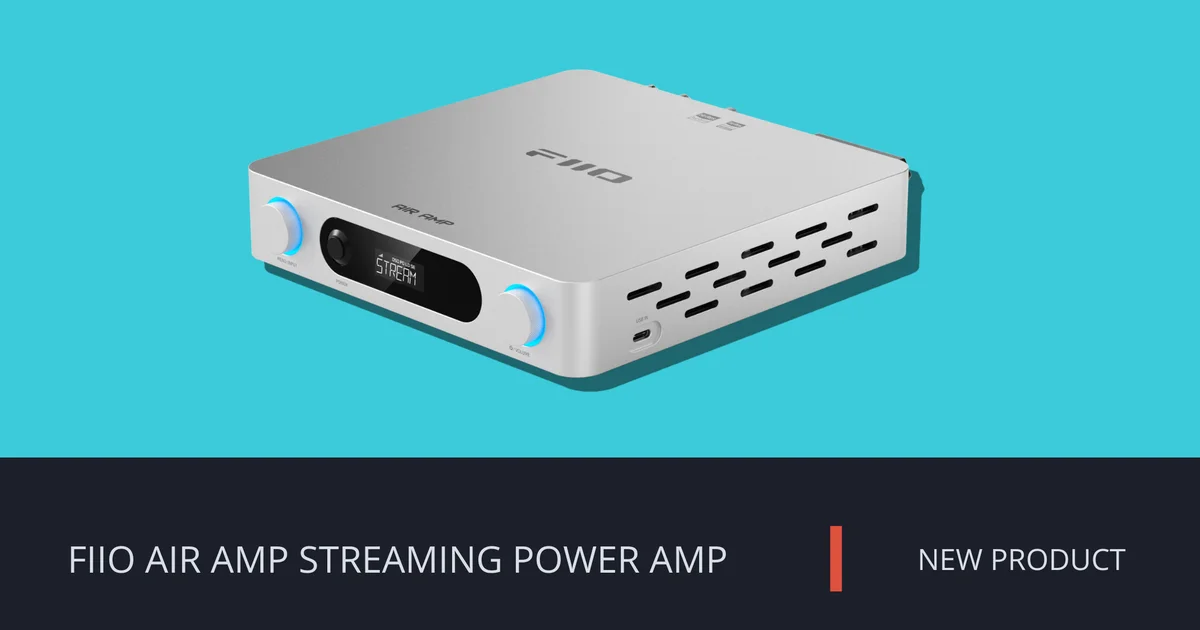
A network player, DAC and power amplifier in 207mm
AIR AMP measures 207 x 188 x 42mm and weighs approximately 930g. It occupies much less space than a conventional full-width integrated amplifier.
Inside that enclosure FiiO combines three traditional components: a network streamer, digital-to-analogue converter and speaker amplifier.
Digital conversion uses an XMOS XU316 interface feeding an ESS ES9020Q DAC. Speaker power comes from a Texas Instruments TPA3255 Class D stage.
TPA3255 itself is a familiar component in compact amplifiers. FiiO’s implementation, power supply and feedback topology therefore matter more than simply naming the chip.
The included power supply delivers 120W per channel into 4 ohms
With the supplied 48V/5A adapter, FiiO rates AIR AMP at 120W per channel into 4 ohms and 90W per channel into 8 ohms.
On paper, that is enough output for a wide range of bookshelf speakers and smaller floorstanders in normal domestic rooms.
FiiO also quotes up to 235W per channel into 4 ohms with a 48V/10A supply.
That larger supply is not included, so 235W should not be treated as the power available from the standard retail package.
PFFB addresses one of the familiar Class D variables
The amplifier uses post-filter feedback, or PFFB. A Class D output passes through a filter before reaching the loudspeaker.
Taking the feedback signal after that filter lets the amplifier compensate for some of the interaction between the output network and the loudspeaker’s changing impedance.
FiiO says this improves consistency across different speaker loads while reducing distortion.
PFFB is neither unique to FiiO nor a guarantee of sound quality, but it is a more meaningful engineering detail than a peak-power number on its own.
NAS playback works without leaving a computer running
AIR AMP is Roon Ready and also supports Apple AirPlay and QPlay.
It can browse music stored on a NAS over the local network, while USB flash drives and external USB storage can also be played directly.
Control is available through FiiO Control, a web interface, the supplied infrared remote or the two front-panel encoders.
Networking includes dual-band 2.4/5GHz Wi-Fi and Gigabit Ethernet.
USB, optical, coaxial, RCA and Bluetooth cover plenty of hardware
Network playback is only one part of the input selection. AIR AMP also accepts digital audio over USB, optical and coaxial connections.
Bluetooth 5.2 includes LDAC support for higher-bitrate wireless playback from compatible sources.
A conventional RCA line input handles analogue hardware. Outputs include speaker binding posts, a preamp output and a dedicated subwoofer connection.
That is a substantial amount of connectivity for a chassis weighing less than a kilogram.
USB decoding extends to PCM 768kHz and DSD512
Through its XMOS USB interface, AIR AMP supports PCM up to 768kHz/32-bit and DSD512 according to FiiO’s published specification.
Those limits are far beyond the requirements of almost every commercially distributed music library.
Their practical advantage is simply that a computer can feed the amplifier without the USB stage becoming an obvious format limitation.
Despite FiiO’s long history in personal audio, there is no headphone output. AIR AMP is fundamentally a speaker amplifier.
Ten-band PEQ may be more useful than DSD512
FiiO includes several EQ presets plus a ten-band parametric equalizer accessible through the app and web interface.
PEQ can be used to target particular tonal problems in a loudspeaker or known resonances in a room with much more precision than simple bass and treble controls.
An Auto EQ system can also apply available tuning curves.
It should not be confused with full automatic room correction, however. AIR AMP does not measure the room with a microphone and generate a complete correction profile by itself.
There is a subwoofer output, but bass management remains simple
A dedicated subwoofer connection makes a compact 2.1 system straightforward to build.
The preamp output also lets AIR AMP work as a streamer, DAC and volume controller feeding another amplifier or active loudspeakers.
Subwoofer integration is less sophisticated than on some living-room-focused competitors, particularly because there is no integrated measurement-based room correction.
A subwoofer with its own crossover and phase controls therefore remains useful when matching it carefully to the main speakers.
No HDMI ARC means TVs have to use optical
The most conspicuous omission is HDMI ARC or eARC.
A television can still connect through its optical output, but that loses some of the simplicity that makes modern streaming amplifiers attractive. HDMI ARC normally allows more seamless TV volume and power control.
For a music-first system, this may be irrelevant.
For someone trying to use one box as both stereo amplifier and soundbar replacement, it is a much larger compromise.
Turntables may need another box too
The RCA input is line level. AIR AMP does not contain a phono stage.
A turntable with an integrated preamp can connect directly, while a conventional MM or MC setup needs a separate phono preamplifier.
That decision is understandable in such a small, network-focused device.
It still prevents AIR AMP from being a completely universal one-box integrated amplifier.
European stock is expected around October
FiiO officially launched AIR AMP on August 19, initially beginning sales in China and arranging overseas shipments progressively.
As of September 22, several European dealers list the unit at around €269 with availability expected during October.
Black and silver finishes are offered. The standard package includes the 48V/5A power supply and an infrared remote.
That price places it directly in the increasingly competitive category of compact streaming amplifiers designed to modernize passive-speaker systems.
FiiO leans harder toward hi-fi than television integration
Comparisons with WiiM’s amplifiers are unavoidable. Compact Class D amplification, network streaming, EQ and subwoofer support put the products in much of the same territory.
FiiO counters with USB DAC functionality, coaxial input, Gigabit Ethernet, Roon Ready support and substantial claimed power in an unusually small enclosure.
WiiM’s alternatives retain practical advantages for many living rooms, including HDMI ARC, more direct integrations with major streaming services and more automated room correction on relevant models.
AIR AMP therefore makes more sense as a miniature network hi-fi amplifier than simply a cheaper universal living-room box. Paired with passive speakers and a NAS or Roon library, many of its omissions become far less important.
The remarkable part is how much now fits inside one kilogram
An ESS DAC, XMOS interface, network streamer, Wi-Fi, Gigabit Ethernet, 120W-per-channel amplification and ten-band PEQ inside 930 grams is a dense piece of hardware.
It also illustrates how dramatically Class D and network playback have changed entry- and mid-level hi-fi. A passive-speaker system no longer needs a stack of separate components just to play a local digital library properly.
FiiO has fitted almost all of that stack into one small box.
The word “almost” is roughly the width of an HDMI socket.