
 By Tsuky
ETH was trading around $2,510 on Friday after reaching a weekly high near $2,566. That puts it roughly 7.8% above its August 21 opening price of $2,326.
The move happened during a broader crypto rebound, but Ethereum is also seeing demand through channels that are more specific to its own market.
Eight ETF sessions brought in $1.18 billion
US-listed spot Ethereum ETFs have recorded eight consecutive days of net inflows, totaling approximately $1.18 billion according to SoSoValue data cited by FXStreet.
That is their longest positive streak since April and the largest eight-day inflow since October. The week ending August 21 alone brought roughly $697 million into the products, their strongest weekly performance of 2026.
For investors, these funds provide ETH exposure through conventional brokerage infrastructure rather than requiring direct ownership through a crypto exchange or self-custodied wallet.
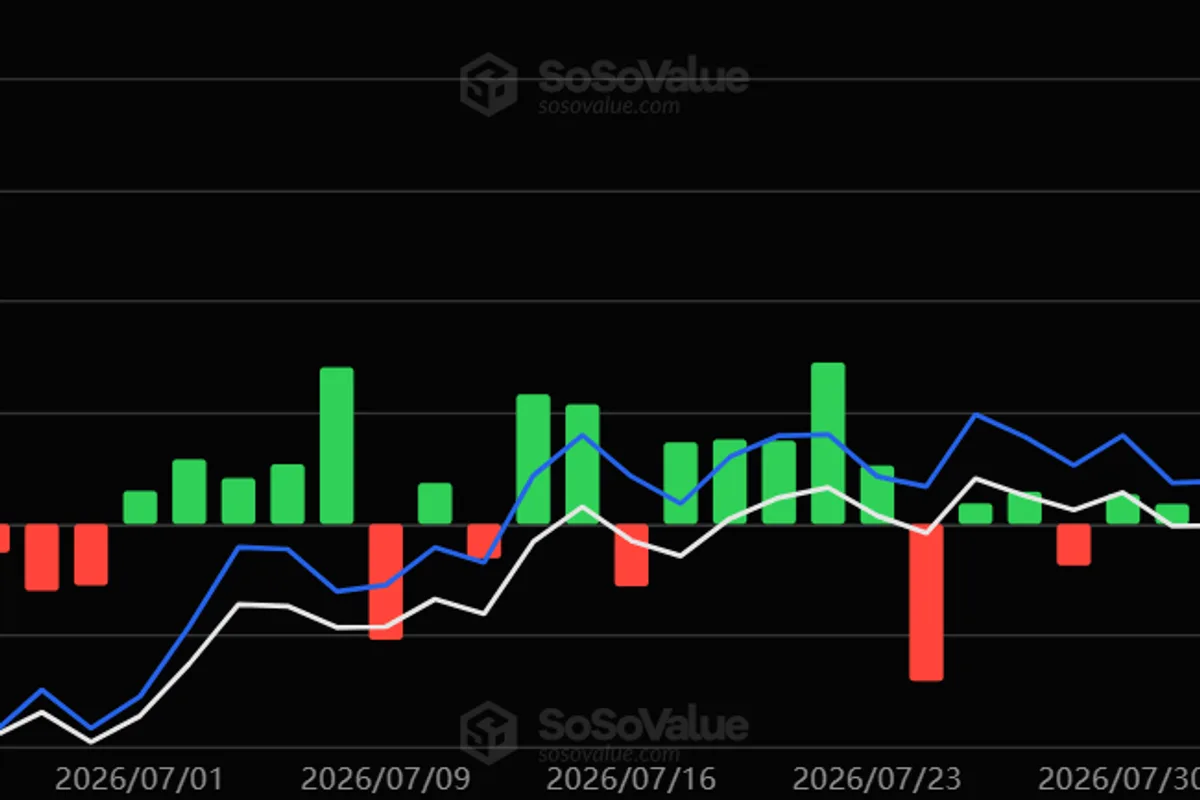
The distinction does not make the flows irrelevant to Ether itself. Spot products ultimately require exposure to the underlying asset through their creation and redemption structures, connecting fund demand with the ETH market.
Crypto-native liquidity is expanding at the same time
The stablecoin market has grown by roughly $4.1 billion over the past two weeks, with approximately $2.37 billion of that expansion occurring during the last seven days.
It is the first two-week increase since mid-May. Between mid-May and August 11, total stablecoin capitalization had contracted by about $16.1 billion.
That $4.1 billion should not be described as money that all landed on Ethereum. Stablecoins now operate across a wide range of competing blockchains.
Ethereum is still the largest home for them. Ethereum's official institutional portal says its ecosystem hosts more than 60% of global stablecoin supply, with about $159 billion currently on Ethereum L1 and another $12 billion across its Layer 2 networks.
Stablecoin growth is liquidity, not an automatic ETH purchase
An expanding stablecoin supply is frequently treated as evidence that more deployable capital is entering crypto. Those tokens can be used for trading, decentralized finance, settlement, payments or simply held as digital dollars.
They do not have to be exchanged for Ether.
That is why the combination of the two trends is more informative than either figure on its own. ETF inflows represent demand arriving through traditional financial markets. Stablecoin expansion points to additional capital inside crypto-native rails.
More than a third of ETH is now staked
Supply available to the market is also being shaped by staking. Roughly 42.4 million ETH is currently staked, equivalent to about 34.7% of total supply according to Ultrasound Money figures cited on Friday.
Staked Ether is not permanently removed from circulation. Validators can exit under protocol rules, while liquid-staking systems can provide tradable representations of locked positions. Still, the scale of staking changes how much ETH sits immediately available for other uses.
Ethereum's total supply remains dynamic after The Merge. Proof-of-stake validator rewards create new ETH, while EIP-1559 permanently burns part of transaction fees. Network activity and staking participation therefore both matter to issuance over time.
The $2,500 level is not a guarantee of another leg higher
The rally has already moved quickly. FXStreet reported a daily Relative Strength Index around 77 on Friday, while 24-hour ETH liquidations reached approximately $122.9 million. Around $77 million of those liquidations came from short positions.
Some of the move therefore came from traders being forced out of bearish leveraged bets as Ether rose.
What makes this rebound more interesting than the round $2,500 number is the activity around it: eight consecutive ETF inflow sessions, a stablecoin market expanding again after months of contraction, and more than one third of ETH supply participating in staking.