
 By Tsuky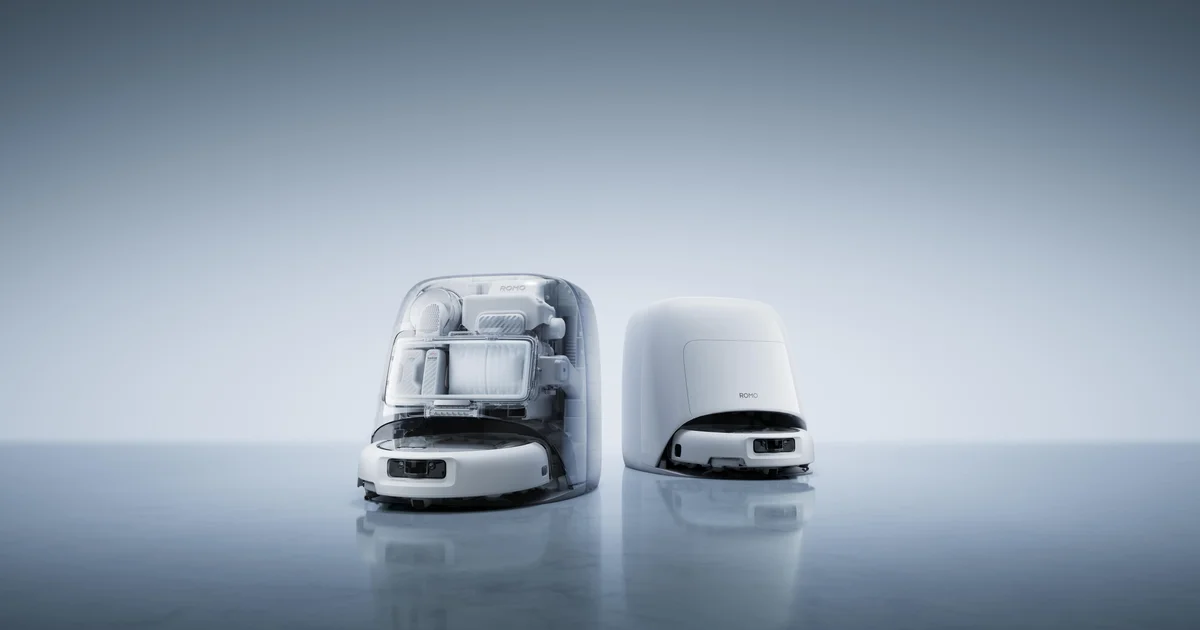
ROMO 2 comes in P2 and A2 versions
DJI launched the second-generation ROMO family globally on September 3 ahead of its European IFA appearance.
ROMO P2 uses the company's distinctive transparent robot and transparent water-tank station. A2 keeps essentially the same core cleaning hardware with a conventional opaque base.
European launch pricing starts at €1,299 for P2 and €1,199 for A2.
The maximum suction figure rises to 36,000Pa
DJI specifies up to 36,000Pa of fan pressure. On carpet, a pressure plate lowers toward the surface to create a partial seal and increase dust extraction.
That figure comes from DJI laboratory testing and describes maximum fan pressure rather than an independently measured cleaning score.
The original ROMO generation was rated at 25,000Pa.
Its mop arm can swing through 123 degrees
A new robotic arm extends the cleaning hardware away from the circular chassis. DJI gives it a maximum 123-degree swing and says its reach has increased by 7.8cm over the previous design.
A side-mounted ToF LiDAR helps the mechanism follow furniture and wall geometry instead of extending at one fixed angle.
The purpose is straightforward: reach around chair legs and irregular edges where the body of a round vacuum cannot physically fit.
The 8.5cm climbing claim needs an asterisk
ROMO 2 can dynamically raise itself using its new robotic-leg mechanism.
DJI rates it for single obstacles up to 4cm. The much larger 8.5cm specification applies to a two-stage obstacle in which the first step is no higher than 4cm and the second adds no more than 4.5cm.
It should not be read as the robot vertically climbing one conventional 8.5cm stair.
Drone-derived sensing now combines several systems
The front perception array includes 3D ToF LiDAR and dual fisheye cameras, while an additional ToF system operates at the side.
DJI says the system performs millimeter-level obstacle sensing and can generalize from objects it has encountered previously.
A built-in dust-revealing light illuminates about 2,000 square centimetres ahead of the robot.
DJI also documents limitations around reflective surfaces, transparent objects and very low-light environments.
The AI changes cleaning behaviour according to the mess
ROMO 2 can increase suction automatically on carpet and alter its movement when it identifies debris that could be scattered.
Its vision system can distinguish some liquid spills and approach them differently so the wheels do not immediately spread the mess across the floor.
Liquid detection requires suitable surface texture and at least 0.1 lux of ambient light according to DJI.
The camera is useful, which is exactly why privacy matters
DJI Home can use ROMO 2 for remote video and voice calls. That means the robot retains both camera and microphone functionality while moving through the home.
The first-generation ROMO attracted serious scrutiny after a security vulnerability exposed the possibility of unauthorized access to camera feeds and mapping information. DJI says that flaw was patched.
ROMO 2 therefore arrives with a much more explicit set of privacy controls.
Local Data Mode is promised for Q4
DJI says Local Data Mode will allow ROMO 2 to process data locally without uploading video or map data online.
Users can separately disable the camera and microphone in DJI Home and delete personal data stored through the service.
The important limitation is timing. Local Data Mode is not part of the launch firmware and is scheduled for Q4 2026.
DJI's own Trust Center currently labels it as coming soon.
The base station gets an unusually specific 365-day claim
The station cleans the mop system with water heated up to 80 degrees Celsius and uses four high-pressure jets feeding a 16mm waste outlet.
DJI advertises up to 365 days of maintenance-free operation, but its footnote narrows that promise to the station washboard. Water refilling and consumable replacement are not included.
In DJI's quiet vacuuming test, a full charge lasts about three hours and covers approximately 178 square metres with roughly 12 percent battery remaining.
DJI also claims 85 percent lower noise energy
The company says acoustic energy has been reduced by as much as 85 percent versus the previous generation.
That is not an 85 percent reduction in the decibel reading. DJI lists around 54dBA for combined vacuuming and mopping and approximately 40dBA while the station is drying.
The new flagship is cheaper than the old one was
ROMO P2 starts at €1,299. The first-generation ROMO P originally launched in Europe at €1,899.
A2 starts at €1,199 and the ROMO Clean More bundle at €1,349.
European retailers are already listing the P2 around the €1,299 recommended price for September availability.
Local Data Mode follows later in Q4.