
 By Camille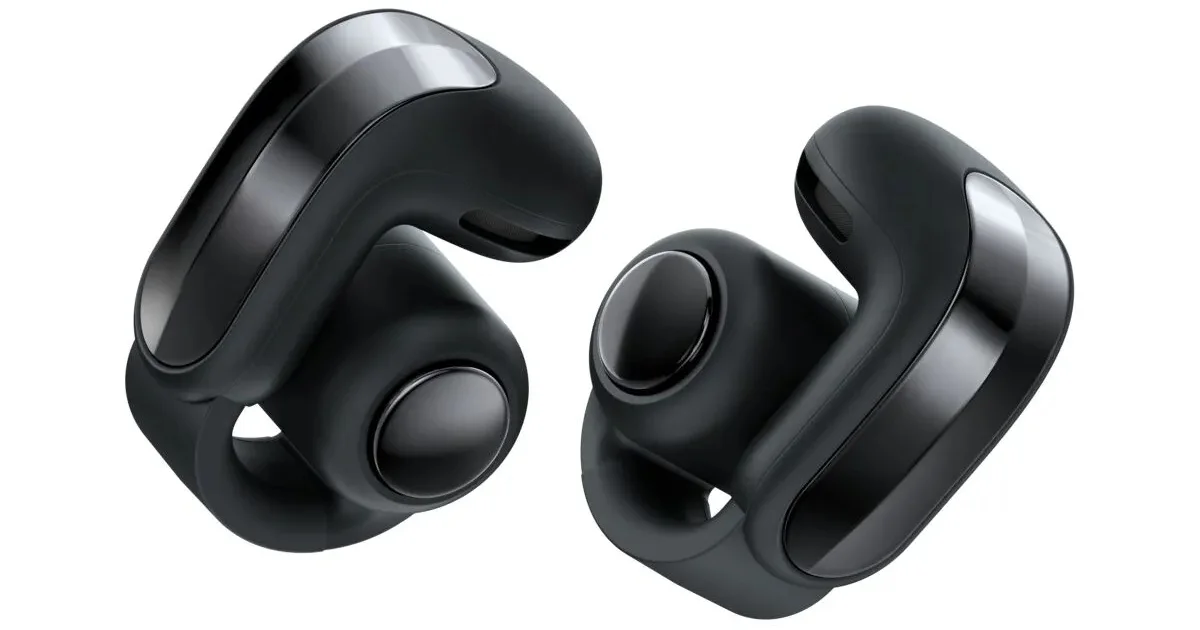
The ear canal remains completely open
The second-generation Ultra Open Earbuds retain Bose's cuff-shaped architecture. One part sits behind the ear while the acoustic module rests near the canal without inserting a silicone tip into it.
Bose OpenAudio delivers sound through the air toward the ear. This is not bone conduction, so the transducer does not need to press tightly against the listener's head to transmit vibration through bone.
The trade-off is explicit. Bose confirms that neither Ultra Open Earbuds (2nd Gen) nor Sport Open Earbuds provides active noise cancellation. Both are intentionally designed to preserve awareness of traffic, announcements and conversations around the listener.
A new driver targets deeper bass and higher volume
Bose says the second-generation Ultra uses a newly engineered driver capable of deeper bass and higher volume than the original model.
For now, those remain manufacturer claims. Bose announced the earbuds on September 17 and general availability begins October 1 in several markets, leaving independent listening and measurement to follow the announcement rather than precede it.
The underlying challenge is unchanged. An open transducer has to generate convincing low frequencies and useful output without a sealed ear canal while keeping leakage to nearby people under control. Bose says its acoustic structure directs sound precisely toward the listener; independent testing will establish how much the redesign improves that balance.
Cinema Mode does not require specially encoded content
The new Ultra adds Cinema Mode using Bose TrueSpatial technology. The processing is designed to produce a wider soundstage for video and podcasts while keeping dialogue clear and centered.
Bose says the feature works with any content source, so it is not limited to material specifically mixed for a spatial-audio format.
Bose Immersive Audio also remains available on the Ultra. The cheaper Sport model shares the open-ear concept but not the flagship's full spatial-processing feature set.
Battery life rises from seven to nine hours
Bose rates the new Ultra for up to nine hours of playback, compared with up to seven hours for the original model. Its redesigned charging case stores up to another 19.5 hours.
The case can now stand upright and supports wireless charging directly. With the first-generation Ultra Open Earbuds, Bose had offered a dedicated charging-case cover as one route to adding wireless charging.
The Ultra remains IPX4 rated for water resistance. Sport Open Earbuds move to IP54, adding a defined level of dust protection for a product intended specifically for workouts and outdoor use.
SpeechClarity puts AI on the microphone side
Both new models introduce Bose SpeechClarity, an AI-enhanced voice-isolation system. Each earbud combines a dedicated microphone with a voice pickup unit to separate the speaker's voice from surrounding noise during calls.
Bose says the processing preserves natural tone and expression while suppressing background interference. That claim will need real calls in wind, traffic and crowded spaces before its practical value can be judged.
The design logic is sensible for an open product. These earbuds do not try to remove the outside world for the wearer, so reducing how much of that world reaches the person at the other end of a call attacks a different part of the noise problem.
aptX Adaptive remains an Android-specific advantage
Ultra Open Earbuds (2nd Gen) support Snapdragon Sound and aptX Adaptive on compatible Android hardware. Bose associates the codec with higher-quality audio, lower latency and reliable connectivity.
Both models also provide SBC and AAC, Bluetooth Core 5.4, Google Fast Pair and two-device multipoint connectivity. Bose lists aptX Adaptive specifically for the Ultra rather than the Sport.
iPhone playback consequently remains on AAC. That is hardly unusual, but it means one part of the $299 Ultra's premium connectivity specification depends on using compatible Android hardware.
Sport swaps premium trim for silicone and IP54
Sport Open Earbuds are not simply discounted Ultras. Their C-shaped cuff uses a soft matte silicone construction, with Bose emphasizing stability during running, workouts and more abrupt movement.
Textured physical controls are designed to remain easy to locate with sweaty fingers, while the IP54 rating adds dust resistance alongside protection against sweat and splashes.
Bose rates playback at up to seven hours, with another 22 hours stored in the wireless charging case. Auto Volume automatically adjusts playback level as environmental noise changes.
US pricing is $199, exactly $100 below the $299 Ultra Open Earbuds (2nd Gen). Bose lists the Sport at €199.95 in Germany with availability on October 15, while the €299.95 Ultra is scheduled there for October 1.
Some features are arriving after launch
Bose plans a post-release firmware update that will add Google Find Hub, Alexa+ and Apple Music shortcut support to both products. Those features are announced rather than launch-day capabilities.
The Bose app already provides a three-band EQ, Auto Volume settings, configurable shortcuts, Bluetooth device management and firmware updates.
Bose is improving open-ear audio instead of hiding its compromise
Ultra Open Earbuds (2nd Gen) still are not intended to replace QuietComfort products. On an aircraft or a loud train, their open architecture lets through exactly the noise an ANC headphone is designed to suppress.
Bose has instead concentrated on other pressure points of the format: more bass and volume, cleaner outgoing calls, two additional hours of advertised battery life and a case that finally charges wirelessly without an extra accessory.
The Ultra-versus-Sport decision consequently comes down to use rather than a simple good-better hierarchy. Ultra adds spatial processing, aptX Adaptive and a more premium finish. Sport cuts $100 and puts more emphasis on secure fit, tactile controls and environmental resistance. Neither seals the ear, because that is the product rather than the missing feature.