
 By Camille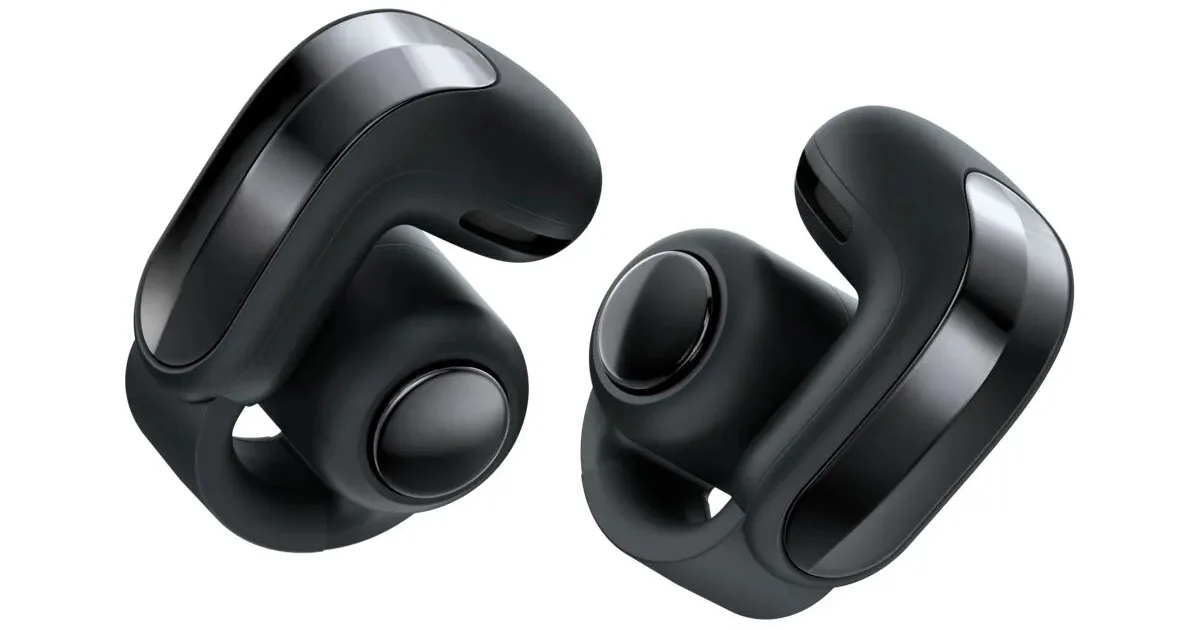
Bose introduced its second-generation Ultra Open Earbuds on September 17, a little over two years after the original model.
The U.S. price remains $299. Preorders open September 19, with general availability scheduled for October 1.
Black and White Smoke are joined by limited-edition finishes including Cherry Chocolate, Olive Green and Sky Pink depending on market.
The basic design still works in the opposite direction from an in-ear earbud
Ultra Open Earbuds do not sit inside the ear canal.
Their cuff-shaped structure wraps around the ear while the acoustic section remains close to the canal entrance.
Bose OpenAudio technology then directs sound toward the listener while attempting to minimize leakage to nearby people.
The canal itself stays physically open.
Traffic, announcements, conversations and other environmental sounds therefore reach the eardrum naturally rather than being reconstructed through an electronic transparency mode.
There is still no ANC, and that is not an omission
Bose confirms that Ultra Open Earbuds (2nd Gen) do not include active noise cancellation.
ANC would conflict with the product's fundamental design.
A sealed earbud first reduces acoustic coupling between the outside environment and the ear, then uses microphones and signal processing to cancel part of what remains.
Ultra Open deliberately preserves that acoustic path.
External noise reaches the eardrum without needing to pass through the earbud at all.
For aircraft cabins or very loud trains, Bose's QuietComfort line therefore remains the more logical architecture.
Ultra Open is designed for situations where environmental awareness is a feature rather than a problem to remove.
Bose concentrated heavily on the bass problem
An open design has an obvious physical disadvantage at low frequencies.
An in-ear model can create a relatively controlled acoustic volume between driver and eardrum.
Ultra Open has to generate convincing low-frequency energy from outside that sealed space with far less control over the surrounding air.
Bose says the second generation uses a newly engineered driver.
The company claims deeper, more refined bass and greater maximum volume than generation one.
Those remain manufacturer claims until independent measurements show exactly how much low-frequency extension and output capability have changed.
More headroom matters especially when the outside world is always audible
On sealed earbuds, extra volume can simply be a preference.
On open earbuds, it can become necessary when the environment gets louder too.
That creates a difficult engineering balance.
The driver needs enough acoustic output to remain useful outdoors without turning the earbud into a miniature loudspeaker for everybody nearby.
Bose continues to say OpenAudio directs most of the useful sound toward the wearer's ear.
The company also acknowledges that at maximum volume in a very quiet setting, somebody standing close may hear some leakage.
Auto Volume follows changes in ambient noise
Bose's second answer is software.
Auto Volume changes playback level as environmental noise rises or falls.
Walking from a quiet office onto a busy road can therefore trigger a volume increase before the system lowers it again in a calmer environment.
That approach fits the open-ear concept neatly: if the product cannot remove the world, it can adapt itself to it.
Users retain control of Auto Volume through the Bose app.
Battery life finally rises from seven to nine hours
The original model was rated for seven hours of standard listening.
Bose now claims up to nine hours, based on its own testing at a 75 dBA playback level.
That is a useful improvement for a device explicitly designed to remain on the ear for long periods.
The number changes dramatically when processing features are enabled.
With either Immersive Audio or Auto Volume turned on, Bose rates playback at up to five hours.
Using both simultaneously lowers the figure to four hours.
The most feature-heavy configuration therefore consumes much of the generation's battery-life gain.
The case still adds another 19.5 hours
The charging case provides up to 19.5 additional hours under standard playback conditions.
That reserve falls to around eleven hours with either Immersive Audio or Auto Volume enabled, then 8.5 hours when both are active.
Quick charging remains available: ten minutes in a charged case can provide up to two hours of playback under Bose's specified test conditions.
A full earbud charge is rated at roughly one hour.
Wireless charging finally reaches the case
Its absence was increasingly difficult to justify on $299 earbuds.
The second-generation case can now charge wirelessly in addition to USB-C.
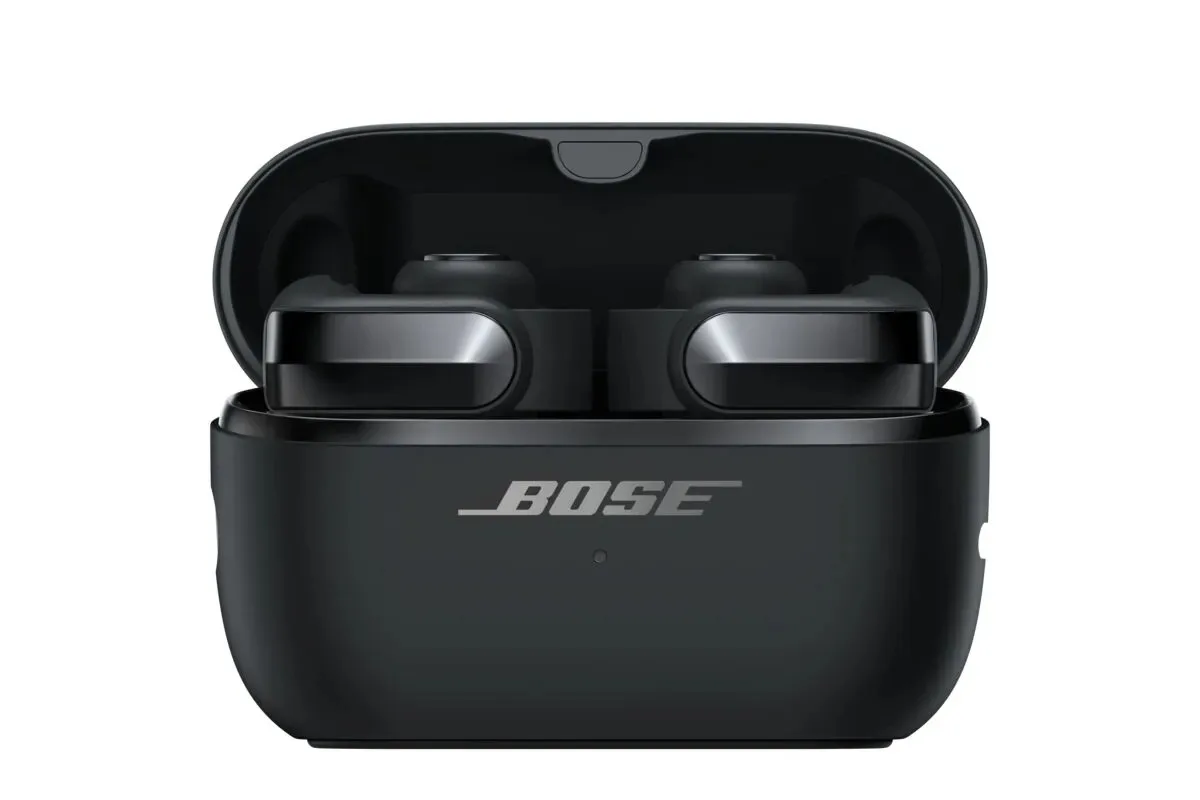
Bose has also redesigned the case so it can stand upright and describes the construction as more robust.
The earbuds themselves retain an IPX4 water-resistance rating.
That is appropriate for sweat and splashes, but it does not turn them into highly sealed sports earbuds intended for heavy water exposure.
Voice calls were another difficult open-ear problem
A product designed to let environmental sound reach the listener also has to stop that same environment from overwhelming its microphones during a call.
Bose introduces SpeechClarity for this job.
Each earbud combines a dedicated microphone with a voice pickup unit, while processing Bose describes as AI-enhanced attempts to isolate speech from background noise.
The goal is not simply maximum suppression.
Bose says SpeechClarity is tuned to preserve tone, warmth and natural expression rather than producing the metallic or fragmented voice quality that aggressive noise filters sometimes create.
Wind and dense street noise will be the more revealing independent tests.
Cinema Mode is aimed at video rather than music
The first Ultra Open already supported Bose Immersive Audio.
Generation two adds Cinema Mode.
The feature uses Bose TrueSpatial technology to widen the presentation while keeping dialogue sharply centered.
Bose positions it for films, series, video and podcasts without requiring a specially encoded source format.
The earbuds therefore generate the spatial presentation from ordinary incoming content.
A separate Immersion Mode remains focused more directly on music.
Spatial processing makes unusual sense on a device that already feels less physically inside the ear
One common characteristic of sealed in-ear headphones is the perception that sound is located directly inside the listener's head.
Bose's external driver geometry already changes that sensation to some extent.
TrueSpatial tries to push the presentation further outward so the apparent stage sits more in front of the listener.
Cinema Mode uses the same principle to anchor speech centrally while expanding other elements around it.
The cost appears clearly in the battery specifications, with spatial processing substantially reducing runtime.
Bluetooth 5.4, multipoint and aptX Adaptive
Connectivity moves to Bluetooth 5.4.
The earbuds can remain connected to two devices simultaneously through multipoint and support SBC and AAC.
Bose also includes Snapdragon Sound with aptX Adaptive on compatible Android hardware.
aptX Adaptive can vary bitrate dynamically and is designed to balance audio quality, latency and link reliability.
Support depends on the source device. An iPhone will use AAC and does not gain the Qualcomm-specific part of the feature set.
Google Fast Pair is supported on Android as well.
Several announced features will arrive after launch
Bose says a later firmware update will add Google Find Hub, Alexa+ and an Apple Music shortcut.
Those features should therefore not be treated as necessarily available on October 1.
Existing configurable shortcuts can already launch Spotify Tap, the phone's native voice assistant or cycle through Bose Immersive Audio modes.
The Bose app also provides a three-band equalizer, Auto Volume controls, Bluetooth management and firmware updates.
The shape changes little because Bose appears satisfied with the original mechanical idea
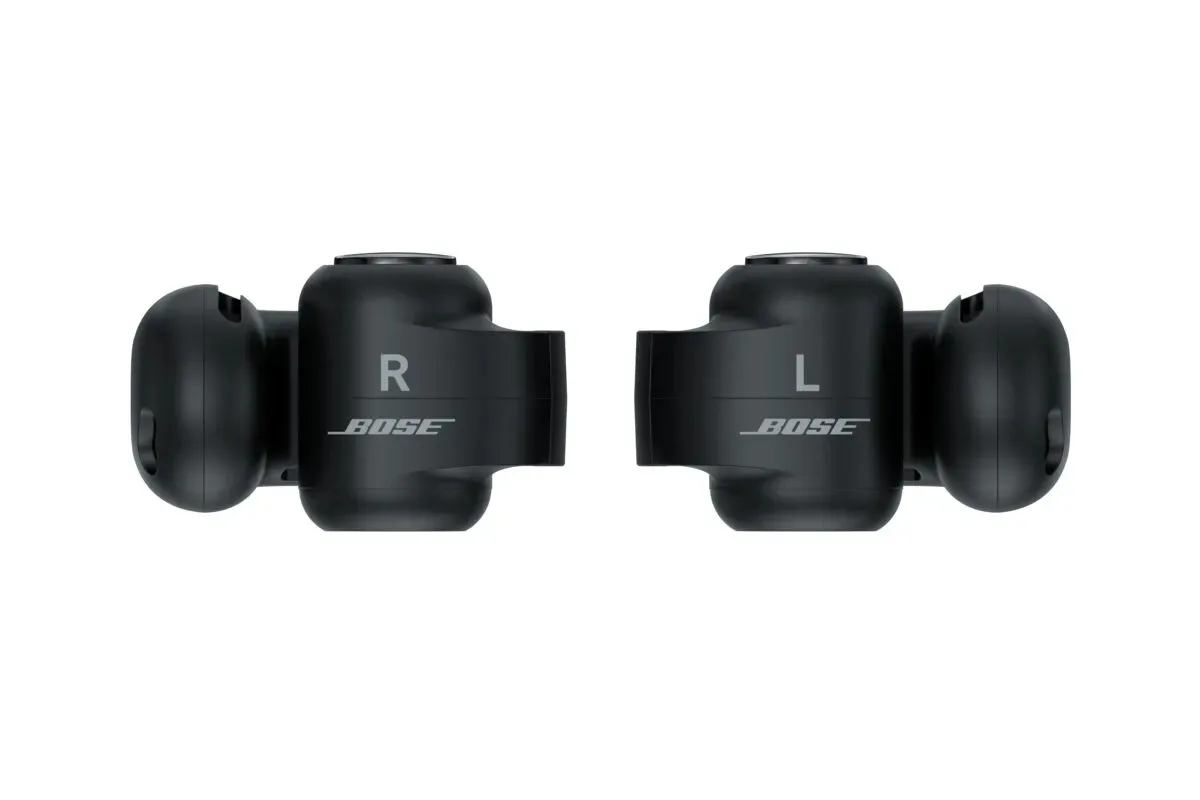
The overall cuff silhouette remains recognizable.
One section sits in front of the ear and contains the acoustic hardware while another rests behind it, joined through a flexible section around the cartilage.
Generation two uses what Bose calls a simplified flex joint and adds a more prominent beveled metallic finish.
It is refinement rather than a completely new wearing method.
The central advantage remains the absence of an eartip inside the canal or a large hook wrapping around the full outer ear.
Ultra Open still trades isolation for the ability to remain present
At $299, Ultra Open Earbuds (2nd Gen) sit in the same price territory as some of the strongest noise-cancelling earbuds.
A pure specification comparison can therefore look harsh: no ANC, effectively no passive isolation and a harder acoustic environment for reproducing deep bass.
Bose is targeting a different behavior.
These earbuds are for people who would otherwise keep removing sealed earbuds to talk, cross a road, work near colleagues or remain aware of what is happening around them.
Music becomes a persistent layer added to the environment instead of a separate acoustic space.
Generation two is ultimately a deliberately narrow set of corrections
Bose has not solved the fundamental contradiction of open-ear audio because that contradiction is also the reason the product exists.
The outside world will remain audible and can still overpower parts of the music.
Instead, Bose has targeted what can be improved without sealing the ear: a more capable driver, extra volume headroom, longer battery life, better voice capture, wireless charging and spatial processing designed for video.
That does not make Ultra Open a replacement for QuietComfort Ultra.
It makes the tradeoff behind the original idea substantially more complete.