
 By Tsuky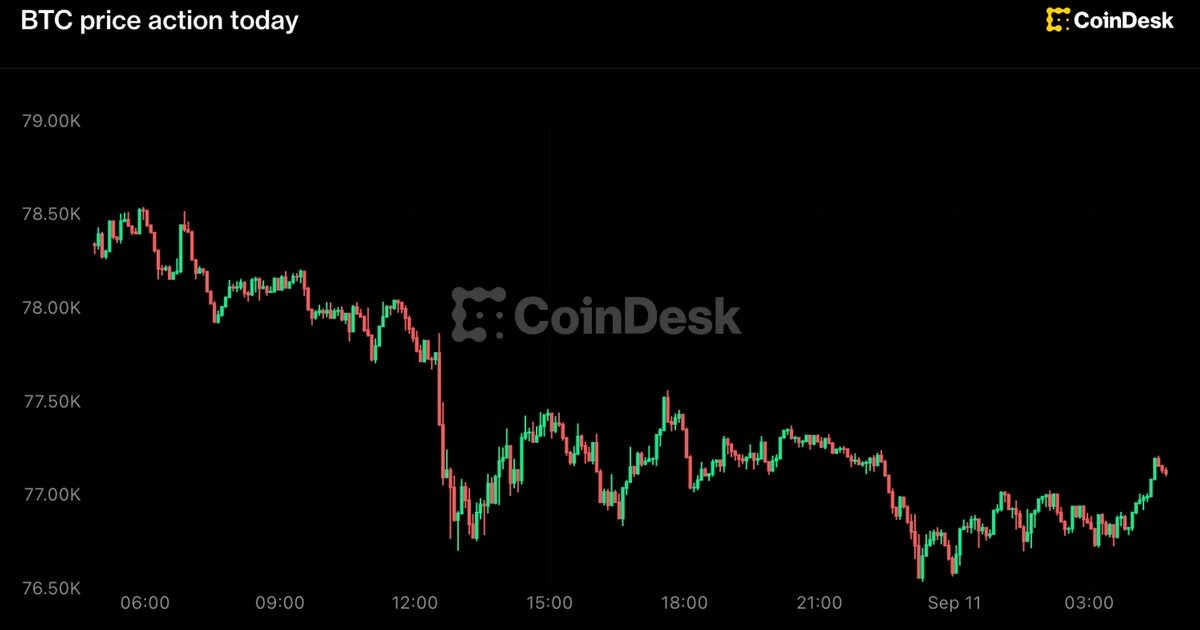
Bitcoin has surrendered part of its early-September rally and is trading around the $77,000 area after recently reaching approximately $82,000.
There is no obvious Bitcoin-specific event driving the move. The pressure is coming largely from outside crypto: firmer US inflation, oil above $100, high government-bond yields and a rapidly increasing probability of another Federal Reserve rate hike.
Markets now overwhelmingly expect a September hike
Interest-rate futures are pricing roughly an 85% to 87% probability that the Federal Reserve raises rates by 25 basis points at its September 15-16 meeting.
The federal funds target currently sits at 3.50% to 3.75%, where the Fed has kept it throughout 2026.
The repricing has become strong enough to change major Wall Street forecasts. Goldman Sachs said on September 14 that it now expects a quarter-point increase, reversing its previous call for no change.
Goldman said the revision reflects market pricing more than a major change in its underlying economic outlook. At current probabilities, holding rates steady would itself represent a meaningful surprise.
Inflation is not moving cleanly back toward 2%
August consumer-price data strengthened the case for tighter policy.
Headline US CPI rose 0.4% from the previous month and 3.4% from a year earlier.
Core inflation increased 0.3% month over month, above economists' 0.2% expectation, and 2.4% year over year.
Those numbers are far below the worst inflation prints of the early 2020s. They are still uncomfortable for a central bank that has spent years trying to restore inflation sustainably to its 2% objective.
Oil is supplying exactly the wrong kind of price pressure
Energy has made the calculation more difficult.
Renewed Middle East supply concerns pushed Brent crude to roughly $107 a barrel in recent trading, with US crude above $102.
Higher oil prices propagate through transportation, manufacturing and other parts of the economy while simultaneously reducing household purchasing power.
That combination can leave central banks facing weaker growth without the luxury of easier monetary policy.
Bitcoin has to compete with government debt yielding almost 5%
The US 10-year Treasury yield recently came close to 5% before easing back toward the high-4% range.
That has consequences for bitcoin even though it has nothing to do with the Bitcoin protocol.
When highly liquid US government debt offers a yield close to 5%, assets that generate no cash flow have a higher opportunity cost.
Bitcoin pays no coupon or dividend. Investors are compensated only if its market price rises.
The higher the risk-free rate climbs, the more demanding that trade becomes.
Spot ETFs lost almost $450 million in three sessions
US spot bitcoin ETF flows also reflected the risk reduction.
Farside Investors recorded $46.6 million of net outflows on September 8, $120.2 million on September 9 and $282.7 million on September 10.
That adds up to approximately $449.5 million leaving the products over three consecutive trading sessions.
The run then largely stalled on September 11, when aggregate flows returned to roughly flat territory with a small net inflow.
That context matters. The three-day withdrawal was significant, but the products have accumulated tens of billions of dollars of net inflows since launch. A few negative sessions do not establish the collapse of institutional demand.
The latest golden cross did not produce an immediate breakout
Bitcoin also recently generated one of technical analysis's favorite bullish signals: the 50-day moving average crossed above the 200-day moving average.
The problem with the so-called golden cross is that it is inherently backward-looking.
Bitcoin had already risen from roughly $62,000 to $82,000 before the crossover appeared and subsequently retreated toward $77,000.
Previous golden crosses have shown a similar tendency. In several cases, much of the rally occurred before the signal and a short-term pullback followed afterward.
The area around $76,000 now matters more than the indicator
Bitcoin is approaching a price zone that has already attracted buyers during recent pullbacks.
A sustained move below roughly $76,000 would not automatically signal a new bear market. It would, however, make the rebound to $82,000 look less convincing.
Holding that area through a potentially hawkish Fed meeting would tell a different story about the depth of demand.
Digital gold can still be rate-sensitive
There is no requirement for bitcoin to fit only one macroeconomic role.
An investor can view it as a long-term hedge against monetary debasement while the market simultaneously treats it as a highly liquid risk asset over shorter periods.
When interest rates rise and portfolios become more defensive, those short-term characteristics can dominate.
For the next few days, bitcoin's most important catalyst may therefore have almost nothing to do with crypto itself.
It may simply be the Federal Reserve.