
 By Camille
The interesting specification is not 60W
A 10,000mAh power bank capable of charging a laptop at 60W is no longer especially unusual. BoostSolid is what makes Belkin's new model different.
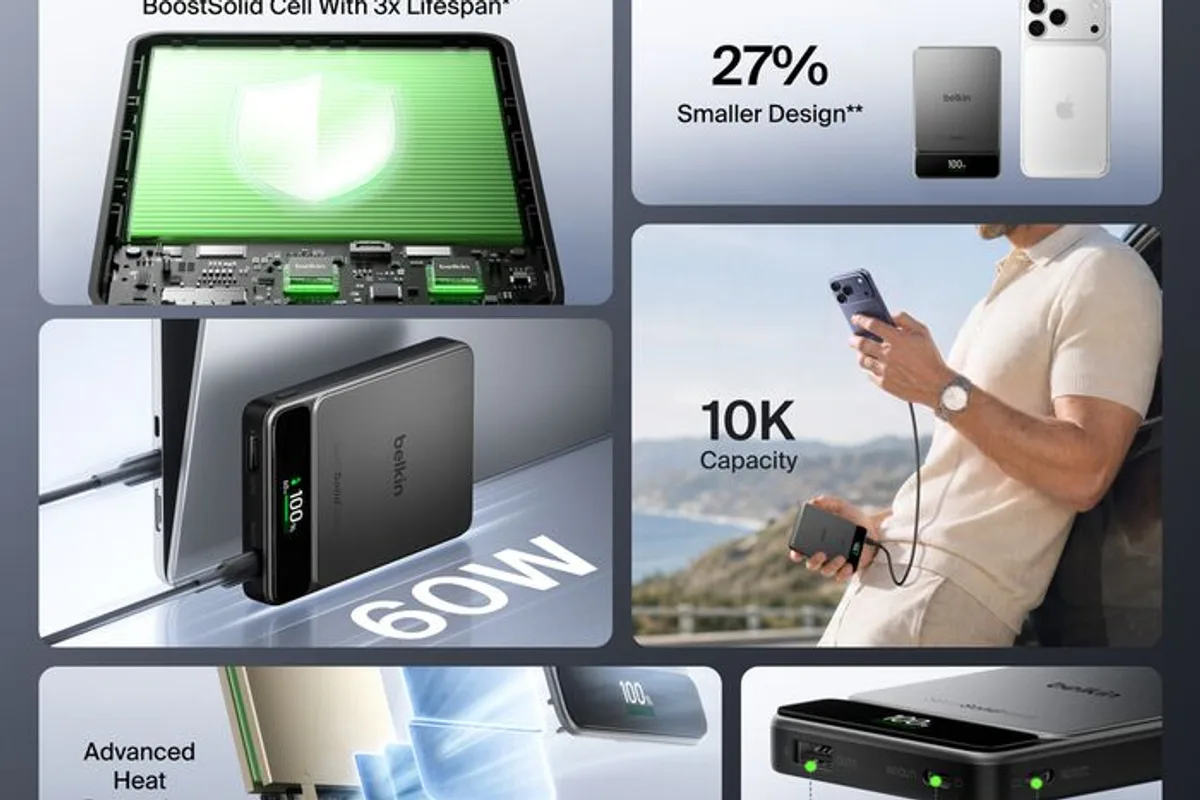
Belkin describes the cells as semi-solid rather than conventional liquid-electrolyte lithium-ion batteries. A more stable gel-like internal structure is intended to increase energy density, improve thermal behaviour and reduce long-term degradation.
The company says the cells should retain more than 80 percent of their original capacity after over 1,000 complete charge cycles. Belkin translates that into a lifespan claim of up to three times longer than traditional liquid cells.
Those figures come from Belkin's own testing. Verifying a claim about five years of estimated service life will, by definition, take a while.
Higher density also makes the pack smaller
The 10,000mAh UltraCharge Pro measures roughly 109.5 x 73 x 14.5mm. Belkin says its volume is 27 percent smaller than the conventional 45W 10,000mAh power bank it uses for comparison.
That may be a more immediately useful advantage than the chemistry terminology. Power banks live in bags and pockets, where removing a few millimetres is often more valuable than adding another decorative feature.
A 0.96-inch color display shows remaining capacity, charging power, internal temperature and battery health information.
One USB-C port gets the full 60W
There are two USB-C ports and one USB-A connection. Either USB-C port can deliver up to 60W when used on its own, while USB-A reaches up to 22.5W.
Plug in several devices and the numbers change quickly. Belkin's technical documentation lists up to 30W of shared output when two or three ports are active. USB-C input reaches 40W, and pass-through charging is supported at up to 15W.
PD, PPS, AVS and UFCS protocols are supported. Belkin says the power bank can take an iPhone 17 Pro from zero to 50 percent in about 24 minutes in its internal testing.
Battery health is becoming part of the interface
Belkin also positions the semi-solid structure as a way to reduce risks associated with overheating, swelling and thermal runaway. That does not remove the need for active protection.
Two protection chips monitor temperature four times per second, according to the company. The display can surface thermal information, and charging speed is reduced when temperatures require it.
The emphasis is unusual for a category that has spent years advertising almost nothing except watts and milliamp-hours.
The 10K model costs €79.99
European pricing for the UltraCharge Pro 10K is €79.99, while the US price is $89.99. Belkin says availability begins in September through its own store and selected retailers.
A 5,000mAh UltraCharge Pro Slim Magnetic model launches alongside it for €64.99. That version is only 8.8mm thick, supports 15W Qi2 magnetic charging and offers up to 22.5W over USB-C.
Belkin claims the smaller model is up to 40 percent thinner than comparable 5,000mAh power banks.
The power-bank race is starting to move away from simply pushing more current through a cable. How much useful capacity remains after the thousandth recharge may be a better specification.