
 By Camille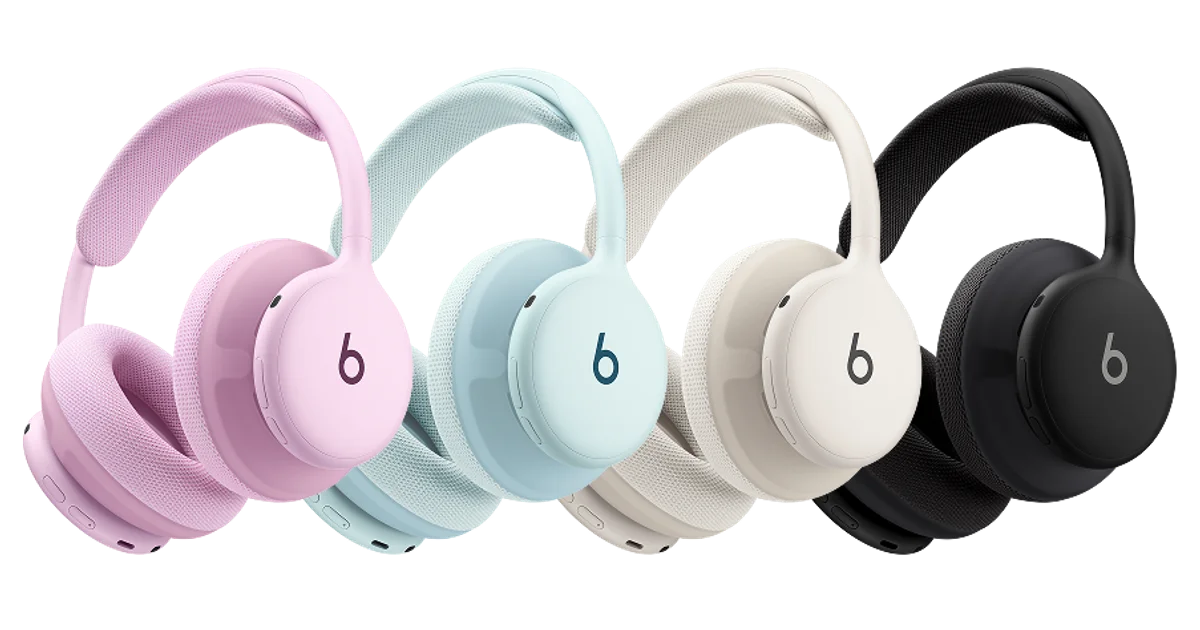
Beats finally gives an over-ear model an IP rating
Beats unveiled 360 on September 22 as its new flagship over-ear headphone, sitting above the newly discounted Studio Pro.
Its most unusual specification is not the driver or ANC system. Beats 360 is the company's first over-ear headphone with official IPX4 sweat and water resistance.
That rating is intended for sweat, rain and splashes during non-water exercise. It does not make the headphones suitable for swimming, and Beats notes that resistance can decline with normal wear.
For an over-ear design, the change is meaningful. Large sealed cushions naturally trap heat and moisture around the ears during exercise.

Both ear pads and the headband cushion are replaceable
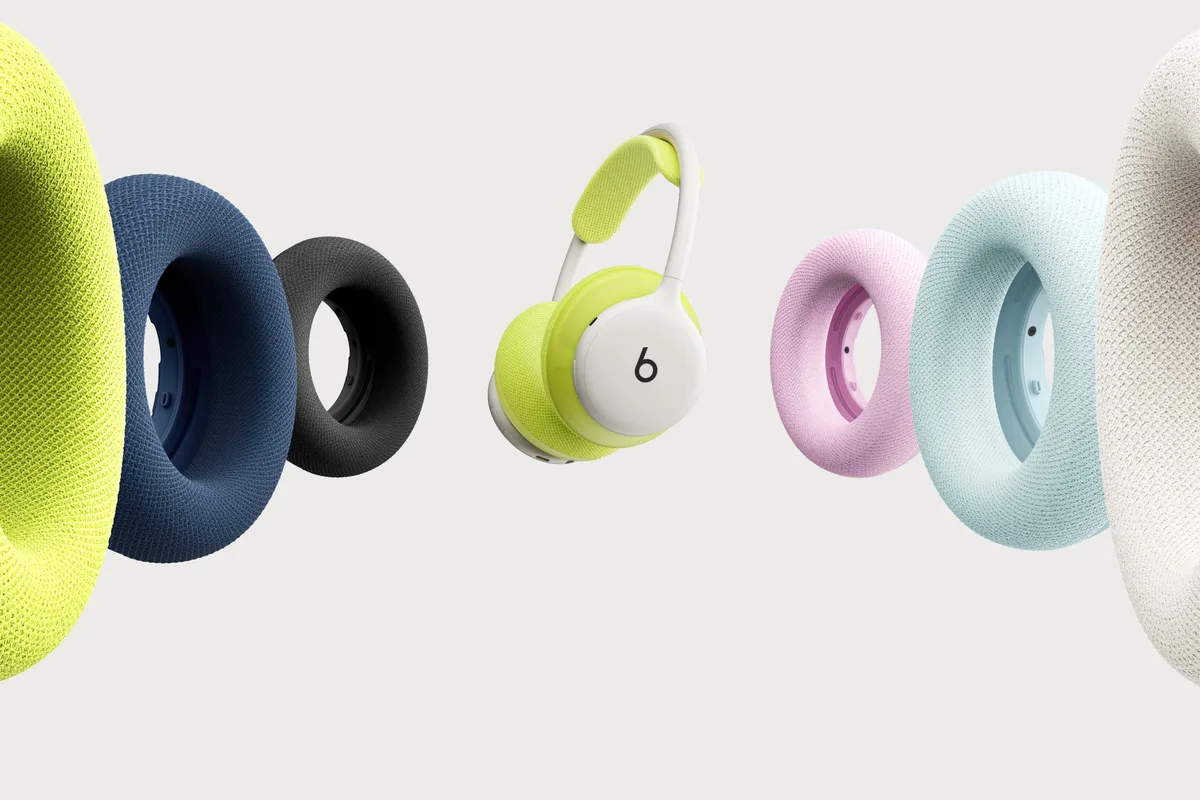
Beats has made the two ear cushions and the headband pad removable and interchangeable.
The standard Performance Knit set uses memory foam wrapped in breathable woven material designed around airflow, durability and moisture management.
An optional UltraPlush version switches to the smoother engineered-leather material already used on Studio Pro and Solo 4.
The concept allows someone to wear the knit cushions for training, then fit a softer and more isolating set for work or travel.
Changing cushions is an acoustic change too
Ear pads are never purely cosmetic. Their density, seal and surface material influence bass response, passive isolation and how an ANC system behaves.
Beats therefore uses Adaptive EQ to continuously account for fit and seal around the ear.
Early testing also suggests the more closed cushion option can alter passive isolation slightly.
The automatic compensation matters because a modular fashion feature would be much less useful if every pad combination created a completely different tuning.
Four headphone colors become many more combinations
The headphones themselves come in Black, Cloud, Pink and Sky.
Performance Knit kits are available in Black, Cloud, Pink, Sky, Navy and Volt. UltraPlush is offered in Black and Cloud.
Each kit contains both ear cushions and the headband cushion.
Standard U.S. pricing is $49.99, with a temporary $9.99 introductory offer in selected markets through October 31 while supplies last.
A new driver uses dual magnets and a three-layer diaphragm
Beats has also built a new acoustic platform for the 360.
Each custom dynamic driver uses a sensitive three-layer diaphragm and dual neodymium magnets.
The company describes the design as delivering greater dynamic range, precision and lower distortion than its earlier headphones.
Those claims will be easier to judge as independent measurements arrive. Initial reviews generally describe strong, controlled bass and clear treble, while some reviewers have been less enthusiastic about separation in the midrange.
Eight microphones are dedicated to noise cancellation
There are nine digital MEMS microphones in total.
Eight contribute to Active Noise Cancelling. Three can be used for voice pickup, with two of those shared with the ANC array.
Beats claims up to 1.75 times more combined active and passive noise cancellation than Studio Pro under testing based on IEC 60268-24.
That figure should not be interpreted as every external sound becoming exactly 1.75 times quieter. ANC performance varies substantially with frequency, fit and noise type.
Early testing says ANC is much better, but Bose still matters
The first independent reviews are broadly consistent about the improvement over previous Beats headphones.
Steady gym noise, ventilation and ordinary environmental sound are reduced effectively.
Reviewers still place top Bose models ahead in some difficult low-frequency situations such as aircraft engine noise.
Beats does not need to be the absolute ANC leader for the upgrade to be significant.
Battery life reaches 32 hours with ANC and Spatial Audio
Beats rates the 360 for up to 32 hours of continuous playback with Active Noise Cancelling and Personalized Spatial Audio with dynamic head tracking enabled.
The company also quotes up to 32 hours with ANC and Transparency disabled while Adaptive EQ remains active.
Transparency mode is rated at approximately 24 hours under Apple's test conditions.
Five minutes of Fast Fuel charging provides up to one hour of playback.
Charging uses USB-C, although the retail box does not include a charging cable or power adapter.
There is no 3.5mm headphone jack
Beats describes the 360 as a wireless-first design. Removing traditional cable routing from the headband gave engineers more freedom to work on flexibility and weight distribution.
The trade-off is the disappearance of the analogue 3.5mm input.
Digital wired listening is possible over USB-C, but older in-flight entertainment systems and purely analogue sources require an additional adapter.
That omission is more noticeable on a $350 travel-capable over-ear headphone than it would be on a pair of earbuds.
294.5 grams is heavier than Studio Pro
Beats 360 weighs 294.5g.
That makes it heavier than Studio Pro even though Beats has focused heavily on making the new design feel balanced rather than heavy.
Much of the hardware is concentrated inside the earcups, while the redesigned headband distributes force across the head.
Stainless-steel sliders and rotating earcups provide adjustment, while the headphones fold flat for transport.
Beats includes a woven ripstop soft case rather than a rigid clamshell case.
Android users still get more than basic Bluetooth
Beats uses its own custom chip rather than limiting the headphone to an Apple-only feature set.
On supported Apple devices, features include one-touch pairing, automatic switching, Audio Sharing, Find My, hands-free Siri and Personalized Spatial Audio with dynamic head tracking.
Android users get Fast Pair, Audio Switch, Find Hub, voice-assistant support and access to the Beats app for settings.
That remains a major difference between Beats and Apple's AirPods line: choosing an Android phone does not reduce the product to a generic Bluetooth headset.
Bluetooth 5.3 and physical controls fit the workout positioning
Wireless connectivity uses Class 1 Bluetooth 5.3.
Controls are physical rather than capacitive. Volume and playback sit on the right earcup, while power and listening modes are controlled from the left.
That is a sensible decision for exercise, where wet fingers and sweat can make touch surfaces less predictable.
Beats does not list automatic wear detection in the specification, so playback and power management remain more manual than on some competing premium headphones.
The price is $349.99 and Studio Pro drops to $299.99
Beats 360 costs $349.99 in the United States and is launching across more than 100 countries and regions.
Orders opened on September 22, with in-store availability scheduled for September 24.
At the same time, Beats has reduced Studio Pro to a new $299.99 U.S. list price.
The positioning is therefore straightforward: Studio Pro remains the more conventional over-ear model, while 360 charges extra for the modular design, stronger ANC, IPX4 protection and new acoustic platform.
Premium workout headphones are becoming a real category
The most interesting thing about Beats 360 may not be the personalization itself, but the problem the modular parts are being used to solve.
Over-ear headphones offer comfort, powerful bass and effective noise cancellation, yet most were never engineered around years of sweat accumulating in their softest components.
Replaceable contact surfaces, official moisture protection and premium-level ANC make more sense than simply putting an athlete in ordinary lifestyle headphones for an advertisement.
At $350, Beats still has to compete with Sony and Bose on sound quality and isolation.
But for people who insist on wearing full-size headphones while training, Beats 360 is one of the few premium models that finally acknowledges sweat as an engineering requirement rather than a marketing backdrop.