
 By Camille

A Physics Model Unlike Conventional Racing Games
Traditional racing games generally calculate vehicle movement using models that represent the main parameters of driving.
Visual damage may be handled separately, sometimes through predetermined bodywork changes or animations.
BeamNG.drive takes a different approach.
Its soft-body physics engine simulates networks of nodes and structural connections representing individual vehicles.
Those structures can deform under pressure and break when forces exceed their limits.
Vehicle behavior emerges from these interactions.
That makes it possible for damage to change how a car drives after a collision.
The impact is not simply visual. It changes the simulated object.
What Does 2,000 Hz Mean?
BeamNG GmbH CEO Thomas Fischer explains on the PlayStation Blog that the physics engine operates at 2 kHz.
That means the simulation is updated two thousand times per second.
Such a high update frequency helps track rapid interactions between structural components.
It is particularly relevant when large forces act on a vehicle during a crash.
However, an important distinction is necessary.
The 2,000 Hz figure refers to physics calculations, not display refresh rate.
It does not mean that BeamNG.drive renders two thousand frames per second.
Physics updates and rendered frame rates are different technical measurements.
Why the Port Is Technically Demanding
Running BeamNG.drive on PS5 requires maintaining detailed physical interactions within the console's available resources.
The processor must handle complex calculations, while the graphics system displays vehicles, environments and collision results.
Interactions can become particularly demanding when several vehicles collide.
The engine must evaluate many structural relationships simultaneously.
BeamNG GmbH acknowledges that this level of fidelity presents challenges on any hardware.
According to the developer, the console adaptation required significant optimization in performance, controls, interface and overall usability.
However, the company has not published a complete quantitative analysis of those changes.
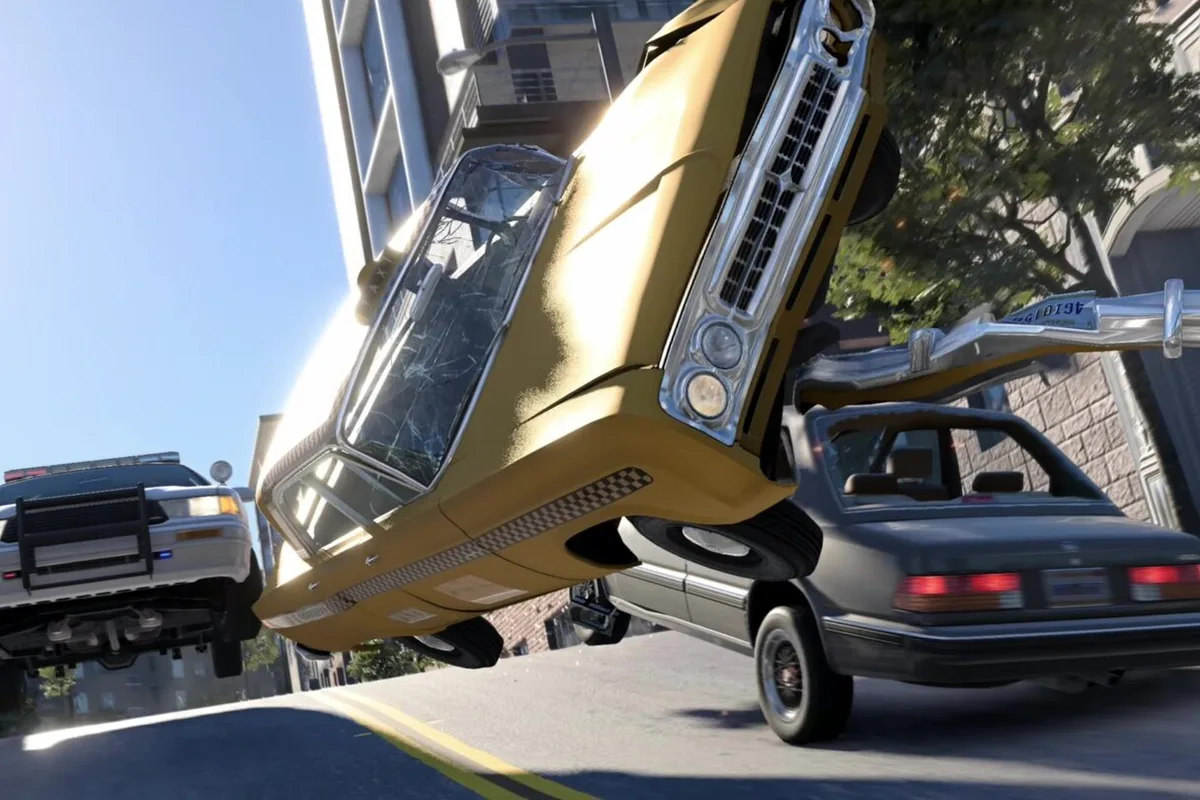
Damage Is Part of the Driving Model
The simulation's value extends beyond watching crushed bodywork.
An impact may damage suspension components, change wheel alignment or break mechanical parts.
The vehicle then handles differently.
That connection between physical damage and driving behavior creates opportunities for detailed experimentation.
Players can compare collisions or examine the effectiveness of different mechanical setups.
They can also observe how modifications influence real-time vehicle behavior.
This helps explain why BeamNG.drive's crashes are so varied.
Two apparently similar impacts may produce different results depending on speed, angle and vehicle structure.
Twelve Environments for Testing Vehicles
The available maps are more than visual backgrounds.
BeamNG.drive includes 12 open environments featuring different surfaces and terrain.
Mountain roads, industrial areas and desert landscapes create distinct driving challenges.
Players can test the same vehicle setup under different conditions.
Customization options include suspension, drivetrain, tires and ride-height settings.
Each modification can influence the car's behavior.
This freedom turns the environments into extensive testing grounds.
DualSense: Adapting a Simulation to Controller Input
Moving to PS5 also requires adapting the interaction model.
The PlayStation Store confirms support for DualSense vibration and adaptive trigger effects.
These features can communicate certain aspects of driving through physical feedback.
However, their effectiveness depends on implementation.
It would be premature to describe specific trigger resistance for different surfaces or vehicles without testing the final release.
The storefront also confirms advanced control customization, including stick sensitivity adjustment and axis inversion.
Those options are important in a simulator where small steering inputs can affect handling.
PC Mods Remain a Major Difference
BeamNG.drive has developed an extensive community of creators on PC.
Mods contribute additional vehicles, environments and gameplay scenarios.
However, BeamNG GmbH has confirmed that mods will not be supported on PlayStation 5 at launch.
That limitation should be distinguished from the game's internal vehicle customization.
Console players will still be able to modify numerous mechanical components of supported vehicles.
They will not initially have the same community mod ecosystem as PC players.
The developer hopes to improve feature parity over time but has not confirmed specific additions or a timetable.
Missing VR Limits Some Setups
Virtual reality is another confirmed launch omission.
The PS5 edition will not support VR on day one.
That matters for driving simulator enthusiasts who prefer immersive headset experiences.
Future PS VR2 support has not been confirmed.
The release should therefore not be described as establishing a new PlayStation VR driving simulator.
Any future compatibility would require a separate announcement.
A Version Still Under Development
The PlayStation Store confirms BeamNG.drive's early-access status.
This matters when considering its current features and future development.
The team may continue adding functionality and modifying existing systems.
The console launch does not mark a definitive version 1.0.
On PC, update 0.40 is also expected around October 19.
The September announcement did not provide enough detail to establish that the PC patch has already launched.
Actual Performance Still Needs Measuring
The central technical question concerns simulation stability on PlayStation hardware.
Testing should examine crashes involving multiple vehicles.
Dense traffic, complicated environments and elaborate mechanical setups may also create different workloads.
Assessing the port will require measurements of frame rate, frame-time consistency and input responsiveness.
The examined official sources do not guarantee a universal 60 or 120 frames per second.
A sophisticated physics engine does not, by itself, establish graphical performance.
An Important Moment for Console Vehicle Simulation
BeamNG.drive's PS5 arrival marks a significant development for a project long associated with PC-based automotive experimentation.
The technical challenge involves more than displaying detailed cars.
It means preserving a consistent physical system where crashes, adjustments and mechanical modifications can influence driving behavior.
The studio describes substantial work on the port while acknowledging several differences from the PC version.
Hands-on testing after launch will reveal how successfully BeamNG GmbH has preserved the simulation's depth on PlayStation 5.
If that depth translates well, BeamNG.drive may offer console players something distinct from traditional racing games: not merely the opportunity to drive fast, but the ability to experiment with what happens when vehicle physics takes control.