
 By Tsuky
At the low end of that strategy sits the $899 M6 Mac mini. Its new 2nm SoC has a 12-core CPU and 12-core GPU, with Neural Accelerators added to the GPU architecture. Unified-memory bandwidth reaches 170GB/s, although capacity tops out at 32GB.
That capacity ceiling matters. The machine can be fast at running a model that fits, but AI inference is brutally literal about memory requirements. A bigger model does not become usable because the processor gained another benchmark win.
Apple's own tests claim up to four times the AI performance of the M4 Mac mini on selected workloads. The company is also advertising the device as an always-on home or office system for local agents, rather than treating AI as an occasional feature inside a creative application.
M5 Pro fixes some of the mini's memory problem
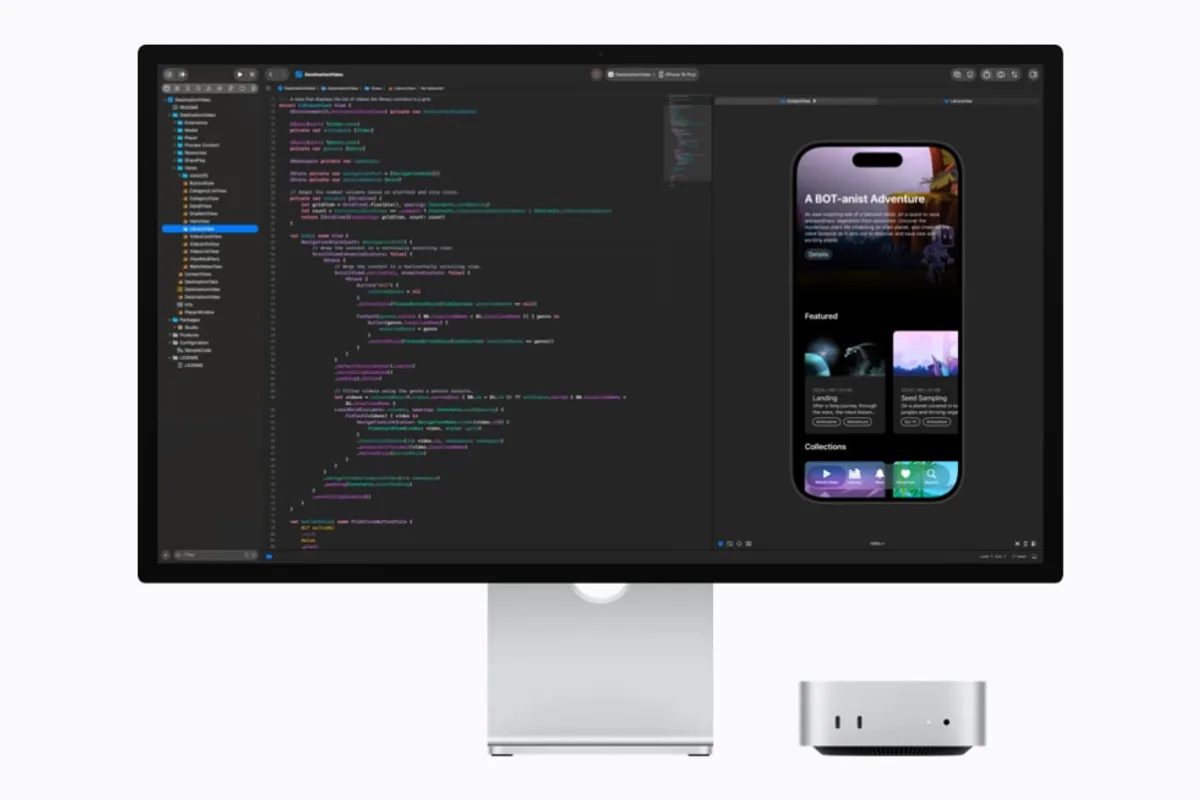
The higher-end Mac mini takes a different route with M5 Pro. It can be configured with up to 64GB of unified memory and 307GB/s of bandwidth, alongside an 18-core CPU and 20-core GPU.
Thunderbolt 5 is also present on that version, and Apple supports linking multiple systems for distributed AI workloads. That creates an inexpensive-looking path into clusters compared with rack servers, though software support and inter-node communication still determine whether the arrangement is actually efficient.
The systems remain independent computers. A cluster is not equivalent to adding their memory modules together behind one gigantic GPU. Models and inference engines need to understand how to partition work across those nodes.
Mac Studio makes memory capacity the headline specification
The M5 Ultra Mac Studio is where Apple's approach becomes genuinely unusual. It scales to a 36-core CPU, an 80-core GPU, 1.2TB/s of unified-memory bandwidth and as much as 512GB of memory.
For local AI, that last number can be more consequential than another percentage point of compute performance. Large language models need their weights and runtime state somewhere accessible to the accelerator. Conventional workstation GPUs with far smaller VRAM pools often require heavier quantization, multiple cards or offloading to system memory.
Apple says the 512GB configuration can run models with hundreds of billions of parameters locally. That should not be treated as a universal model-size guarantee. Precision, quantization, context length, cache requirements and the inference framework all change the amount of memory and usable performance.
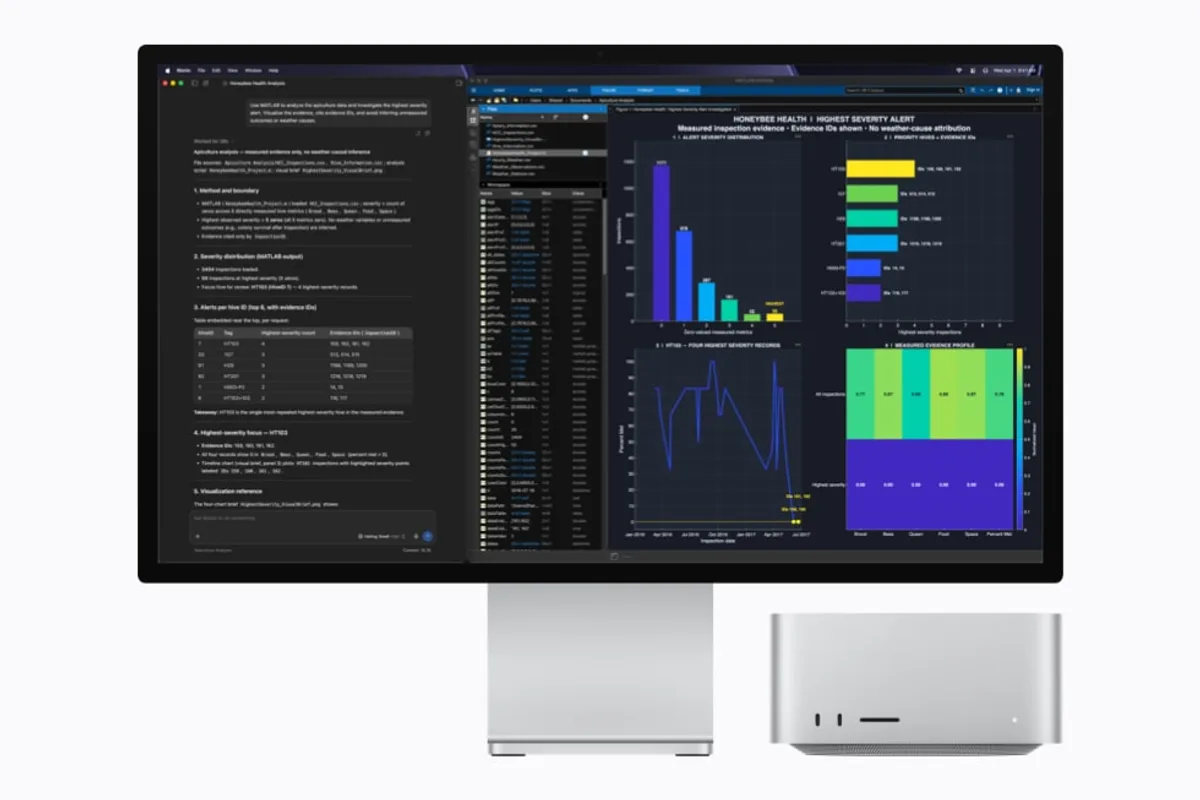
The 512GB configuration also has a different shipping schedule. The main Mac Studio lineup starts arriving September 22, while Apple says the maximum-memory version will follow in late October.
Thunderbolt 5 is becoming a compute fabric
Apple now supports clustering multiple Mac Studio systems over Thunderbolt 5 using RDMA. A four-machine configuration delivers up to three times the AI inference performance of one Mac Studio in Apple's testing.
That is a useful option for teams that need more model capacity or throughput without moving everything to a hosted GPU provider. It also comes with the usual distributed-computing caveat: scaling is workload-dependent, and four machines rarely mean four times the performance.
The link between systems is much slower than M5 Ultra's internal memory fabric. Model partitioning, communication overhead and inference software become part of the performance equation.
Local AI shifts the bill instead of eliminating it
Apple's pitch emphasizes privacy and freedom from per-token cloud charges. Both can be legitimate advantages. Keeping code, research data or internal documents on premises reduces the number of systems that need access to them, and a heavily used local inference server has predictable hardware costs.
The upfront bill is substantial. Mac Studio with M5 Ultra starts at $5,499, while M5 Max starts at $2,499. Reuters notes that the new $899 Mac mini is $100 more expensive than the previous entry model, as memory costs remain under pressure from AI data-center demand.
For occasional inference, renting compute can still make more economic sense. A machine or cluster that stays busy all day changes the comparison, especially when the organization values local control as much as raw token cost.
Apple silicon's memory architecture is now part of the AI sales pitch
M5 Ultra uses a new UltraFusion implementation that connects two dual-die M5 Max packages into Apple's first four-die M-series design. Apple specifies more than 4.4TB/s of die-to-die bandwidth and 1.2TB/s between the resulting processor and unified memory.
That does not turn the Mac Studio into a replacement for every CUDA workstation or GPU server. Software support, training performance, model compatibility and accelerator-specific tooling remain major considerations.
It does give Apple a clear niche: very large shared memory in a compact desktop, with CPU and GPU accessing the same pool and a software stack increasingly designed around local inference.
Preorders for both desktop families opened August 25. General availability begins September 22.