
 By Tsuky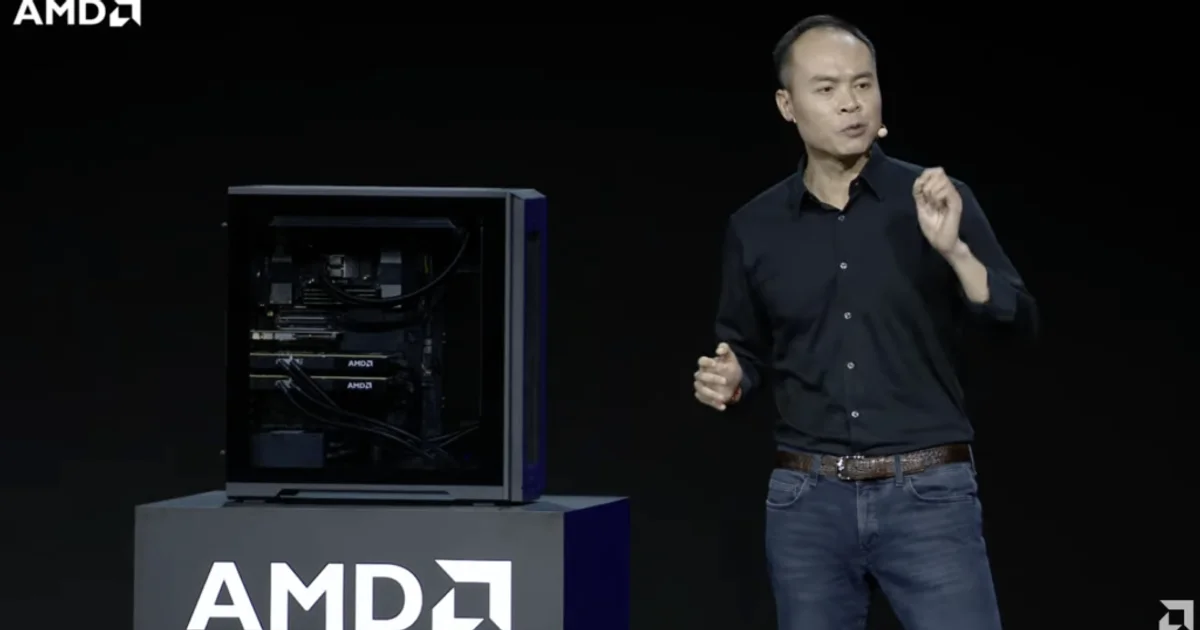
Personal AI starts with local context
Jack Huynh delivered AMD's IFA opening keynote on September 4 under the title “The Era of Personal AI: The Future of Imagination.”
AMD's pitch combines local compute, privacy and personal context.
The company is looking beyond AI applications that simply wait for a question. Agentic systems are expected to understand goals, use context and eventually coordinate actions across multiple tools.
That requires access to considerably more personal information than a basic prompt window.
Local execution reduces one dependency, not every dependency
On-device AI can avoid some round trips to remote infrastructure, improving latency and allowing certain workloads to remain available without a constant cloud connection.
It can also keep more working data on the machine.
That matters once an assistant is dealing with files, projects, schedules or other private context. It does not mean every AMD AI workload will suddenly become offline.
Large models and external services will continue to use remote compute when necessary.
Threadripper Halo Station is the extreme version
AMD's new Halo Station is a liquid-cooled deskside workstation intended for heavyweight local AI development.
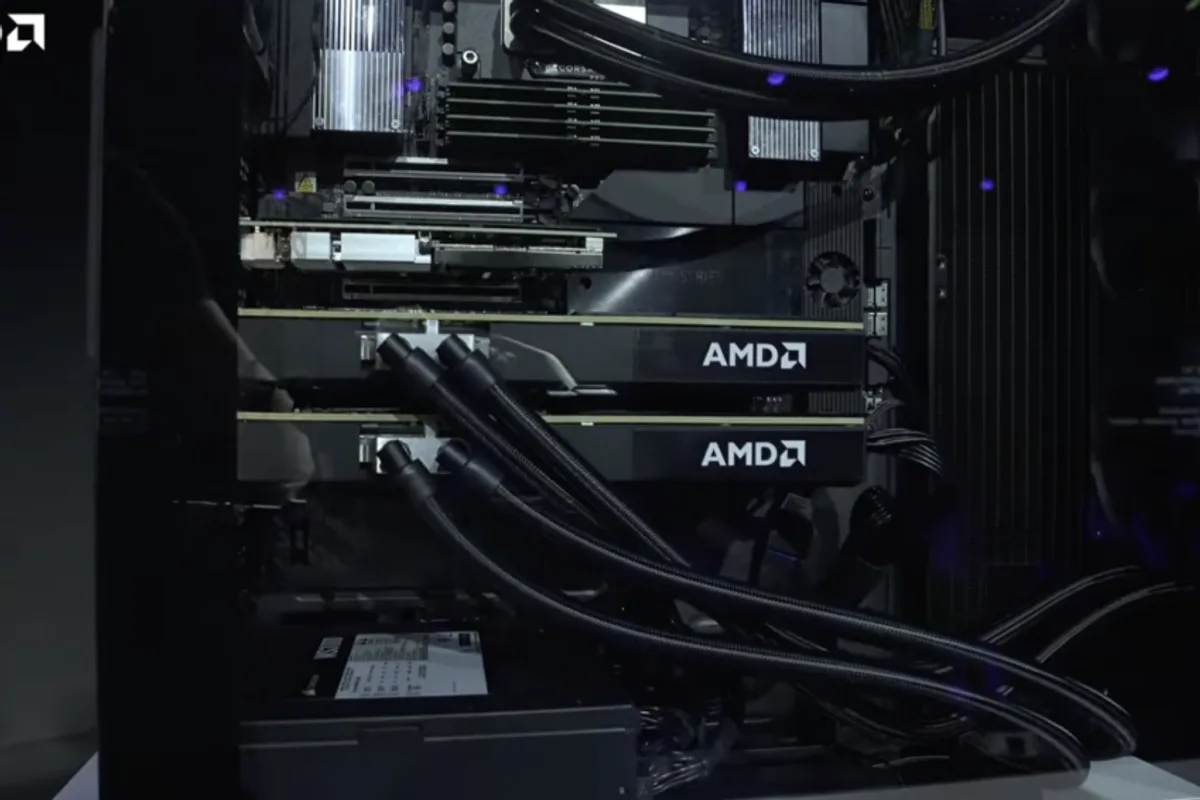
The unit shown at IFA uses a 96-core Threadripper PRO processor and two Instinct MI350P accelerators.
Each MI350P carries 144GB of HBM3E, giving the demonstrated machine 288GB of accelerator memory. AMD also equips the platform with 2TB of system DDR5.
The company says there is a path to four MI350P accelerators. Such a configuration would raise aggregate HBM3E capacity to 576GB.
That four-GPU machine was not the system demonstrated on stage.
One trillion parameters is the headline claim
Huynh says Halo Station is designed to handle AI models with more than one trillion parameters locally.
Memory capacity is central to that argument. Extremely large models need space for their weights before runtime context and intermediate data are added.
AMD has not published performance benchmarks showing how the workstation actually behaves when a model is distributed across multiple PCIe-connected MI350P accelerators.
Its description of Halo Station as the world's most powerful workstation should therefore remain a vendor claim until comparative testing exists.
The demonstrated configuration can already account for 1,550 watts of silicon
A Threadripper PRO 9995WX is rated at up to 350W TDP.
Each MI350P can reach 600W.
That puts the CPU and two accelerators at a combined 1,550W before the rest of the system is considered.
AMD is liquid-cooling both the host processor and accelerator hardware.
Lenovo squeezes the other end of the strategy into 1.6 litres
The ThinkCentre X Ultra makes the Personal AI message look much more like an ordinary desktop product.
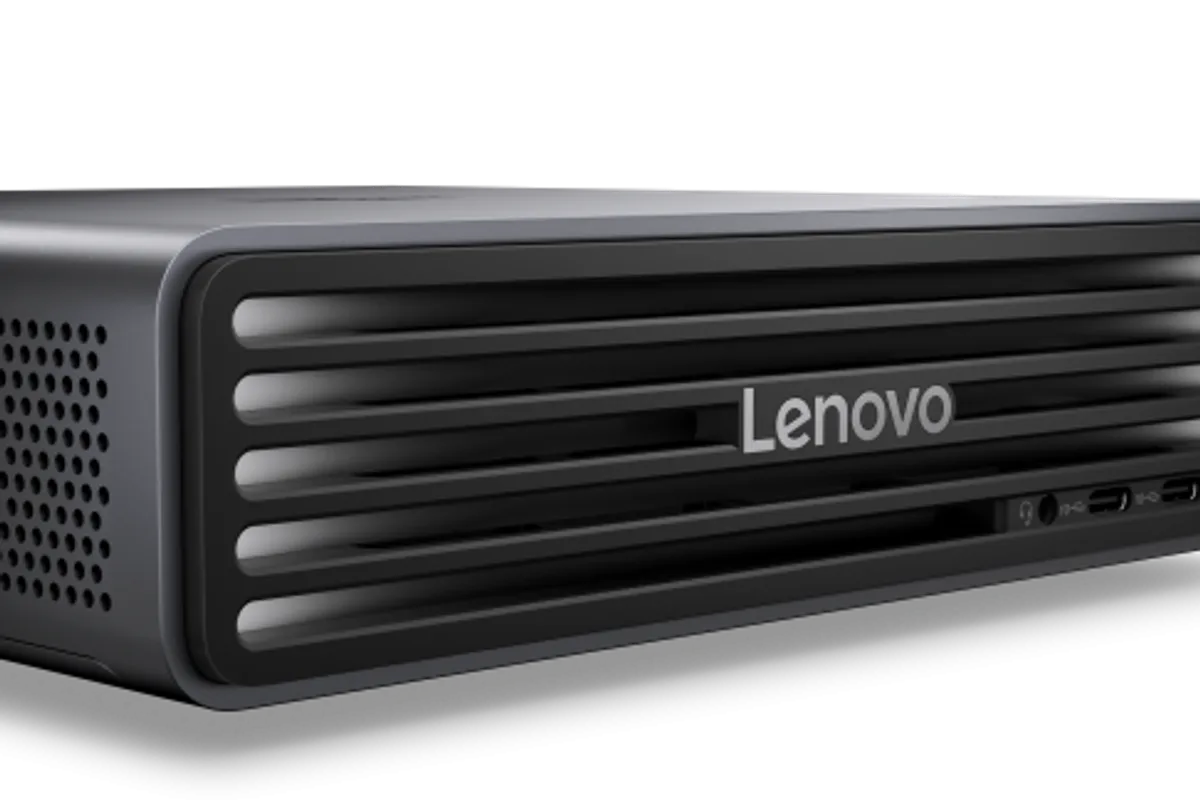
Its chassis measures 183 × 183 × 51mm and starts at 2kg.
Configurations reach an AMD Ryzen AI Max+ PRO 495 and 128GB of unified LPDDR5X memory. Lenovo says as much as 96GB can be allocated to the integrated Radeon 8065S graphics.
The NPU is rated for up to 55 TOPS.
Storage support extends to two M.2 drives with configurations up to 4TB each. Rear connectivity includes two Thunderbolt 4 ports, DisplayPort 2.1, HDMI 2.1 and 10Gb Ethernet.
Four X Ultras can work as a cluster
Lenovo designed the system to connect as many as four units into a larger local AI platform.
The company specifically mentions larger models, longer context windows, concurrent requests and multi-agent workloads.
AMD Ryzen AI Developer Center provides preconfigured tools and workflows across Windows and Linux.
ThinkCentre X Ultra is scheduled for November 2026, starting at €3,100.
The difficult Personal AI questions are not measured in TOPS
A useful contextual agent needs permissions.
It may need to read documents, observe application state or perform actions on a user's behalf. That turns access control, confirmation and data retention into core parts of the experience.
Local compute can reduce how much context leaves the machine. It cannot decide which application should be trusted with that context or what happens when a task moves back to cloud infrastructure.
AMD is using one label for two radically different scales
Lenovo's ThinkCentre X Ultra has a November launch date and a published starting price.
Threadripper Halo Station does not yet have either.
AMD has also not announced when a four-MI350P version might become available.
For now, Personal AI stretches from a 1.6L desktop to a workstation whose CPU and two GPUs alone can account for 1,550W.