
 By Camille
Carbon fibre does much of the weight-saving work
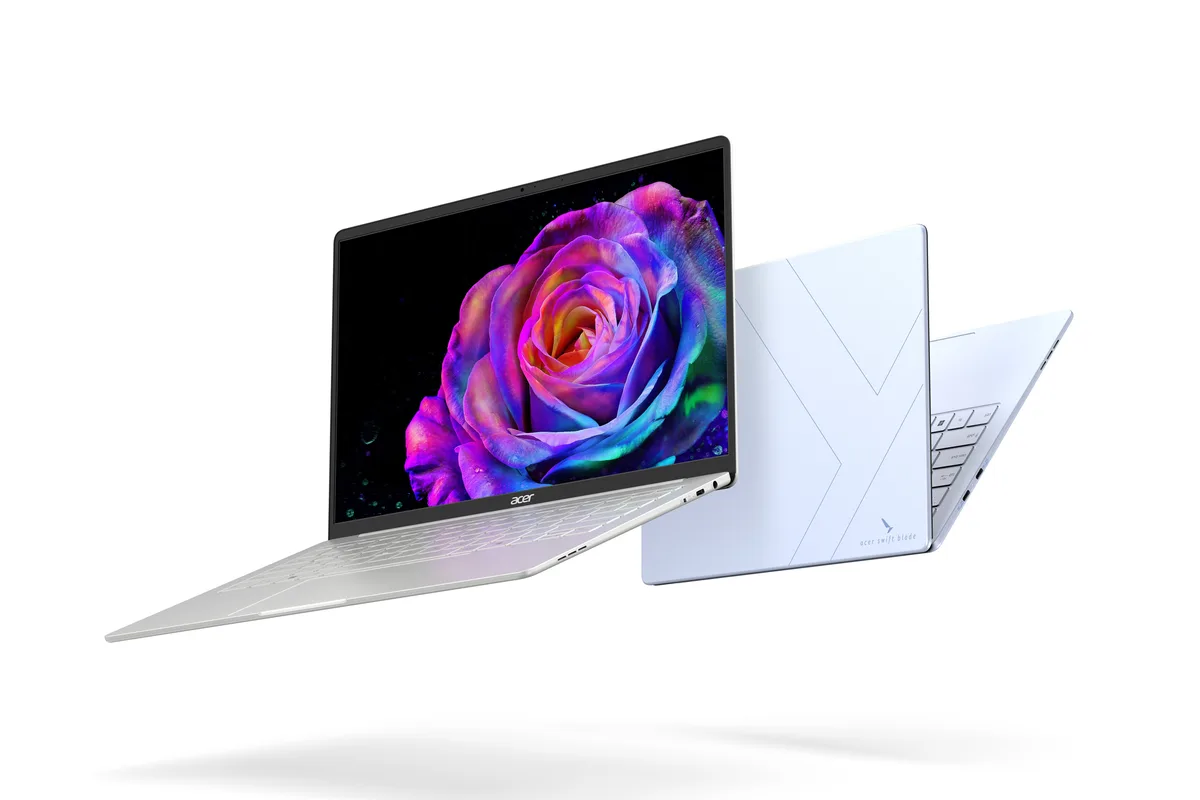
Swift Blade 14 measures 312.5 by 216.8mm and is as thin as 12.9mm, with some OLED configurations listed at up to 13.5mm.
Acer combines a magnesium-aluminium keyboard deck with carbon-fibre top and bottom covers. The result weighs 799g across the published specification.
Marshmallow White and Marshmallow Blue are the two announced finishes.
The best display is a 2880 by 1800 OLED
Acer offers three display configurations.
The highest-end option is a 14-inch 2880 × 1800 OLED running at 90Hz, with 400-nit brightness and claimed 100 percent DCI-P3 coverage.
A second OLED uses 1920 × 1200 at 60Hz and 300 nits while retaining 100 percent DCI-P3 coverage.
The IPS option is also 1920 × 1200 at 60Hz and can include multitouch, although Acer specifies only 45 percent NTSC color coverage for that panel.
Intel Core Series 3 goes up to Core 7 350
Processor choices range from Core 3 304 through Core 5 315 and 320 to the Core 7 350. Graphics are integrated Intel Graphics rather than a discrete GPU.
The memory configuration is much less flexible. Acer specifies 12GB of onboard LPDDR5-6400 system memory.
That amount is perfectly usable for routine productivity, but it is an unusual ceiling for a new premium-looking ultraportable in late 2026. Heavy browser sessions, creative tools and virtualised workloads can consume it quickly.
Because the memory is onboard, buyers cannot solve the limitation later with a conventional RAM upgrade.
Storage reaches 1TB
Acer lists up to a 1TB PCIe Gen4 NVMe SSD.
The launch material does not specify user accessibility or the physical SSD format for every regional configuration, so upgradeability should not be assumed from the capacity alone.
A 2MP Full HD webcam sits above the display, and a physical switch on the chassis can disable the camera.
A 50Wh battery is the other obvious weight trade-off
Swift Blade 14 contains a 50Wh battery with fast-charging support.
Acer has not published a battery-life figure in hours for the new model, making it impossible to turn that capacity into an endurance claim before independent testing.
The 3K OLED configuration is particularly worth watching because higher-resolution OLED panels can impose a very different power load from the lower-resolution IPS option.
The port list is USB-C all the way down
Three USB-C ports are built into the chassis. Two are described as full-function USB 3.2 Gen 1 connections, while the third handles data transfer.
Acer's specification also lists dual Thunderbolt 4, indicating that the two full-function Type-C ports provide the high-speed interfaces.
There is a 3.5mm combination audio jack. There is no USB-A port, HDMI connector or integrated card reader in the published specification.
A thin laptop can live perfectly well with that arrangement, but a dock or adapter becomes part of the travel kit for many existing peripherals.
Connectivity stops at Wi-Fi 6
Wireless networking is Wi-Fi 6 with Bluetooth 5.3.
That is functional rather than cutting-edge for a machine arriving at the end of 2026, when Wi-Fi 7 is already established across higher-end notebooks.
Audio comes from two 2W speakers and dual digital microphones.
December has a launch window but no price
Acer says Swift Blade 14 will go on sale in EMEA during December 2026.
Pricing has not been announced, and exact configurations will vary by market.
Until the price and measured battery life arrive, 799 grams remains both the laptop's strongest argument and the easiest part of its specification to judge.