
 By Kilam
No Man's Sky is ten years old, and it remains difficult to decide which version is technically the strangest.
The same game runs on the original Switch, Switch 2, PSVR2, two console generations and PCs capable of using DLSS 4.
Across all of them, Hello Games maintains a shared procedural universe containing save files that may themselves be nearly a decade old.
Voyagers sometimes looks more like an engine modification than a content update
The Corvette is the clearest example.
It can be assembled from hundreds of modules, contains a real interior, carries multiple players and continues travelling while those occupants move around inside.
Players can leave through an airlock, walk around the exterior hull and return. In atmosphere, they can open the ship and skydive directly toward the planet.
That requires the engine to handle a moving vehicle, an interior space, multiple players, their interactions and the exterior universe at the same time.
Even the windows required new rendering technology
Voyagers introduced moment-based order-independent transparency, or MBOIT.
The technique improves overlapping translucent surfaces, which suddenly matters enormously when players spend time looking through the numerous windows of a custom Corvette.
Cockpits, aquariums, base glass and other transparent materials also benefit.
It is exactly the sort of rendering improvement that would have seemed relatively minor in 2016 and becomes important only because another new system changed how players occupy the world.
PC keeps absorbing technologies much younger than the game
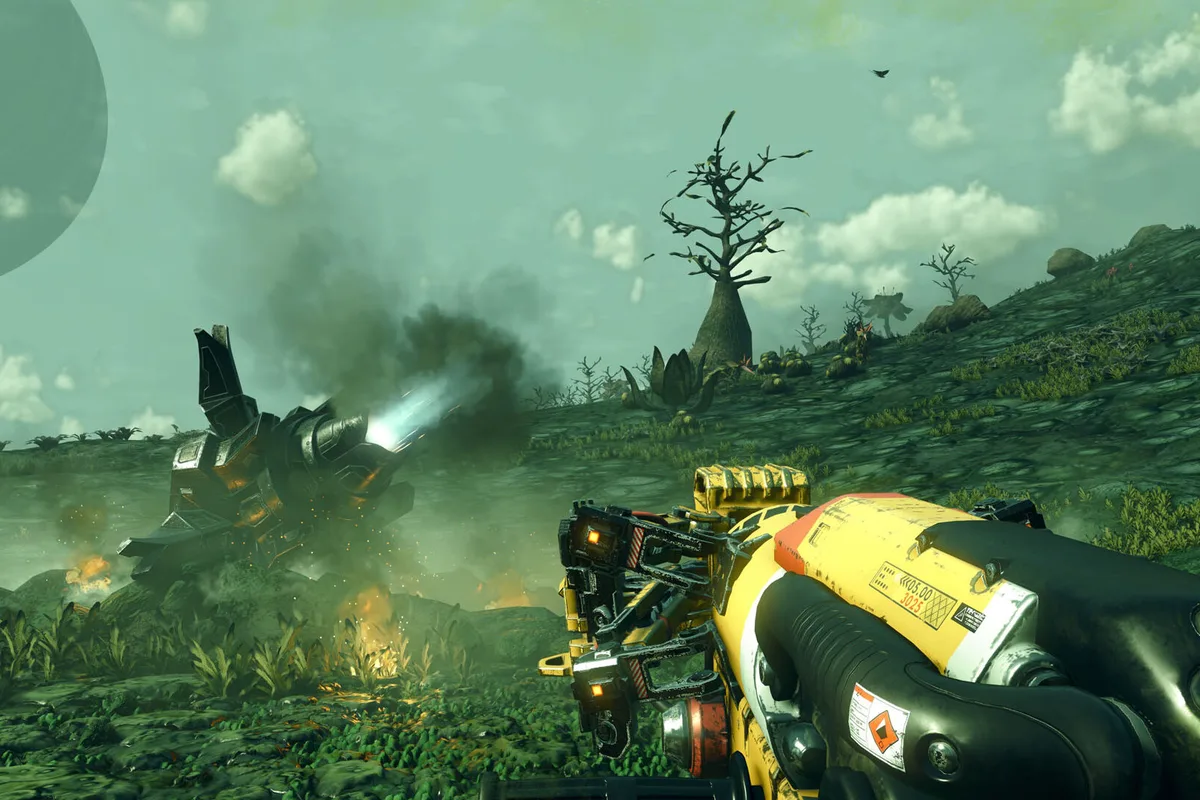
Voyagers also added DLSS 4 for compatible NVIDIA RTX hardware.
Hello Games promotes the option as a way to improve both performance and image quality, with particular value in VR where rendering cost remains high.
A renderer first shipped in 2016 therefore continues to integrate reconstruction technology designed almost a decade later.
That modernization is impressive without eliminating every old behavior. Object streaming, pop-in and performance variation remain visible depending on planet and hardware.
PSVR2 now benefits from PSSR too
Voyagers brought PlayStation Spectral Super Resolution to the PSVR2 version.
Reconstruction is particularly useful in VR because the hardware must produce two high-frequency views while preserving enough clarity for distant environmental detail.
No Man's Sky increasingly resembles a continuously modernized technical platform rather than a frozen 2016 release.
Switch 2 may be the cleanest summary of the optimization work
Nintendo Life described the Switch 2 edition as No Man's Sky without the cuts and exclusions that defined the original Switch port.
Multiplayer, absent from Switch 1, returns on the newer machine.
The port also offers substantially stronger image quality and broader rendering options. It finally feels close enough to the main console versions that portability no longer requires accepting a fundamentally diminished feature set.
It cannot match the strongest platforms in every detail. What matters is that the same underlying universe and systems still function.
The Swarm stresses the engine in a very different way
Update 6.4 does not merely add one giant object.
The Hive of Glass surrounds itself with swarms of small fighters while allied ships and other players can occupy the same battle.
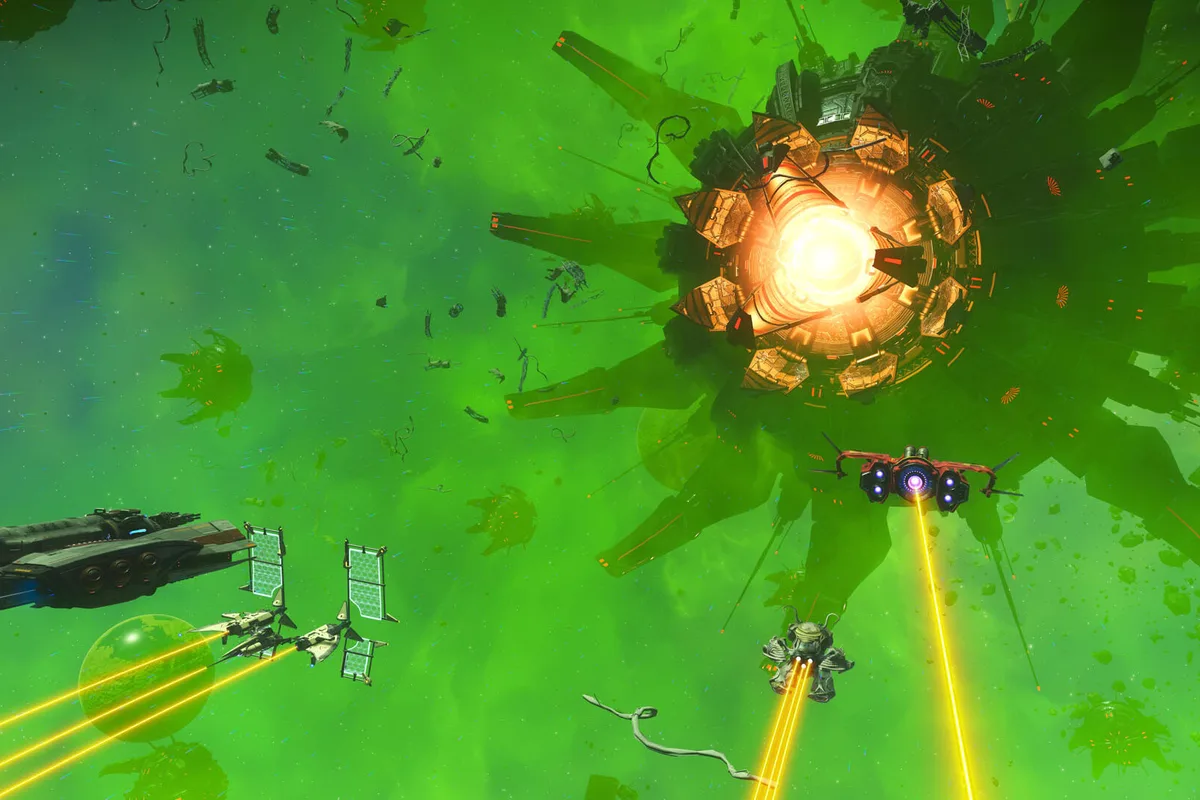
Hello Games calls these the largest space battles yet built for No Man's Sky.
The increase in scale is obvious. Flight paths, weapons and ships can fill the space surrounding a structure that dominates the entire scene.
That complexity also helps explain why subsequent patches continued addressing networking, animation, crashes, models and multiplayer synchronization.
The patch history exposes the cost of continuous ambition
The Swarm was quickly followed by versions 6.41, 6.42, 6.43, 6.44, 6.45 and 6.45.1.
Fixes included network crashes, model-streaming problems, Hive interactions, multiplayer behavior and even a bug capable of making freighters disappear.
This rhythm has become familiar after major No Man's Sky updates.
It demonstrates both Hello Games' responsiveness and how difficult it is to keep grafting new systems onto an increasingly complicated foundation.
The Worlds updates changed what procedural generation has to render
Recent planetary overhauls increased terrain variety, biome density, oceans, clouds and atmospheric effects.
Modern No Man's Sky is visually far denser than its launch version.
Streaming remains one of the visible costs. Vegetation and environmental detail can still appear relatively close to the player, especially on weaker hardware.
The engine can now draw much more. It cannot always hide when those objects arrive.
The interface may be the part that carries ten years most visibly
No Man's Sky has repeatedly redesigned its menus, but accumulating resources, technologies and systems inevitably created density.
Inventory management, construction, blueprints and specialized catalogues work, yet often reveal the historical layering underneath.
The game became more powerful faster than it became simple.
The technical achievement is no longer the theoretical planet count
In 2016, the headline number was the size of the procedural universe.
In 2026, the more interesting achievement is continuity.
An old save can visit a completely reworked planet, board a hand-built multi-crew ship, use a physics tool introduced this year, enter a giant space battle and then be opened on another platform through cross-save.
All of it runs on infrastructure whose public life began ten years ago.
Cosmos has been announced as the next major update, but Hello Games has not yet detailed its features. Until it arrives, The Swarm 6.45.1 remains the current frontier of an engine that seems determined to postpone its own obsolescence one update at a time.