
 By Adri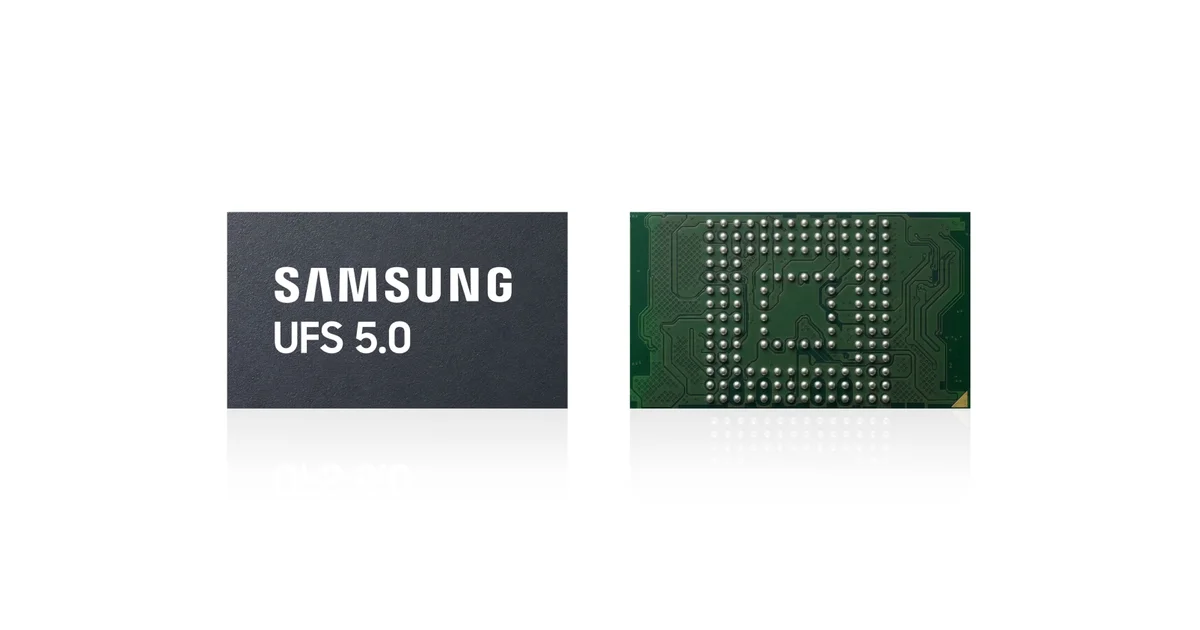
Smartphone storage performance used to have a fairly simple job description. Faster flash meant quicker app launches, game loading and large-file transfers.
On-device AI complicates that model. Samsung's first UFS 5.0 device reaches up to 10.8GB/s sequential read speed and 9.5GB/s sequential write speed, with mass production scheduled for the fourth quarter of 2026.
Capacities are planned up to 1TB.
The random-read number may matter more than the headline bandwidth
Samsung says sequential performance is more than twice that of its UFS 4.1 generation. That is useful for moving large contiguous files, recording heavy camera workloads and loading large game assets.
Its UFS 5.0 documentation also claims as much as five times higher random-read performance than UFS 4.1.
That number is particularly relevant to AI workloads. Model files, caches, retrieval databases and multimodal assets do not always behave like one enormous sequential movie file being read from start to finish.
Large numbers of small and scattered accesses can make latency and random performance more important than peak throughput alone.
UFS 5.0 changes the link as well as the flash
The standard is built around UniPro 3.0 and M-PHY 6.0, with Samsung highlighting optimized PAM4 signalling and a more efficient protocol architecture.
PAM4 encodes more information per symbol than conventional binary signalling, increasing the amount of data that can move through the physical link without simply relying on the old interface running faster in the same way.
That comes with tighter signal-integrity requirements. UFS 5.0 therefore is not just faster NAND packaged under a new label; the transport layer itself has evolved.
10.8GB/s does not mean twice the LLM inference speed
Storage bandwidth is not a direct tokens-per-second metric.
Once model weights reside in system memory, inference performance is dominated by the NPU, GPU or CPU, memory bandwidth, caches and the software stack coordinating those resources.
UFS matters when models are initially loaded, when working sets exceed available RAM, when large external data sources are consulted or when a device switches between several local models.
That last case could become increasingly relevant on memory-constrained devices. Faster storage gives software more freedom to keep some assets outside expensive LPDDR until they are actually needed.
Moving the data efficiently matters on battery power
Doubling bandwidth while doubling energy use would be a poor mobile trade.
Samsung claims more than a 40% improvement in power efficiency compared with its UFS 4.1 solution. Clock gating and multi-voltage techniques are among the changes the company identifies.
This should not be read as a blanket claim that the component always consumes 40% less power. Samsung's comparison concerns efficiency while moving equivalent amounts of data.
That distinction still matters. Data movement consumes energy, and local AI already puts sustained pressure on compute blocks, memory and thermal limits.
The package gets smaller at the same time
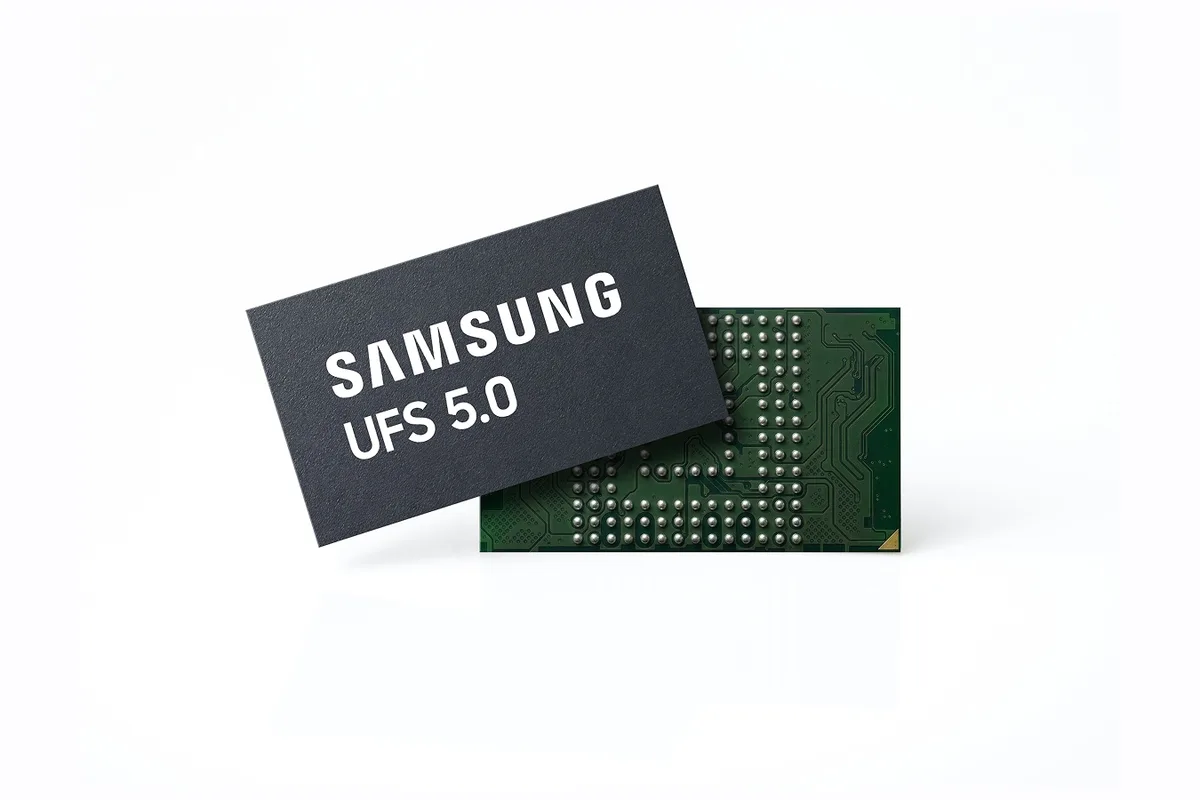
Samsung packages its UFS 5.0 solution in a 7.5mm by 13mm by 0.9mm footprint, which it says is 16.7% smaller than the previous design.
A few saved square millimetres sound trivial until every component is competing for space on a smartphone motherboard. The freed area can contribute to battery volume, cooling or simply easier device integration.
Samsung is targeting smartphones, wearables and XR devices rather than treating UFS 5.0 as a phone-only technology.
Mobile AI is becoming a memory hierarchy problem
The industry initially sold on-device AI through NPU TOPS. Then RAM capacity and bandwidth became central because larger models needed somewhere to live.
Storage is the next obvious layer.
Data moves from NAND through the UFS interface into LPDDR, caches and finally the compute engines. If only the last stage becomes dramatically faster, an earlier stage eventually becomes the bottleneck.
UFS 5.0 does not perform the AI computation. Its role is to feed the rest of the system with less latency and less energy.
Mass production is scheduled for Q4 2026
Samsung says mass production will begin in the fourth quarter of 2026, with its current product information listing 512GB and 1TB capacities.
The company has not officially named the first commercial smartphone that will use its implementation. Rumours about future Galaxy devices therefore remain separate from Samsung's confirmed UFS announcement.
What is confirmed is already substantial: 10.8GB/s sequential reads, 9.5GB/s writes, far stronger random-read performance and improved energy efficiency in a smaller package. Smartphone storage is no longer just the place where an AI model sits when it is not running.