
 By Camille
Sony has officially brought the WH-1000XM4 platform back under a new name: WH-1000XM4C.
The headphones are available from September 2026 in Black, Platinum Silver and Lavender, priced at roughly €250 in Europe.
The model name is revealing.
Sony is not presenting XM4C as the next generational step after XM6. It is explicitly based on the old WH-1000XM4 and retains the broad design philosophy that made that headset popular.
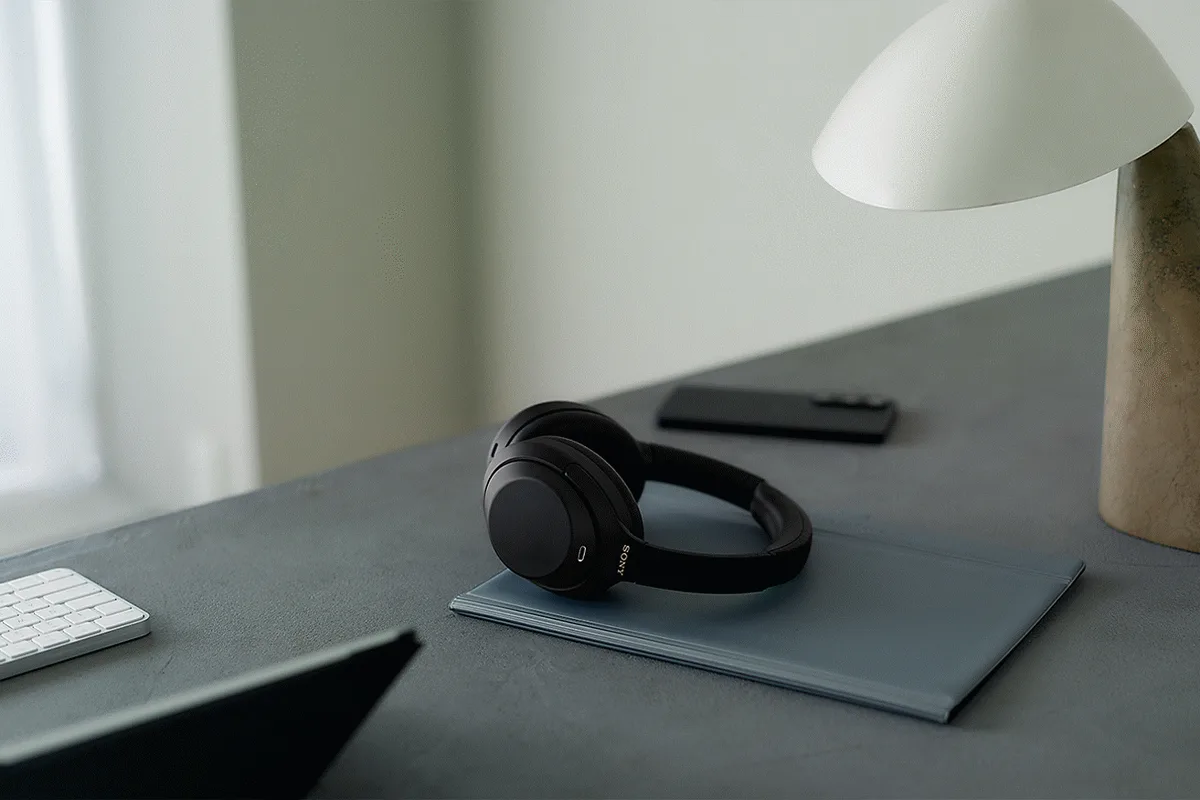
Sony is keeping the folding design that later generations moved away from
WH-1000XM4C uses a lightweight folding chassis weighing approximately 253 grams.
It can collapse into its supplied carrying case, preserving one of the practical characteristics associated with the original XM4 platform.
That decision is notable because Sony is not pretending the older mechanical design became obsolete.
It is actively reintroducing it as a useful feature.

For headphones designed around commuting and travel, the amount of space they occupy inside a bag can matter more than another small specification improvement.
The most important announced change is the sound tuning
Sony says WH-1000XM4C has been retuned for contemporary listening preferences.
The company does not describe a completely new driver architecture. The headset still uses 40mm dynamic drivers.
The update is therefore primarily acoustic and software-driven rather than an entirely new mechanical platform.
That distinction matters because tuning can substantially change how a familiar headphone sounds without requiring a new transducer.
Independent measurements will still be needed to show exactly how its frequency response differs from the original XM4.
The equalizer expands to ten bands
WH-1000XM4C also gains a 10-band equalizer through the Sony Sound Connect app.
That gives users considerably finer control over tonal balance than a small number of broad adjustment bands.
Specific areas of bass, mids and treble can be changed without shifting such a large section of the spectrum at once.
That is particularly useful on a product Sony is positioning around flexibility rather than one supposedly perfect fixed tuning.
Sony is even distributing an artist-specific EQ profile
In Germany and Austria, Sony is extending that idea through a collaboration with Apache 207.
The artist worked with Sony on a dedicated WH-1000XM4C sound profile, including a characteristically bass-forward tuning.
The preset is scheduled to appear in Sony Sound Connect during autumn 2026 in supported markets.
The technically interesting part is not the artist endorsement itself.
It is the idea that headphones can now receive downloadable sound profiles almost like cameras receive creative presets.
Part of a product's sonic character can continue changing after purchase.
LDAC and DSEE Extreme remain part of the package
Sony has not stripped away the core audio technologies associated with the old flagship tier.
Supported Bluetooth formats include SBC, AAC and LDAC.
With a compatible source, LDAC supports high-resolution transmission up to 96kHz with a maximum bitrate of 990kbps.
DSEE Extreme also remains available for Sony's processing of compressed audio.
The headphones retain a stereo mini-jack input and can operate passively over a cable.
That remains useful in 2026 because a phone, PC and wired source can still offer very different Bluetooth capabilities.
Bluetooth 6.0 arrives inside hardware that still visually belongs to 2020
Sony's current specification sheet lists Bluetooth 6.0.
It is perhaps the clearest example of what XM4C actually is: an older physical concept with selected electronics brought forward.
Multipoint remains supported for two simultaneous devices.
A user can keep the headset paired with a laptop and phone at the same time and switch audio between them without repeating the entire pairing process.
That functionality is no longer exotic at the premium end of the market, but it remains more useful every day than many rarely used sound modes.
Noise cancelling remains the product's central purpose
Sony continues to position XM4C as a 1000X-series active-noise-cancelling headset.
Personal NC Optimizer, Ambient Sound and Quick Attention remain part of the feature set.
Sony does not present the implementation as equivalent to every improvement found on the current WH-1000XM6.
The hierarchy is deliberate: XM4C brings back the XM4 platform rather than transplanting every piece of current flagship hardware into an older shell.
Its actual isolation performance against newer Sony and Bose designs will therefore require controlled comparative testing.
Twenty-seven hours with ANC is useful, but no longer remarkable
Sony rates the headset for up to 27 hours of continuous music playback with noise cancelling enabled.
Turning ANC off extends that figure to as much as 34 hours.
Charging takes approximately three hours.
Those numbers are easily sufficient for long flights and several days of ordinary use.
They are no longer class-leading, however.
Less expensive headphones increasingly reach 40 or 50 hours, sometimes while keeping ANC active.
Battery life is therefore not the main reason for XM4C to exist.
That is exactly what makes bringing XM4 back interesting
Sony is not trying to win every column in a specification comparison.
WH-1000XM4C instead combines a known formula: folding construction, manageable weight, ANC, LDAC, Multipoint, app-based tuning and a lower price than the flagship.
The result looks more like a mature product than a technology demonstration.
That is unusual in an industry that often prefers a completely new enclosure simply to make a new model number look justified.
Sony is doing almost the reverse: reuse a design whose development cost has already been absorbed, then modernize the areas where software and connectivity have moved most.
At €250, XM4C may create more confusion for discounted XM5 stock than for XM6
The pricing creates an unusual middle position.
WH-1000XM6 remains Sony's current premium flagship, while WH-CH730N sits much lower around €120.
XM4C lands directly between them.
That gives Sony an option for customers who want the 1000X family without paying flagship pricing.
It may also make discounted older XM5 units harder to evaluate.
Retail promotions can occasionally push a previous flagship surprisingly close to the price of a newly launched XM4C.
At that point, marketing hierarchy matters less than comfort, ANC performance, battery life and whether the buyer prefers the folding design.
Lavender also shows this is not simply old inventory being cleared
A product brought back only to empty warehouses could have quietly returned in black and silver.
Sony has instead added Lavender, launched dedicated campaigns and attached regional collaborations.
WH-1000XM4C is therefore being treated as a proper current catalog product.
That is important context.
Sony is not merely shipping a few remaining XM4 units to European retailers. It is deliberately building a second commercial life around an old platform.
The real question is whether mature and proven can beat newer and more expensive
Wireless headphones are now a mature category where every generation does not necessarily produce a revolution.
A few more decibels of noise cancellation, another processor or a redesigned hinge can be useful without suddenly making the previous model unusable.
WH-1000XM4C exploits that maturity.
Sony takes a platform that had already reached a high baseline, revises its tuning, updates the software experience and sells it below the latest flagship.
That does not automatically make it the best €250 headset.
Its battery life is no longer exceptional, and its noise cancellation needs to be measured against much newer competitors.
But Sony is testing a fairly unusual idea: once a category matures, a proven older design with sensible updates may make more sense than inventing an artificially stripped-down new one.