
 By Adri
Solana already produces blocks quickly. Finalizing them is a different problem.
Under TowerBFT, validator votes accumulate over 32 slots before a block reaches full finality, which the Solana Foundation describes as roughly 12.8 seconds. Alpenglow targets about 150 milliseconds.
That number refers to finality, not slot duration. Solana's separate reduced-slot-time work is intended to move slots from 400ms toward 200ms.
Votor removes vote transactions from blocks
The first Alpenglow component shipping with Agave 4.3 is Votor, a replacement for the current voting path.
Instead of encoding validator votes as ordinary onchain transactions, validators communicate votes directly and aggregate them into certificates. Depending on stake participation, a block can reach finality in one or two rounds.
That immediately changes how network activity is measured. Vote transactions disappear from blocks, meaning dashboards that count every ledger transaction as economic activity will show a large decline even when user demand has not changed.
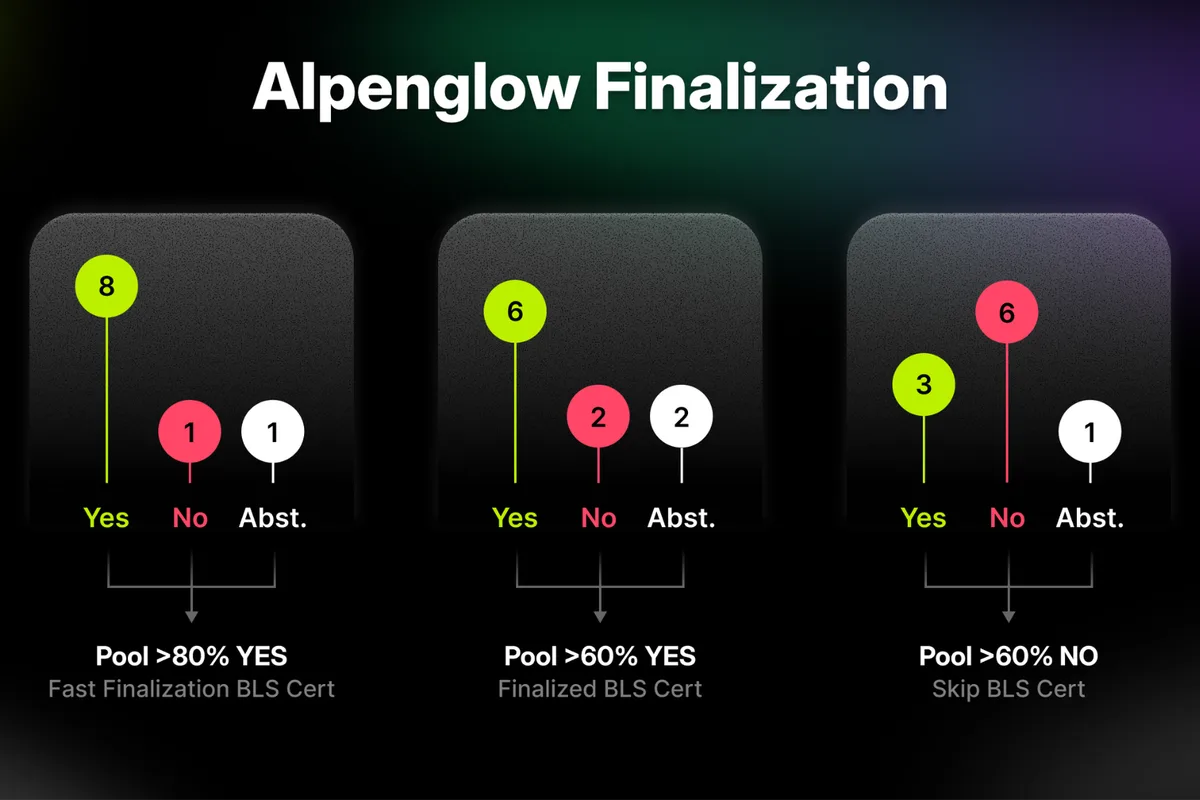
Alpenglow is designed around what Solana calls a 20+20 model: consensus should remain live under its specified assumptions with up to 20% adversarial stake and another 20% offline.
Execution stays where it is
Alpenglow does not replace the SVM, transaction format, accounts, programs or fee mechanics. The upgrade sits below those layers.
What changes is how validators decide which block wins and when that decision becomes irreversible.
Rotor, the second major Alpenglow component, is planned later. It is intended to replace Turbine's tree-style block propagation with a single relay layer designed around lower network latency. Solana has not yet scheduled that phase.
One slot can no longer be treated as one bank
Ordinary applications that only send transactions should require little migration work. Infrastructure providers have a more substantial change ahead.
Agave 4.3 introduces bank_id into Geyser and gRPC events. As Alpenglow evolves, multiple candidate banks can exist for the same slot before one becomes canonical.
Indexers therefore need to buffer data by both slot and bank_id rather than assuming slot alone uniquely identifies the state being streamed.
There is another catch. bank_id is local to a node, so redundant feeds from several providers cannot be reconciled by comparing that value. Solana instructs infrastructure operators to reconcile streams using the blockhash instead.
Confirmed and finalized eventually collapse into one state
Alpenglow also changes commitment semantics.
Once the new consensus is live, confirmed and finalized are intended to become equivalent, with confirmed removed in a later release. Solana explicitly warns developers not to switch too early, because finalized under TowerBFT still carries the current multi-second wait.
Applications with retries, timeouts or payment UX tuned around 12.8-second finality will need to detect the actual cluster migration rather than assume a calendar date means Alpenglow is active.
Agave 4.3 is also moving expensive cryptography into native code
The consensus work shares the roadmap with another protocol-level change: native elliptic-curve operations for BN254 G2 and BLS12-381.
Programs currently have to implement unsupported curve operations in BPF. That approach consumes substantial compute budget because validator-native optimized code is not available to the program.
SIMD-0302 extends Solana's existing BN254 support with G2 addition, subtraction and scalar multiplication. The Foundation estimates these native operations can use roughly 10 to 20 times fewer compute units than pure-BPF implementations.
That matters for batch Groth16 verification, KZG polynomial commitments and other proof systems that need direct G2 arithmetic.
BLS12-381 opens another cryptographic path
SIMD-0388 adds a broader family of BLS12-381 syscalls covering G1 and G2 operations, point validation, pairings and decompression.
BLS12-381 is a modern pairing-friendly curve with roughly 128-bit security and is widely used in contemporary cryptographic systems. Making those operations native lets protocols use them without spending a large part of their transaction compute budget on basic curve arithmetic.
For zero-knowledge applications, bridges and BLS-based constructions, that can matter as much as increasing block capacity. A primitive that is technically possible but prohibitively expensive is often not useful in production.
The 150ms number is only one part of the upgrade
It is easy to reduce Alpenglow to a before-and-after latency comparison: approximately 12.8 seconds versus a 150ms target.
The more consequential shift is structural. Votes leave ordinary transactions, certificates become part of consensus, streaming infrastructure gains multiple candidate banks, and the runtime gets cryptographic operations aimed directly at modern ZK systems.
Solana's current upgrade page lists Agave 4.3 for October 2026. Alpenglow and the new cryptography schemes are still marked as in development, so 150ms remains a protocol target until the mainnet migration is actually activated and measured under production conditions.