 By Tsuky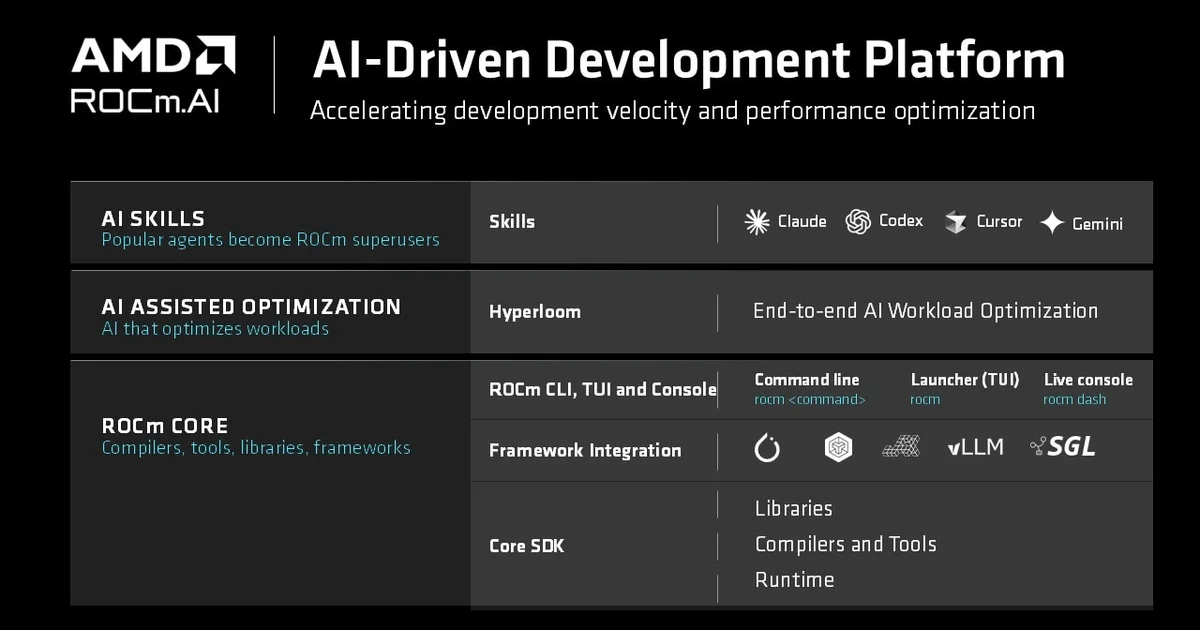
AMD released ROCm 10 on August 27, ten years after the first version of its open GPU-compute software stack.
The headline addition is ROCm.AI, which AMD now describes as generally available.
It is an AI-native development layer intended to help users build, operate, diagnose and optimize workloads running on AMD hardware.
Instead of adding only another library or compiler feature, AMD is putting agentic workflows around the rest of the software stack.
ROCm.AI is built from three distinct pieces
AMD groups Hyperloom, AMD Skills and the ROCm CLI under the ROCm.AI name.
They solve different parts of the development problem.
Hyperloom focuses on autonomous workload optimization.
AMD Skills supplies tested AMD-specific workflows to existing coding agents.
ROCm CLI provides a common way to install, manage and operate environments.
The shared goal is to reduce how many individual ROCm tools and procedures a developer needs to understand manually.
Hyperloom tries to find the performance bottleneck itself
Hyperloom is the most ambitious component.
AMD describes it as an autonomous agentic system for optimizing end-to-end inference workloads across both host code and GPU kernels.
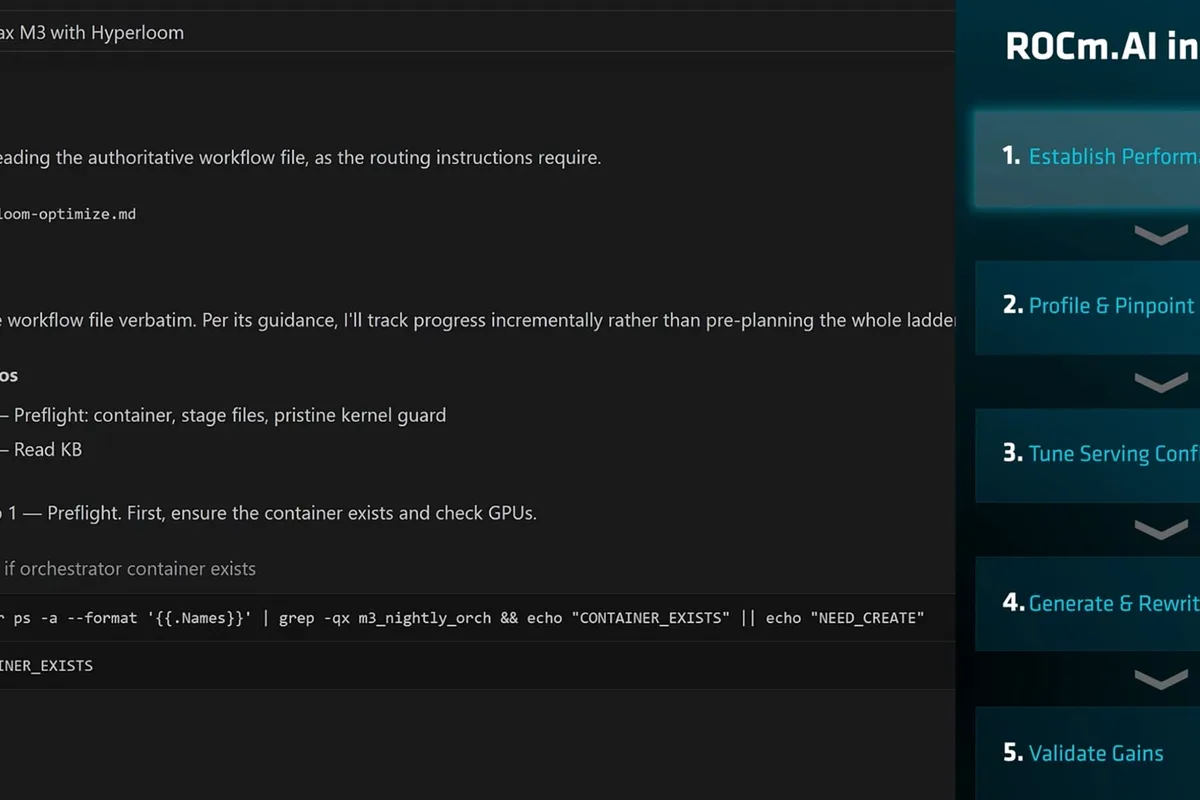
It profiles the workload, identifies bottlenecks, explores possible optimizations, implements changes, benchmarks them and validates both performance and correctness.
Its documentation describes an iterative Think, Decide, Implement and Benchmark loop.
That distinction matters because the agent is not simply producing optimization suggestions in a chat window.
It can change the workload and measure whether the change actually helped.
The optimizer can work across HIP, Triton and FlyDSL
With ROCm 10, Hyperloom supports inference environments including vLLM and SGLang.
Optimization can target HIP, Triton and FlyDSL code.
The system also generates reports describing proposed modifications and measured or expected performance improvements.
Developers can run Hyperloom as a standalone workflow or invoke it through AMD Skills.
AMD's own documentation includes a workflow for launching Hyperloom directly from Claude Code.
The target is the entire serving path, not just one kernel
A slow model is not necessarily held back by one mathematical kernel.
Memory management, request scheduling, CPU-side code and the inference engine itself can all leave expensive accelerators underutilized.
Hyperloom therefore analyzes the workload end to end.
Its profiling pipeline includes TraceLens, which consumes execution traces and derives bottlenecks and performance targets that guide the optimization search.
The agent can then explore several branches rather than assuming its first idea is correct.
Quantization can become part of the optimization process
Hyperloom's documentation also includes optional integration with AMD Quark.
Developers can request quantization before the main optimization loop begins.
Documented structured schemes include FP8, PTPC FP8, MXFP4 and MXFP4 with FP8.
The MXFP4 options are limited to MI355X in the current implementation.
If the requested scheme is unsupported on the selected GPU, Hyperloom can skip quantization and continue optimizing the unquantized model.
AMD Skills puts vendor knowledge inside coding agents
AMD Skills tackles a different friction point.
It packages AMD-specific guidance and validated workflows for coding agents including Claude Code, Cursor and Codex.
The idea is to reduce cases where a general-purpose agent guesses at a ROCm command or overlooks a hardware-specific procedure.
AMD currently divides the catalog into client-native, cross-stack and server-native workflows.
Those cover areas ranging from local AI integration to diagnostics, replay analysis, serving, profiling and performance analysis on Instinct GPUs and EPYC processors.
The Skills are already being distributed through multiple agent ecosystems
Skills previewed at Advancing AI 2026 are now available through Claude Code, Codex and Cursor marketplaces as well as an open GitHub catalog.
AMD says each shipped Skill undergoes structural and behavioral testing.
That does not guarantee that an agent will always make the right optimization decision.
It provides a tested procedural starting point instead of requiring the model to reconstruct an AMD workflow from fragmented documentation.
ROCm CLI attempts to hide some version-management complexity
The ROCm CLI focuses more on environment operations.
A single interface can inspect systems, install and manage ROCm environments, serve models, run diagnostics, update components and control runtimes.
The same workflow can be used manually, through an AI coding agent or in continuous integration.
The CLI is distributed as a prebuilt binary for Windows and Linux and does not require an existing ROCm installation.
It can also maintain multiple runtime environments side by side, activate them and perform rollback.
But ROCm CLI itself is still a Technology Preview
There is an important maturity distinction inside AMD's announcement.
ROCm.AI as a broader experience is described as generally available.
ROCm CLI is still explicitly labeled a Technology Preview.
AMD says its version-agnostic experience currently begins with ROCm 7.13 and that official ROCm 10 support is coming soon.
General availability for the umbrella platform therefore should not be read as every individual component reaching identical production maturity.
The console can monitor tokens per watt
ROCm CLI also contains ROCm Console, previously known as dash.
It provides real-time information about runtime health, model serving, GPU utilization and benchmark telemetry.
On supported Instinct systems, AMD lists HBM usage, power consumption and tokens per watt among the available metrics.
That last figure reflects how AI infrastructure is increasingly evaluated.
For a large operator, throughput alone matters less if obtaining it requires disproportionate power and operating cost.
AMD claims an average 3.3x inference uplift
The most dramatic performance figure in the announcement is a claimed average 3.3x improvement in inference.
AMD also cites a 2.4x training improvement.
The company attributes those gains to optimized kernels, memory management, parallelism and scheduling.
Those numbers need their methodology attached to them.
This is not a simple ROCm 10 versus ROCm 7 benchmark
For the inference result, AMD used a system with eight Instinct MI355X GPUs.
The comparison pits ROCm 7.0 against a preview ROCm.AI configuration based on ROCm 7.2.2 with additional optimized kernels, parallelism and scheduling changes.
The workloads were GLM-5, Kimi-K2.5 and DeepSeek-R1-0528.
The published 3.3x result is a combined average of tokens-per-second throughput across those three models.
It is therefore not a universal multiplier obtained merely by installing ROCm 10.
The 2.4x training figure is similarly workload-specific
AMD again used an eight-GPU MI355X platform for its training measurements.
The tests used Megatron-LM with DeepSeek-V2-Lite, DeepSeek-V3-16B and Qwen3-30B-A3B.
The published result is another combined throughput average across specifically optimized configurations.
AMD itself notes that real performance varies with system configuration, software versions and the optimizations being used.
The results are best read as evidence of the performance AMD believes its software work can recover rather than a guaranteed 2.4x or 3.3x upgrade for every customer.
That software gap is exactly what AMD has to attack
Nvidia's AI position is not built on GPU specifications alone.
CUDA, mature libraries, profiling tools and years of developer familiarity create a major barrier for competing hardware.
A fast Instinct accelerator is less useful if teams need substantially more engineering time to port and tune their applications.
ROCm.AI effectively tries to use AI itself to absorb some of that ecosystem complexity.
ROCm 10 also changes the foundation underneath the agents
The agentic tools are only part of the release.
ROCm 10 continues AMD's move toward a more modular ROCm Core SDK.
TheRock, AMD's open automated build and release system that reached production with ROCm 7.14, now underpins the broader release process.
Nightly builds, release candidates and stable GA releases publish artifacts in a standardized format.
AMD says this simplifies repositories, provisioning scripts, container builds and air-gapped mirrors.
ROCm is trying to reduce how much developers need to know about ROCm
For years, much of the AMD versus Nvidia software discussion centered on compatibility.
Does a framework run on ROCm? Is there a HIP implementation? Does this model serve correctly?
ROCm 10 adds another strategy.
AMD is betting that some of the remaining complexity can be absorbed by tools capable of setting up environments, retrieving vendor-specific procedures, profiling workloads and trying several optimizations automatically.
That does not erase a decade of ecosystem advantage for Nvidia.
But if Hyperloom and the surrounding tools work as intended, some of the expertise developers previously had to acquire manually can become executable automation.
ROCm 10's central idea is therefore almost circular: AMD is using AI to make its GPUs easier to use for AI.