
 By Tsuky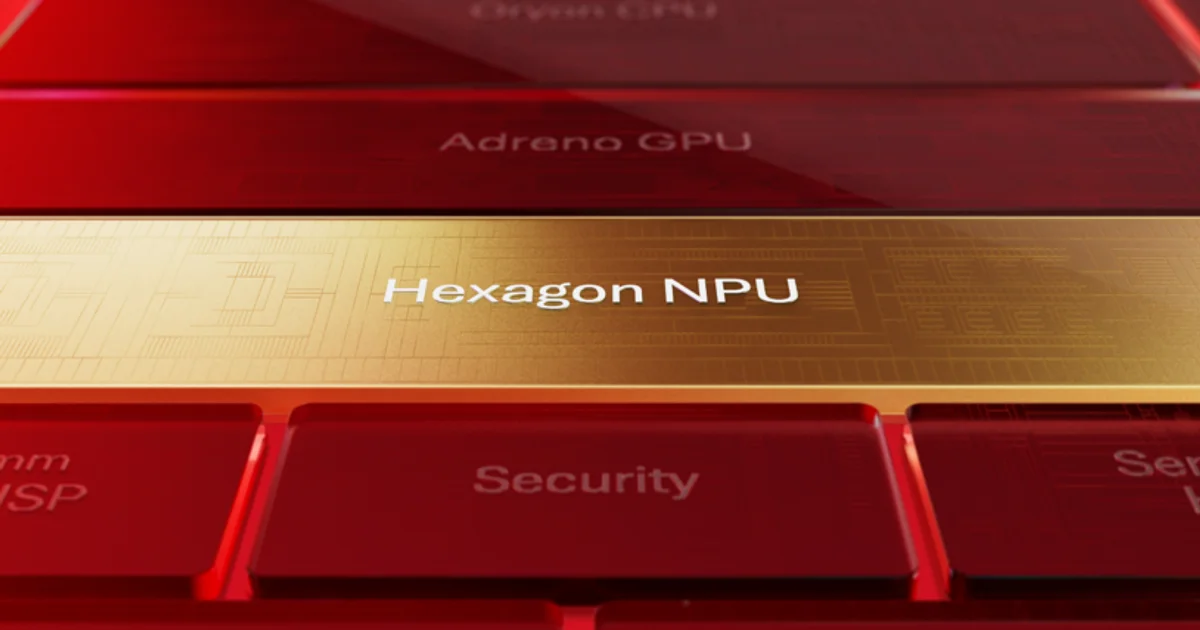
Qualcomm revealed the first architectural details of its next-generation Hexagon NPU on September 10.
The NPU will appear inside the company's next premium mobile platform, whose complete commercial details are being saved for Snapdragon Summit 2026.
Qualcomm is already being unusually clear about the workload it wants to optimize: persistent, on-device AI agents.
Two changes sit at the center of that strategy. A new Element Accelerator joins the NPU's vector, matrix and scalar capabilities, while large shared memory capacity increases by 50 percent.
An AI agent is a very different workload from answering one prompt
The word agent is being attached to almost every AI product in 2026, but the hardware problem underneath it is concrete.
A conventional assistant can receive a request, generate an answer and then wait. A more ambitious agent has to maintain context, determine which steps are required, select tools, possibly understand audio or images, perform an action and then reason about the result.
Some of that work can happen concurrently.
Qualcomm therefore describes the new NPU around always-running intelligence, long-context reasoning, multimodal models, concurrent agents and low-latency action loops.
The phone is no longer being asked only to produce a short burst of tokens quickly. It needs to keep multiple pieces of state active without destroying battery life or continuously shuttling data across the memory hierarchy.
The Element Accelerator is aimed directly at Transformers
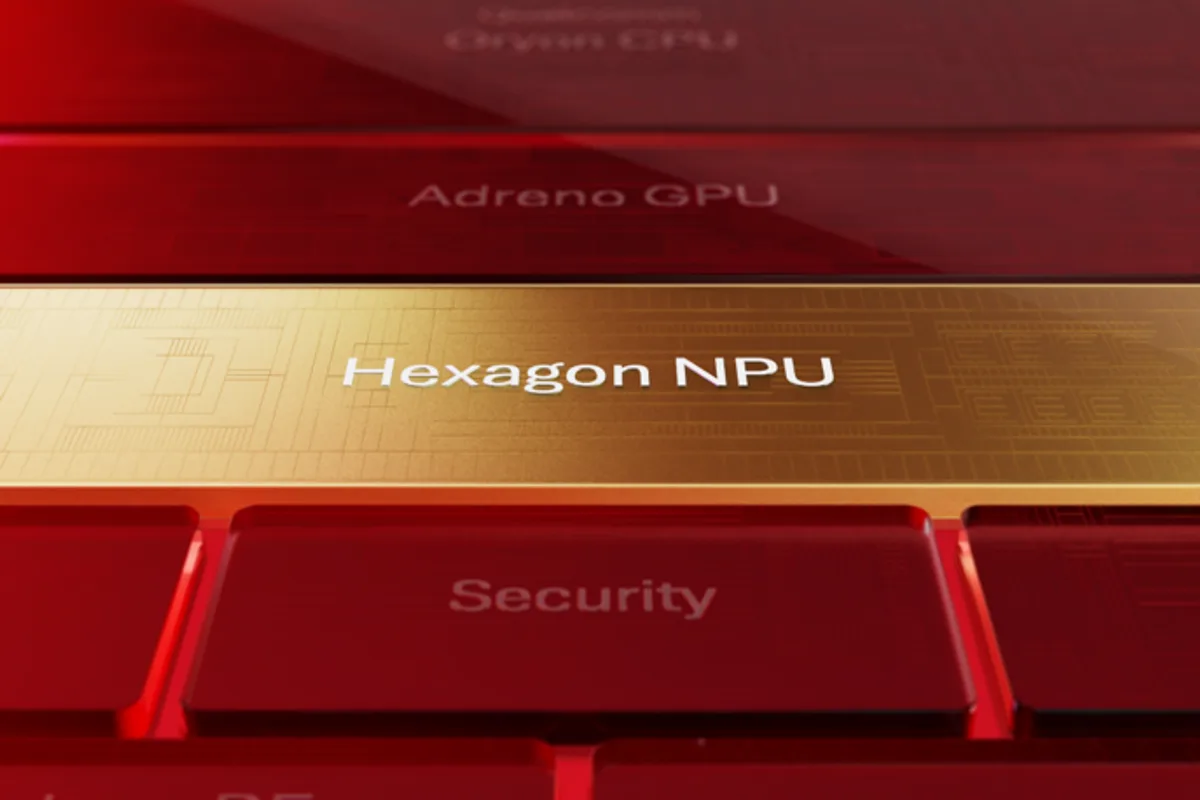
Qualcomm describes the new Element Accelerator as specialized hardware for operations used heavily by the Transformer architectures behind modern generative AI.
It does not replace the rest of Hexagon.
Instead, Qualcomm presents a collective architecture in which matrix extensions handle dense AI math, vector extensions provide high-throughput processing, scalar units deal with logic and orchestration, and the Element Accelerator targets important Transformer operations.
That specialization reflects how quickly mobile AI workloads have changed.
Early smartphone NPUs were commonly demonstrated through computational photography, speech recognition and relatively compact neural networks. They are now being asked to run architectures with very different memory behavior and substantially larger working sets.
The 50 percent increase in shared memory may matter more than the new accelerator's name
Qualcomm is increasing the Hexagon NPU's large shared memory capacity by 50 percent.
That allows more model state, activations and intermediate tensors to remain physically close to the compute engines.
Every piece of useful data that stays there can potentially avoid another trip to external DDR memory.
That matters for latency, but also for energy.
Moving data costs power. A desktop accelerator connected to a wall outlet can often compensate with higher consumption and larger cooling hardware. A smartphone only a few millimeters thick eventually converts those extra transfers into either reduced battery life or additional heat.
Qualcomm is therefore trying to solve part of the agentic-AI problem by moving context closer to compute rather than simply making arithmetic units faster.
Your phone still needs system RAM
Fifty percent more NPU memory does not mean phones suddenly stop needing large amounts of RAM.
Local NPU memory keeps the most useful working data close to the accelerators. The full model, context, Android and every other running application still share a much larger memory system.
Qualcomm has not disclosed the absolute capacity of the new shared-memory pool either.
The company is specifically talking about reducing trips to DDR, not eliminating them.
That distinction matters at a time when AI features are increasingly used to justify flagship phones with 16GB or more of system memory. A better NPU can reduce pressure on RAM bandwidth without making memory requirements disappear.
Mixture-of-Experts models are the other half of the strategy
Hardware alone cannot make dramatically larger models practical on a phone.
Qualcomm is therefore building around Mixture-of-Experts, or MoE, architectures as well.
Instead of activating the full neural network for every token, an MoE model contains multiple specialist expert groups and routes each request through only a subset of them.
Qualcomm gives the example of a 30-billion-parameter MoE model that keeps the full collection available while activating roughly 3 billion routed parameters for each token-generation step.
The total model can therefore contain much broader capacity than the amount of compute actually active at any given moment.
That difference is fundamental on a power-constrained device. Thirty billion parameters participating continuously and thirty billion parameters available while only three billion work on a particular token produce very different compute and bandwidth requirements.
The next problem is loading the right experts at the right time
MoE does not magically erase the experts that are currently inactive.
Their weights still need to exist somewhere and become available when the router decides they are required.
Qualcomm therefore describes intelligent flash-to-memory expert management and caching as part of the larger architecture.
Some experts can remain in storage and be moved when necessary instead of permanently occupying the fastest memory.
That can reduce RAM requirements, but it introduces another source of latency.
If the system fails to anticipate which expert will be needed next, the agent can simply spend its time waiting for data to arrive.
Real responsiveness will therefore depend as much on routing and caching quality as on the impressive total parameter count.
INT2 through FP16 gives developers several different compromises
The new Hexagon architecture supports INT2, INT4, INT8, FP8 and FP16 workloads.
Those formats let model developers trade numerical precision against memory footprint, bandwidth, throughput and model quality.
An INT4 model stores dramatically less information per value than FP16, which can substantially reduce both model size and memory traffic.
That does not automatically mean its answers become proportionally worse. Modern models can be trained or quantized to preserve a large amount of useful capability at lower precision for selected operations.
It does mean that comparing two NPUs through one performance number is increasingly dangerous when those numbers come from different data formats.
The headline 50 percent gain applies to INT4 prefill, not every AI workload
Qualcomm claims up to 50 percent higher prefill performance for INT4 models.
That wording matters.
Prefill is the initial stage in which a model processes the context it receives before beginning to generate new tokens.
A large improvement there can significantly reduce initial waiting time when an agent is given a long conversation, document or large amount of contextual information.
It is not a universal 50 percent increase in all AI performance.
Qualcomm separately mentions faster decoding, higher overall token throughput and improved speculative decoding without collapsing all of those changes into one general-purpose benchmark claim.
That distinction will be worth remembering when future phone presentations inevitably turn a much narrower engineering number into a much larger marketing sentence.
The CPU still matters because agents have to decide what happens next
The NPU accelerates model execution, but Qualcomm does not pretend it runs an entire agent workflow by itself.
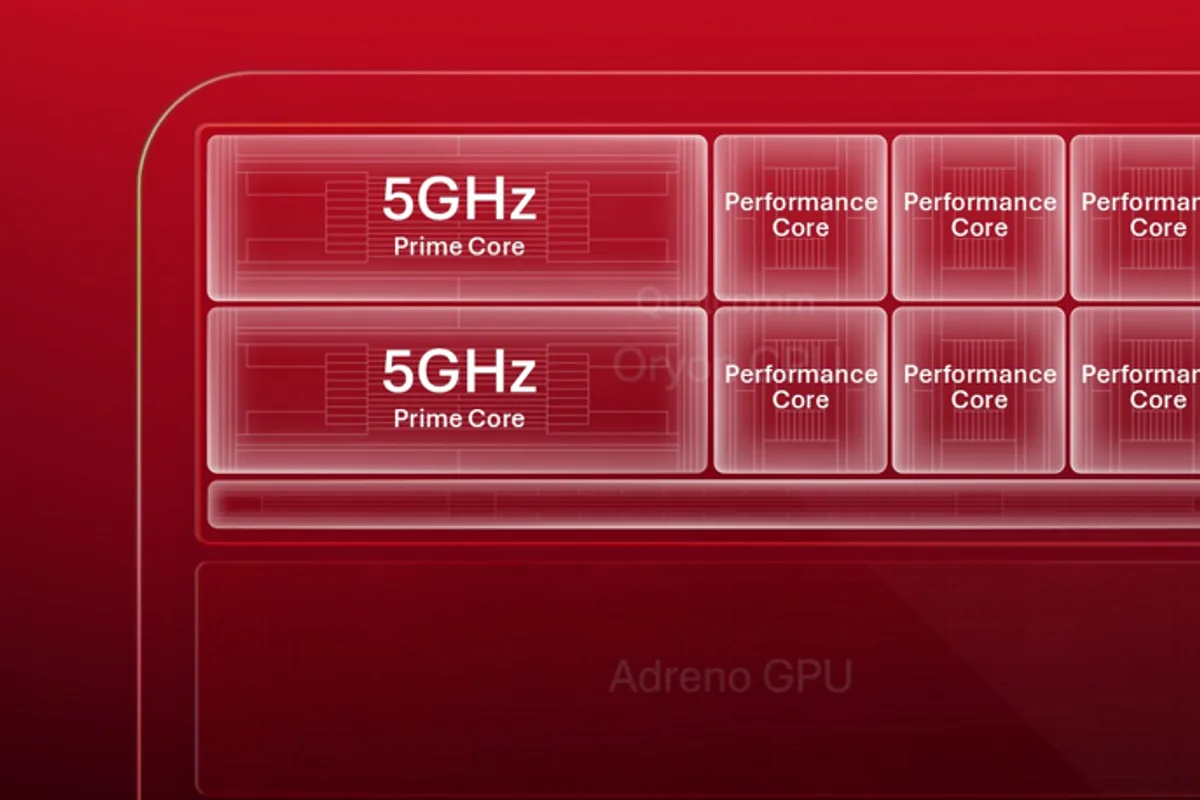
The next Oryon CPU has a complementary role in task orchestration, tool calls and keeping data available as work moves between processing engines.
Qualcomm has already revealed that this Oryon generation reaches 5GHz on its Prime cores and introduces Flex Cache, a shared cache pool that can be dynamically allocated across heterogeneous CPU cores.
The underlying idea resembles the NPU strategy: avoid expensive trips to main memory whenever possible.
An agent that opens an application, retrieves information, runs a model and triggers another action is inherently a workload that crosses multiple pieces of silicon.
The question is therefore no longer which individual block has the largest isolated performance number. CPU, NPU, GPU and memory all need to stop waiting on one another.
Latency is still the clearest practical reason to run locally
An agent executing on the device does not need to send every small step to a data center and wait for the network response.
For a short operation — understanding a notification, extracting information visible on screen or interpreting a command — saving a few hundred milliseconds can be the difference between something that feels like part of the operating system and something that feels like a web service wrapped in an app.
The effect multiplies during multi-step workflows.
A small delay repeated after five or ten separate model calls becomes a very noticeable delay.
Privacy is the second advantage, but software decides whether users actually get it
Local inference can also reduce the amount of personal information that leaves the phone.
An agent capable of reading notifications, calendar entries, messages or information inside other applications handles exactly the kind of context some users would prefer not to send to a cloud service for every action.
The important word is can.
A sufficiently powerful NPU does not guarantee that a commercial feature operates entirely on device. A phone maker can still choose to send some tasks to its servers for a larger model, online services or its own product requirements.
Hardware makes private local AI technically possible. Product policy determines whether that possibility becomes the default.
A 30-billion-parameter phone model is not automatically equivalent to a 30B cloud model
Qualcomm's MoE example will inevitably invite misleading comparisons.
A 30-billion-parameter Mixture-of-Experts model with approximately 3 billion parameters active per token is not directly equivalent to a dense 30-billion-parameter model.
Total parameter count alone does not measure reasoning quality, useful context length, knowledge or agent reliability.
The engineering value is different.
MoE can make a larger collection of specialties available while keeping the active computation within something a mobile power envelope can plausibly sustain.
That may be entirely sufficient for specialized agents handling calendars, local search, documents, photography, translation or system control without trying to reproduce a frontier data-center model on a phone.
The smartphone may become a team of small models instead of one enormous brain
Qualcomm explicitly argues that the agentic future does not necessarily belong to one massive model performing every task.
It expects specialized models to be selected according to task, context and user.
A compact model could handle a local command. Another could understand what the camera sees. A router could decide that a harder request needs a larger model or a cloud call.
That is a much more realistic architecture for a battery-powered phone than keeping one enormous LLM permanently resident in memory.
It is also considerably harder to make invisible.
If routing selects the wrong model, context disappears between tools or every action needs repeated confirmation, the system can be technically sophisticated and practically exhausting.
Qualcomm is still withholding several numbers that matter
The company has not yet disclosed the absolute shared-memory capacity, its bandwidth, sustained power consumption during long agent workloads or the new NPU's complete throughput specifications.
We also do not know how performance behaves after several minutes of continuous local inference inside a commercial smartphone.
That last question matters particularly for agents.
A short benchmark can let a mobile SoC use an aggressive thermal envelope. An always-available assistant needs to operate throughout the day without turning every calendar request into a thermal stress test.
Snapdragon Summit specifications should therefore be read with the same questions applied to CPUs and GPUs: how fast is it, how much power does that require, and how long can the device sustain it?
The next mobile AI battle may ultimately be a memory battle
Element Accelerator is the upgrade with the easiest name to put on a slide.
The 50 percent increase in shared memory may explain the architectural shift more clearly.
Mobile AI has reached a point where additional arithmetic alone is not enough. Models carry more context, multiple tools remain active and agents need to preserve enough state to avoid reconstructing their reasoning after every interaction.
Qualcomm is responding by keeping more data close to the engines using it, activating only the parts of a model required for a particular token and reducing dependence on external memory.
Snapdragon Summit will reveal how much silicon and power the company needs to make that architecture work.
The more important demonstration comes later in actual phones. A local agent only becomes convincing when it can remain useful all day without the user reaching for a charger before the agent reaches its next conclusion.