
 By Tsuky
Custom AI Behaviors is essentially a natural-language automation builder
Signify announced the feature at IFA on September 3. It will roll out to Hue Bridge Pro users in supported languages beginning in early October.
Users type an instruction into the Hue app. The AI assistant translates that request into a behavior built from the triggers, conditions and lighting actions available to the Hue system.
Philips Hue examples include making switches and motion sensors act differently at weekends, activating a scene whenever darkness falls rather than at a fixed clock time, or changing lighting when an entertainment-sync session begins.
The difficult part was exposing all those combinations
Hue technology chief George Yianni told The Verge that advanced automation was constrained partly by the complexity of building a user interface capable of exposing every available combination.
The Bridge already knows about button presses, sensor events, time and lighting states. Turning all of those into menus and nested conditions becomes cumbersome quickly.
A language model gives Hue another front end: describe the intended behavior and let software assemble the underlying rule.
The cloud creates the behavior, the Bridge runs it
The architecture is more interesting than simply attaching an AI label to the app.
Philips Hue says the AI assistant itself operates in the cloud, where it interprets the request. The resulting automation engine runs locally on the Bridge Pro.
A behavior that has already been created therefore does not need a fresh cloud-model response every time a sensor fires or a button is pressed.
Hue built a domain-specific simplified programming language for communication between the cloud assistant and the automation system. The company says it uses models from the open-weight GLM family.
Older Hue Bridges do not get the feature
Custom AI Behaviors is exclusive to the Bridge Pro.
Hue says the additional processing capability of the newer bridge is required for the automation engine behind the feature.
That makes the announcement a software upgrade and a hardware dividing line at the same time.
Generated does not mean immutable
After the assistant creates a behavior, users can review the result and either accept or adjust it.
Existing AI-created behaviors can later be reopened and modified with additional instructions.
That matters because a misunderstood lighting request is annoying; a misunderstood automation connected to sensors and physical controls can keep repeating itself until somebody fixes the rule.
The LLM is not deciding whether every lamp should turn on
Keeping execution local gives the design a useful boundary.
The model converts an instruction into structured automation logic. It is not required to reason from scratch every time the logic runs.
That should make established behaviors less dependent on an internet connection and avoids putting generative-model variability into every routine event.
Sonos controls are coming to Hue switches
A separate integration scheduled for November will let selected Hue switches control Sonos speakers.
The Hue Tap Dial Switch is among the supported controls. Buttons can trigger Sonos Favorites, play or pause audio, change volume and move forward or backward through a playlist.
It is a small change, but one that moves Hue's physical controls beyond lighting.
Nanoleaf Shapes can now enter the Hue ecosystem
Signify also announced an unusual partnership with Nanoleaf.
Compatible Shapes panels — Hexagons, Triangles and Mini Triangles — can connect to Hue using the new Philips Hue Wall Light Module.
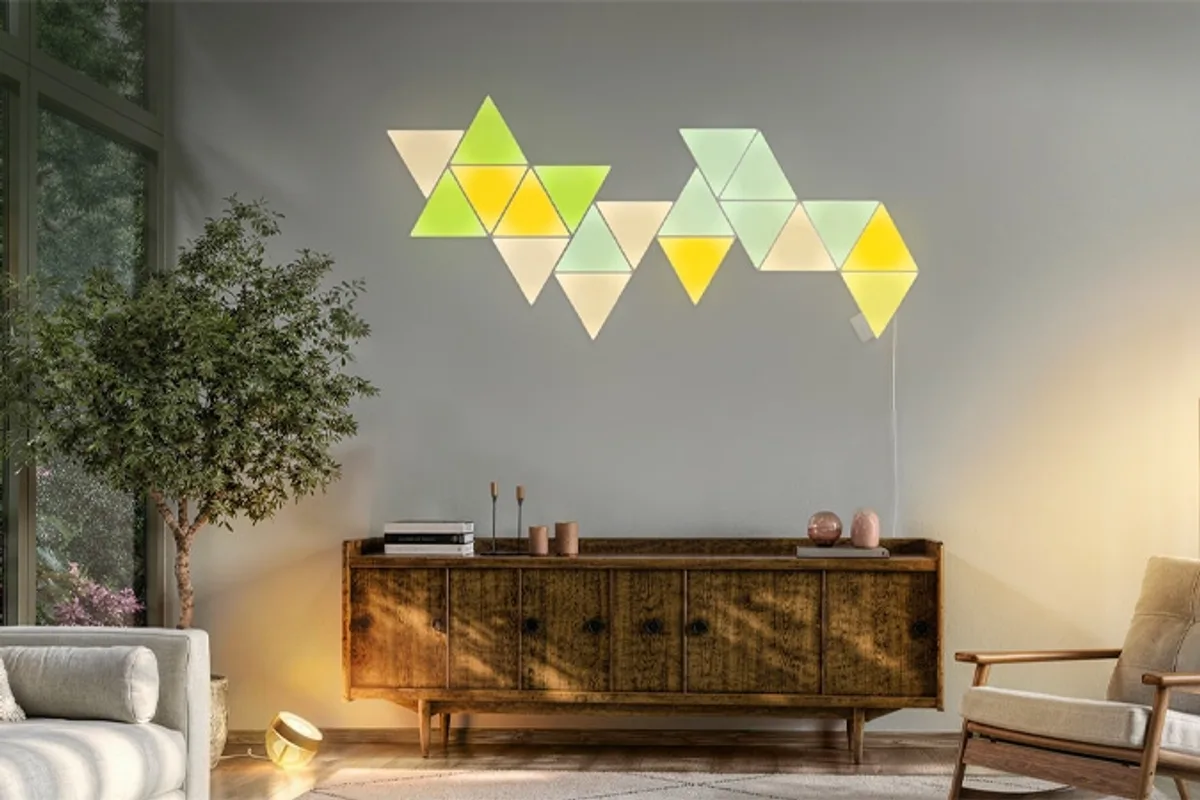
Once connected, those panels can participate in Hue scenes, automations and entertainment experiences. The module launched in the US on September 3 for $39.99.
Back-up & Restore is finally on the roadmap
Hue is also developing cloud backup for Bridge configurations.
Back-up & Restore will preserve lights, accessories, rooms, zones, scenes and automations from both the standard Bridge and Bridge Pro.
Restoring a saved setup will initially require Bridge Pro. Signify has not given the feature a final release date.
TV syncing is becoming less dependent on HDMI
The new Hue Play Screen Sync uses a fisheye camera to watch a television and translate on-screen colors into lighting effects.
Because it watches the screen itself, it can react to native smart-TV apps, broadcast television and HDMI devices rather than only content routed through a sync box.
Philips Hue also introduced a simpler Play HDMI sync box 4K with a single HDMI input.
One Play gradient TV strip can connect directly to either device over Bluetooth without a Hue Bridge. Adding a Bridge or Bridge Pro expands the setup to as many as ten lights.
The AI feature arrives first
Custom AI Behaviors is scheduled for early October 2026 on Bridge Pro.
Sonos integration follows in November, while Back-up & Restore remains in development.
The useful distinction is already clear: AI writes the automation, then the local bridge gets on with running it.