
 By Tsuky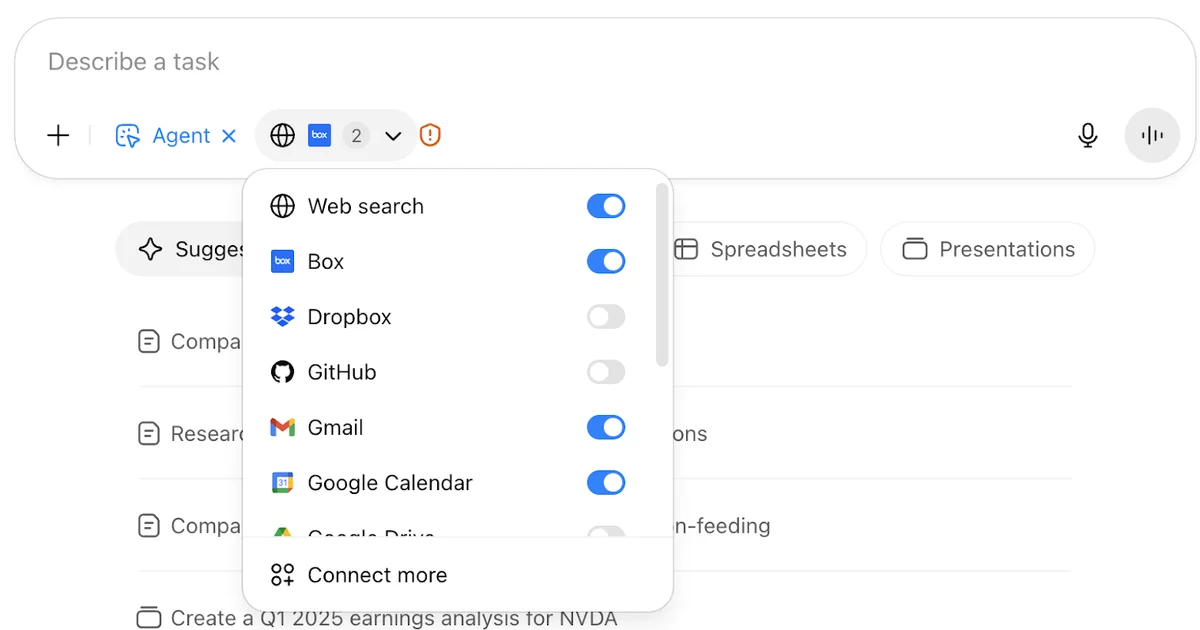
Data agent is installed as a ChatGPT Work plugin
OpenAI announced the Data agent on September 10, 2026.
It appears in ChatGPT Work as the Data plugin and can be installed or enabled by workspace administrators.
Users then start a conversation with the agent and ask a business question directly.
They do not necessarily need to know the table name, query syntax or business-intelligence product that will eventually display the answer.
Snowflake, BigQuery, Redshift and Databricks can feed the same conversation
The first major feature is the breadth of the connection layer.
OpenAI lists approved sources including Amazon Redshift, Datadog, Google BigQuery, ClickHouse, Databricks, MongoDB and Snowflake.
Files and documents from Google Drive and SharePoint can also become part of an analysis.
The agent is therefore not limited to querying one cleanly structured warehouse.
It can combine quantitative data with approved organizational context stored elsewhere.
Writing SQL is often not the hardest part
Inside a large company, knowing how to query a database is only part of the problem.
The analyst also needs to know which table actually represents the metric being discussed.
Two similarly named datasets can use different populations, filters or time windows.
A technically valid query can therefore return a number that is completely wrong in business terms.
Automating SQL without solving that semantic problem would only automate mistakes faster.
OpenAI is trying to teach the agent the company's vocabulary
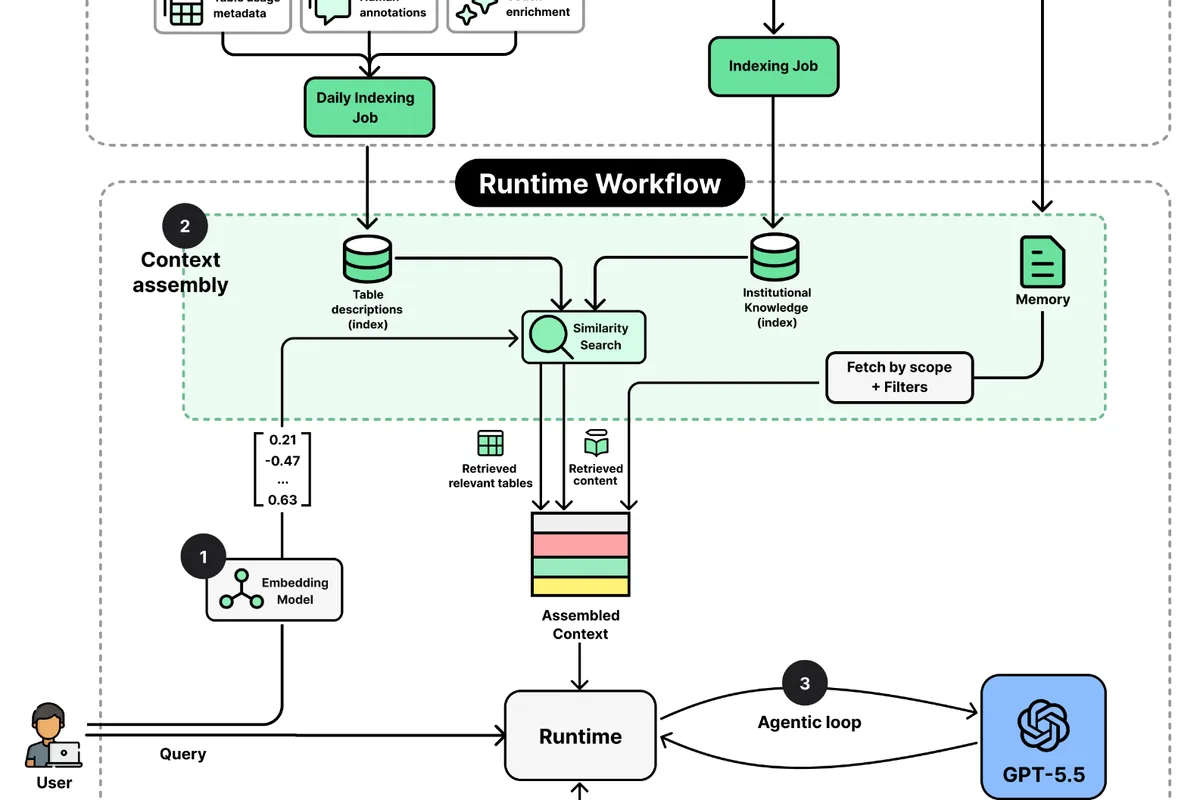
The Data agent can use business terminology, metric definitions, custom calculations and data relationships defined by the organization.
OpenAI cites contextual systems including Databricks Genie Ontology, dbt, GitHub, Snowflake Horizon and existing BI dashboards.
That semantic layer may matter more than raw query generation.
A capable model can produce plausible SQL relatively easily.
Understanding exactly what one company means by active customer, conversion or net revenue is a much more local problem.
The agent can investigate instead of producing one final answer
The experience is designed around follow-up questions.
A user can ask why a metric declined, then break the result down by region, customer segment or time period.
They can inspect evidence behind a finding and keep refining the analysis.
That turns analytics into an iterative investigation instead of a single prompt followed by an authoritative-looking answer.
Real analysis often requires several failed hypotheses before the useful explanation appears.
The result can become an interactive dashboard
Once an analysis is useful, the Data agent can convert it into an interactive dashboard with built-in visualizations.
Teams can edit, share and refresh that dashboard.
Organizations can also provide brand guidelines so the output fits their visual standards.
This narrows the historical gap between one-off exploration and reusable reporting.
A question asked in chat can become something a team keeps monitoring.
ChatGPT can also build inside Power BI or Tableau
OpenAI is not necessarily trying to replace every BI platform already deployed.
The Data agent can build and interact with dashboards in Omni, Oracle BI, Microsoft Power BI, Sigma, Tableau and ThoughtSpot.
ChatGPT can therefore act as a natural-language interface over existing analytics systems.
A company can keep its governed semantic models and dashboards while changing how employees request new analysis.
Dashboards do not disappear; the creation interface changes
That distinction matters when predicting what agents will do to business-intelligence software.
Shared, refreshable and auditable dashboards remain useful.
What may disappear faster is the queue of tickets asking a data team to add one filter or create another variation of an existing report.
If an agent can publish into Power BI or Tableau directly, repetitive dashboard work moves closer to the end user.
Existing data permissions remain in force
This is the most important security claim in the launch.
Administrators choose which data connections are available and which roles can use them.
OpenAI says queries enforce the permissions already attached to the connected account.
That includes table-, row- and column-level restrictions.
An employee who cannot normally view individual compensation data should not gain access simply by asking for it in natural language.
The agent is not supposed to become a master key to the warehouse
That architecture is essential because an agent becomes a serious governance problem if its reasoning ability also bypasses normal access controls.
The model does not need an all-powerful database account to be useful.
It can operate as another interface over rights the user already has.
This does not eliminate every risk.
Bad permissions upstream remain bad permissions even when the final interface is conversational.
Administrators also control the connections themselves
Installing Data does not automatically expose every corporate database.
Administrators configure the relevant source plugins and decide which groups can use them.
The quality of identity management, roles, metric definitions and semantic models therefore still matters.
A sophisticated agent placed on top of chaotic data infrastructure does not magically make the underlying organization clean.
OpenAI wants the workflow to continue from analysis into action
The product does not necessarily stop at a chart.
ChatGPT Work can recommend next steps, identify people who should be involved and share findings through Slack or email.
With appropriate connected tools and user approval, it can also carry out actions.
That changes the nature of the system significantly.
Traditional BI software explains what happened.
A connected agent can potentially participate in what happens next.
That makes verification more important, not less
The more an agent can do with its conclusion, the more costly an analytical mistake can become.
Using the wrong revenue definition in a chart is inconvenient.
Automatically changing a campaign, reallocating resources or contacting customers because of that wrong chart is worse.
Important decisions still require human review.
The ability to execute an action is not evidence that the analysis behind it was correct.
OpenAI built this category for its own teams first
The public Data agent grows out of earlier internal work.
OpenAI described its in-house data agent in January, built to navigate an internal environment containing tens of thousands of datasets.
That system combined metadata, historical queries, human annotations, code-derived table knowledge and institutional context.
It could run queries, inspect results and change approach when intermediate outputs looked wrong.
That history explains why the new commercial product emphasizes semantics and organizational context rather than merely advertising automatic SQL.
OpenAI says almost its entire product organization already uses data agents
OpenAI says nearly all of its product team and more than two-thirds of its go-to-market organization use data agents in ChatGPT Work to analyze company data.
That is an OpenAI-provided usage figure rather than an independent measurement.
It still makes the intended audience clear.
The company does not want this to remain an analyst-only tool.
Sales, marketing, finance, product and operations are expected to ask their own questions.
Early customer stories are mostly about democratizing analytics
NTT DATA, Thermo Fisher, ServiceTitan, Zipline, Turing and other organizations participated in the Alpha program.
Published examples include sales, spending, conversion, capacity and customer-satisfaction analysis.
NTT DATA specifically highlights non-engineers building and updating dashboards through plain language.
micro1 says its operations team rebuilt performance-tracking dashboards in roughly half an hour while identifying errors in the originals.
Those are useful examples, but they are still selected customer testimonials presented as part of a product launch.
The biggest practical risk is over-trusting a polished result
An automatically generated dashboard can look extremely professional.
That does not prove the underlying join was correct, the comparison period was sensible or an internal metric was interpreted properly.
Conversational analytics makes complexity easier to access.
It can also hide that complexity behind a clean answer.
The ability to inspect evidence and assumptions therefore becomes central to responsible use.
The sensible outcome is probably not deleting the data team
A more plausible effect is a shift in what that team spends time doing.
Analysts handle large volumes of repetitive requests: changing date windows, adding segmentations, rebuilding familiar charts or explaining simple metric movement.
An agent capable of handling those requests can free specialists for data modeling, quality, metric governance and genuinely difficult analysis.
At the same time, those specialists are the people most likely to build and maintain the semantic layers and safeguards that make the agent reliable.
The tool that appears to reduce dependency on a data team can therefore depend heavily on the quality of that team's work.
“No query writing” does not mean “no data understanding”
That is the most important limitation to keep in view.
Data agent reduces the technical barrier between a business question and an analysis.
It cannot remove disagreements about what the business actually means.
If two departments disagree on the definition of an active customer, better SQL generation will not settle the argument.
The agent still needs a definition that has been chosen, documented and governed.
ChatGPT is becoming an interface layer over the entire data stack
The launch is ultimately broader than automatic chart creation.
One conversation can now sit above data warehouses, documents, semantic layers, BI products and communication tools.
The user states an intent while the agent decides where approved information should come from and how the result should be presented.
Snowflake, BigQuery and Tableau do not disappear in that architecture.
They become infrastructure that users may need to open much less often.
The real test begins after the first correct answer
Generating one impressive chart from a natural-language question makes a strong demo.
The much harder challenge is returning the same definition of revenue next Monday, maintaining the same permissions after an organizational change and staying correct when an upstream table changes.
That is where the Data agent's long-term value will be decided.
If OpenAI succeeds, SQL will not disappear.
It will simply become an increasingly invisible step somewhere between an ordinary-language question and a dashboard the rest of the company can actually use.