 By Tsuky
The strongest promise is that NVIDIA hardware will remain optional
Jensen Huang says Hugging Face will continue supporting open-source and open-weight models from across the ecosystem.
Developers will still be able to choose their frameworks, cloud providers, inference services and compute platforms.
NVIDIA compute, according to the announcement, will not be required to build on or deploy through Hugging Face.
That sentence will matter long after the purchase price stops making headlines.
Hugging Face is infrastructure now
NVIDIA says more than 18 million developers, researchers and creators use the service.
The platform hosts more than 3 million models, 500,000 datasets and 1 million applications. More than 200,000 companies use it to discover, evaluate, customize and deploy AI.
That scale makes Hugging Face difficult to describe as merely a repository.
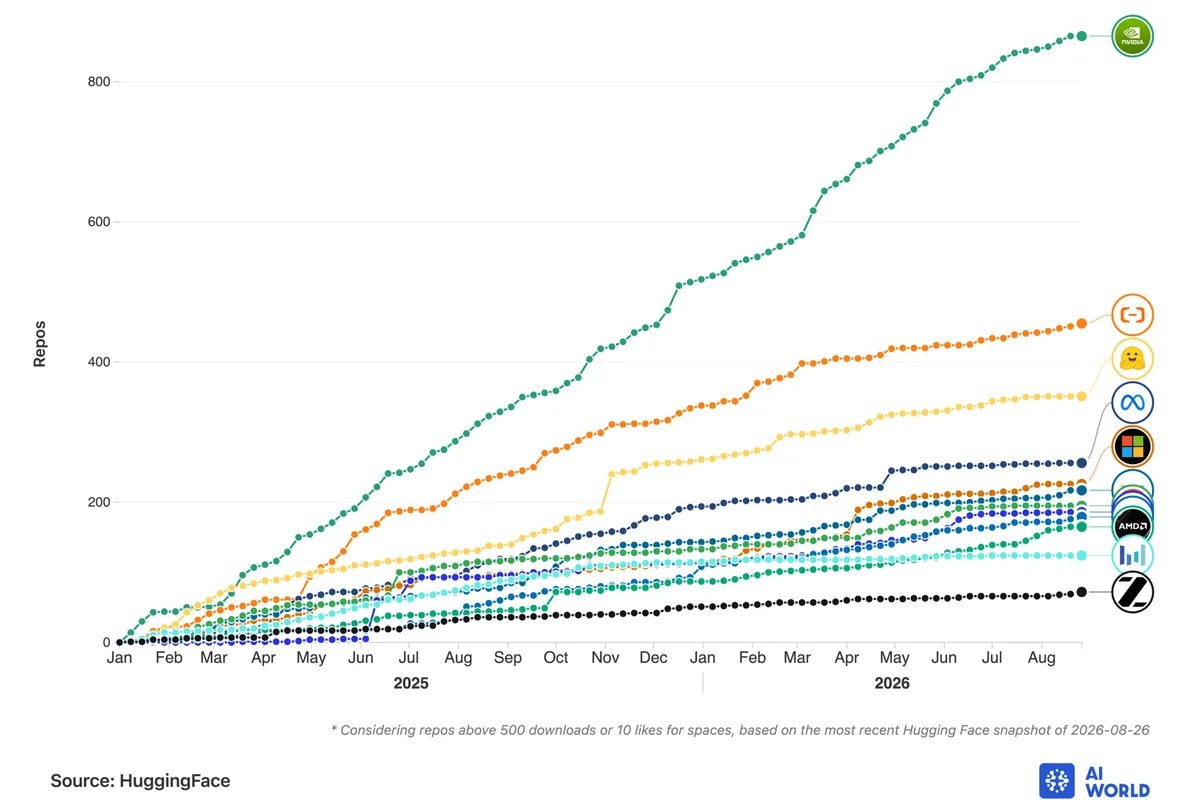
It is simultaneously a model catalog, collaboration layer, distribution channel and increasingly an inference and deployment platform.
NVIDIA is moving closer to the developer's decision point
The company already dominates a large part of the hardware market used to train and run AI.
Hugging Face sits further up the stack. It is where teams compare models, download weights, test applications and decide how something should be deployed.
Owning that layer gives NVIDIA a much broader position than selling accelerators alone.
It also gives the company another way to remain central as hyperscalers and major AI labs invest in their own silicon.
This relationship started long before the acquisition
NVIDIA and Hugging Face announced a DGX Cloud partnership back in 2023, giving developers a route to NVIDIA infrastructure from the Hugging Face platform.
NVIDIA now says it is Hugging Face's largest contributor of open models and data, with more than 500 models and over 250 open datasets published on the platform.
The acquisition turns a deep integration into ownership.
The price includes a large employee-retention component
Reuters reports that roughly $11.9 billion of the deal will go to Hugging Face shareholders.
Another approximately $1 billion is allocated to equity incentives intended to retain employees.
Hugging Face was valued at $4.5 billion in its 2023 funding round.
Three years later, NVIDIA is paying close to three times that amount.
Neutrality is now a product-design question
Hugging Face does not need to remove AMD support for the acquisition to affect competition.
More subtle choices matter: which accelerators receive optimized deployment paths first, which inference providers are easiest to use, which formats get the best tooling and how hosted services are priced.
Those decisions shape developer behavior without requiring an explicit lock-in policy.
NVIDIA has made a clear public commitment to multi-accelerator support. The implementation will be more important than the wording.
Open models also protect NVIDIA from a more centralized AI market
Huang has increasingly framed open-weight AI as economically strategic.
There is a business logic behind that position. A broad ecosystem of independent models, startups and enterprises creates a broad market for compute.
If most advanced AI were concentrated inside a handful of proprietary APIs operated by companies building their own chips, NVIDIA would face a much smaller group of extremely powerful buyers.
Hugging Face helps keep model distribution decentralized across thousands of projects and deployment environments.
The deal connects compute, software and distribution
NVIDIA already has CUDA, AI libraries, DGX systems, cloud services, open models and an expanding software stack.
Hugging Face adds the developer community and one of the industry's most important discovery layers.
That is a different kind of strategic asset from another chip company or data-center operator.
Nothing changes overnight, which makes the next year more important
NVIDIA says developers will not be forced onto its hardware and Hugging Face will keep supporting competing infrastructure.
There is no immediate platform migration attached to the announcement.
The useful evidence will arrive later, in the next generation of hosted inference, optimization tools, model evaluation and deployment features. That is where the promised neutrality will either remain visible or begin to narrow.