
 By Camille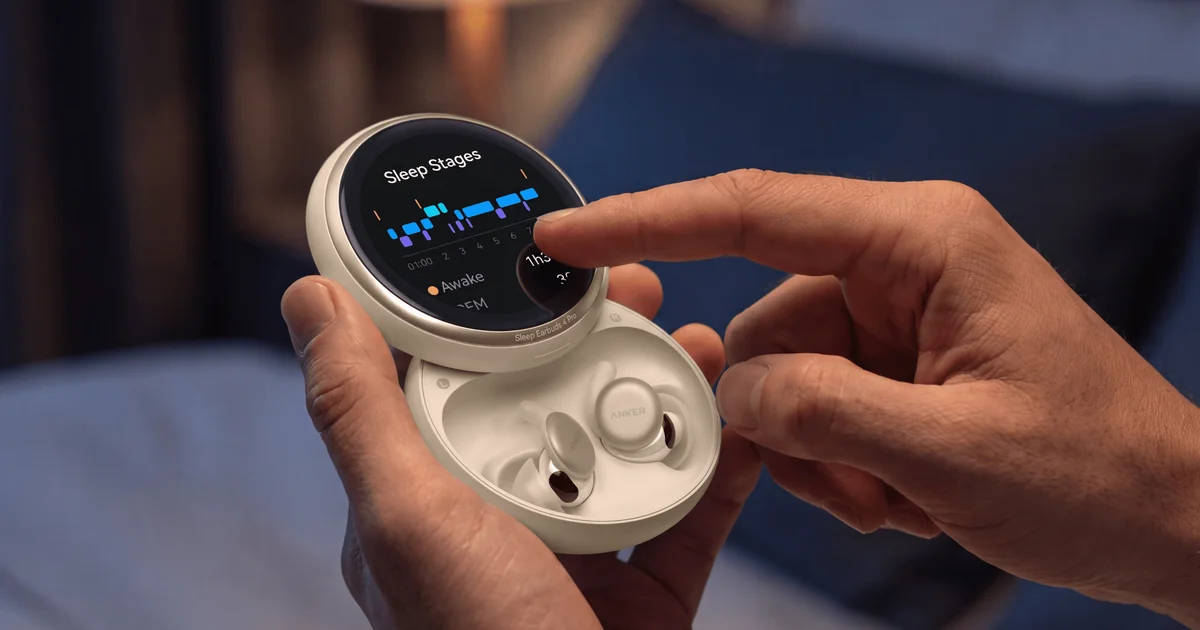
The earbud now contains a sleep sensor
Soundcore's Pro model uses an optical PPG sensor inside the ear to monitor heart rate and heart-rate variability during the night.
Those signals feed features for estimating relaxation, sleep state and recovery, with results presented through metrics including sleep stages and a Sleep Score.
That puts the product in obvious competition with smartwatches and smart rings, even though its primary form factor remains a sleep earbud.
The important limitation is equally obvious: these are consumer wellness measurements, not a medical diagnosis simply because the sensor sits close to the bloodstream.
BioSync tries to do something with the data immediately
Sleep trackers normally explain the previous night after the user wakes up.
Soundcore's BioSync system is designed to react while the user is winding down by playing adaptive soothing audio based on detected physiological state.
In theory, that creates a feedback loop instead of a passive log: measure the user, interpret the signal and adjust the sound.
Whether that improves real sleep is a much harder question than whether the PPG sensor can measure a pulse accurately. It will need proper real-world testing.
Snore masking is still the simpler reason to buy them
The Sleep Earbuds 4 Pro retain sleep-specific noise reduction and adaptive snore masking.
Instead of relying only on a fixed white-noise track, the system can adjust masking audio as snoring changes during the night.
That builds directly on Soundcore's existing Sleep lineup and gives the product a clear job even before its health-tracking features are considered.

The charging case is becoming a bedside device
The Pro model comes with a redesigned SleepHub case featuring an integrated AMOLED display.
Users can browse soundscapes, change sleep settings, set alarms and view a morning sleep summary without opening the phone app.
That is more sensible here than it might sound. A sleep product that repeatedly asks users to pick up a bright, notification-filled smartphone immediately before bed is working against part of its own premise.
The case also supports wireless charging.
Battery life depends on Bluetooth
Soundcore rates the earbuds for eight hours of streamed audio with ANC enabled and 11 hours with ANC disabled.
Local soundscape playback stretches those figures to about 9.5 hours with ANC and up to 14.5 hours without it.
Those numbers matter more for sleep earbuds than they do for ordinary headphones. A battery that comfortably lasts a commute can still fail at the only task that matters here if it dies before morning.
$350 makes these wearables as much as earbuds
The Sleep Earbuds 4 Pro are scheduled for November at $349.99 in the US and £299.99 in the UK.
The regular Sleep Earbuds 4 arrive in October for $229.99 and £199.99.
The cheaper version keeps the core sleep-focused noise reduction and adaptive snore masking while dropping the Pro model's advanced physiological tracking and standalone display case.
That makes the buying decision unusually clear. One is primarily an audio device for sleep. The other is trying to become a sleep wearable that also lives in your ears.
None of the tracking matters if side sleeping still hurts
Soundcore says the new design has a 20 percent smaller contact area than the Sleep A30, specifically to reduce pressure for side sleepers.
That may ultimately matter more than the AMOLED screen or the sleep graphs.
A device worn overnight has to survive hours of movement, pillow pressure and temperature changes without becoming the thing that wakes its owner up.
The Sleep Earbuds 4 Pro have become much more technologically ambitious. Their hardest test is still extremely low-tech: whether someone can forget they are wearing them until morning.