
 By Adri
HUMAIN says its first production infrastructure using AMD Instinct MI355X accelerators is now serving customers inside Saudi Arabia and beyond.
The system combines MI355X GPUs, AMD EPYC CPUs and Cisco networking and is being offered as GPU-as-a-Service for both model training and inference.
The August 31 announcement does not disclose the exact accelerator count or the electrical capacity of the hardware already online.
This is the part of the roadmap that exists today
MI355X is AMD's CDNA 4 data-center accelerator, carrying 288GB of HBM3E and 8TB/s of memory bandwidth per GPU.
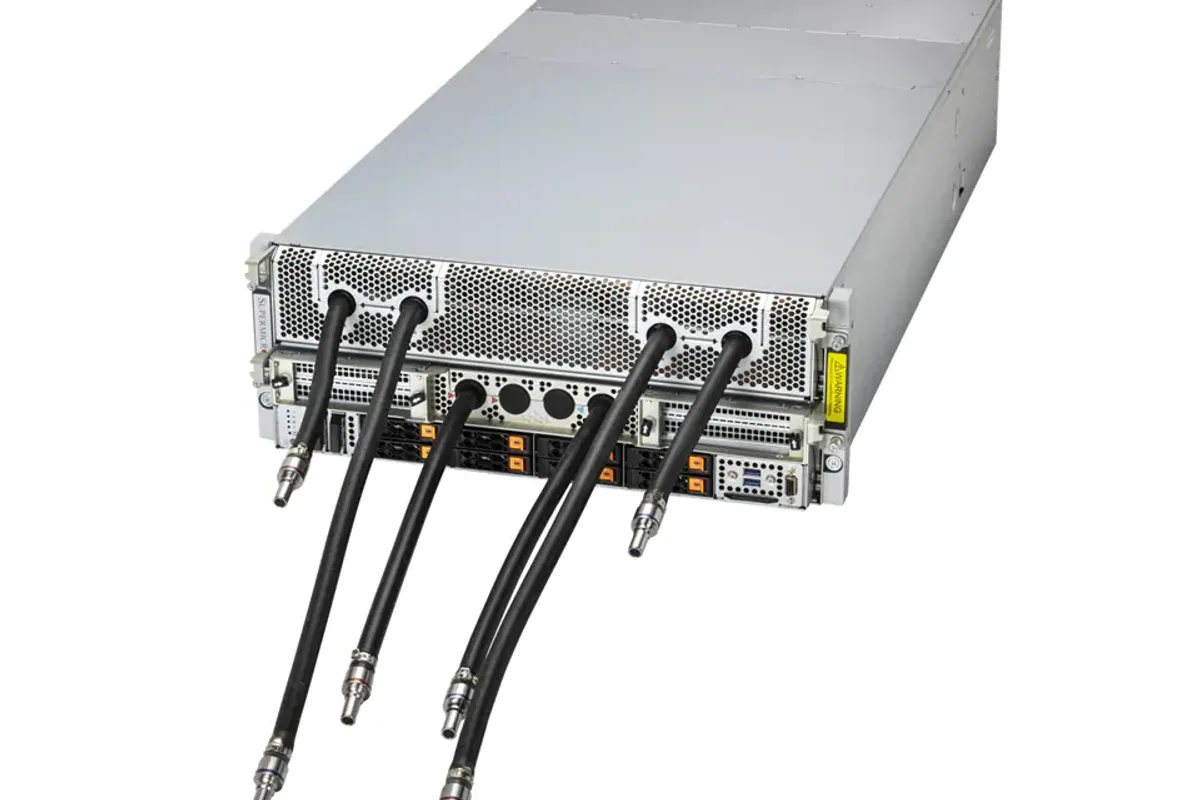
Those specifications are familiar. The more relevant update is operational: HUMAIN says these GPUs are no longer merely part of a Saudi deployment plan. They are running production workloads.
AMD provides no workload-specific benchmark for this installation, so the announcement does not support a direct performance comparison with an equivalent Nvidia deployment.
The network is part of the AI machine
Cisco N9000 switches, Silicon One and 800G optics form the fabric interconnecting the AMD compute.
Large distributed AI systems depend heavily on that layer. A cluster with powerful accelerators can still lose considerable effective performance when collective communication or data movement becomes the bottleneck.
Cisco describes the design as an AI-optimized, low-latency fabric with centralized visibility and control. The companies do not provide detailed utilization or latency measurements from the live HUMAIN system.
The next concrete buildout is up to 250 MW
AMD, Cisco and HUMAIN now plan to begin deploying a much larger phase in 2027.
That phase is sized at up to 250 MW and is expected to start bringing capacity online during the second half of the year.
It will move to AMD Instinct MI400 Series GPUs alongside EPYC processors, ROCm software and Cisco networking and critical infrastructure.
“Up to 250 MW” is the stated ceiling for this phase. It is not capacity that exists today, nor does the announcement say all 250 MW will be energized immediately when deployment starts.
One gigawatt is still a 2030 ambition
The joint venture remains aimed at as much as 1 GW of AI infrastructure by 2030.
That number should not be confused with the live MI355X installation. The current release never says one gigawatt is operational.
It also does not provide a breakdown of facility power between accelerators, CPUs, networking, cooling, storage and other data-center loads.
The figure is therefore most useful as a statement of intended project scale rather than a measurement of compute available to HUMAIN customers today.
The hardware sequence has already evolved
When AMD, Cisco and HUMAIN described the joint venture in November 2025, the initial plan looked different.
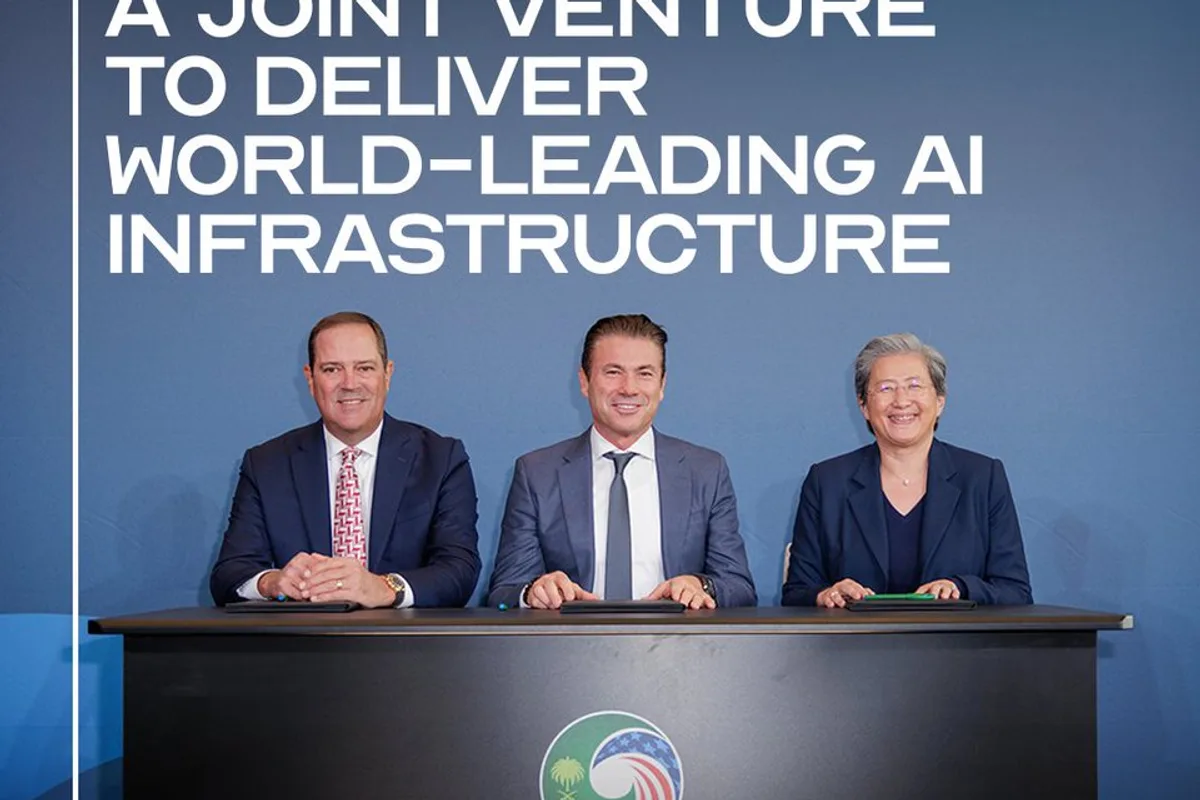
At the time, the companies described a 100 MW first phase planned for 2026 using future Instinct MI450 Series GPUs.
The August 2026 announcement instead establishes a live MI355X deployment and identifies a subsequent 250 MW phase using the broader MI400 Series beginning in 2027.
The partners do not label that evolution a delay or formally explain what happened to the previously described 100 MW MI450 phase. It is simply a different deployment sequence from the one announced nine months earlier.
ROCm has to scale with the hardware
A sovereign AI platform cannot be built from accelerators alone.
The 2027 phase explicitly includes AMD ROCm, giving customers an open software stack for deploying frameworks and models across the Instinct infrastructure.
That is strategically important for AMD because Nvidia's advantage is not confined to GPU silicon. CUDA's long-established software ecosystem remains one of the strongest reasons organizations standardize around Nvidia hardware.
A growing HUMAIN service gives ROCm another large production environment in which AMD can prove that its software and hardware stack can operate together at scale.
HUMAIN is selling control of the infrastructure as well as compute
The companies repeatedly frame the platform around sovereign AI.
The proposition is that governments, enterprises, researchers and model developers can exercise greater control over where their data resides, how models are customized and how deployment is governed.
HUMAIN is owned by Saudi Arabia's Public Investment Fund and operates across data centers, cloud infrastructure, models and AI applications.
The live AMD capacity is intended to serve both domestic and international customers.
For AMD, a working deployment matters more than another roadmap slide
Selling AI accelerators at scale requires more than demonstrating peak FLOPS. Operators have to power, cool and interconnect large numbers of devices while keeping the software environment usable enough for paying customers.
The Saudi deployment gives AMD another place where Instinct is being consumed as production compute rather than evaluated as a standalone accelerator.
The harder scale test comes next: deployment of the up-to-250 MW phase begins in 2027, with initial capacity expected in the second half of that year. The joint venture's upper target remains 1 GW by 2030.