
 By Adri
LED only tells us that a diode emits light
LED stands for Light-Emitting Diode. Current passing through an appropriate semiconductor junction produces photons.
That simple component can be used in radically different ways inside a display.
It can illuminate another technology from behind, or it can become the actual light-emitting element of the image.
The ordinary LED television is an LCD
Conventional LED TVs use a liquid-crystal panel that cannot generate its own light. The LCD controls transmission from an LED backlight.
Replacing fluorescent CCFL lamps with LEDs allowed thinner designs, lower power consumption and far more sophisticated brightness control.
Marketing shortened LED-backlit LCD to LED TV. The LCD never went away.
Edge lighting prioritizes thinness
Edge-lit designs position LEDs around the perimeter of the screen and distribute that light through optical guides.
The approach can make an inexpensive television impressively thin, but the backlight has limited ability to follow the geometry of the picture.
Uniformity, clouding and coarse local dimming are common weaknesses when the implementation is basic.
Direct LED puts the light behind the picture
A direct-lit LCD uses an LED array behind the panel rather than along its edges.
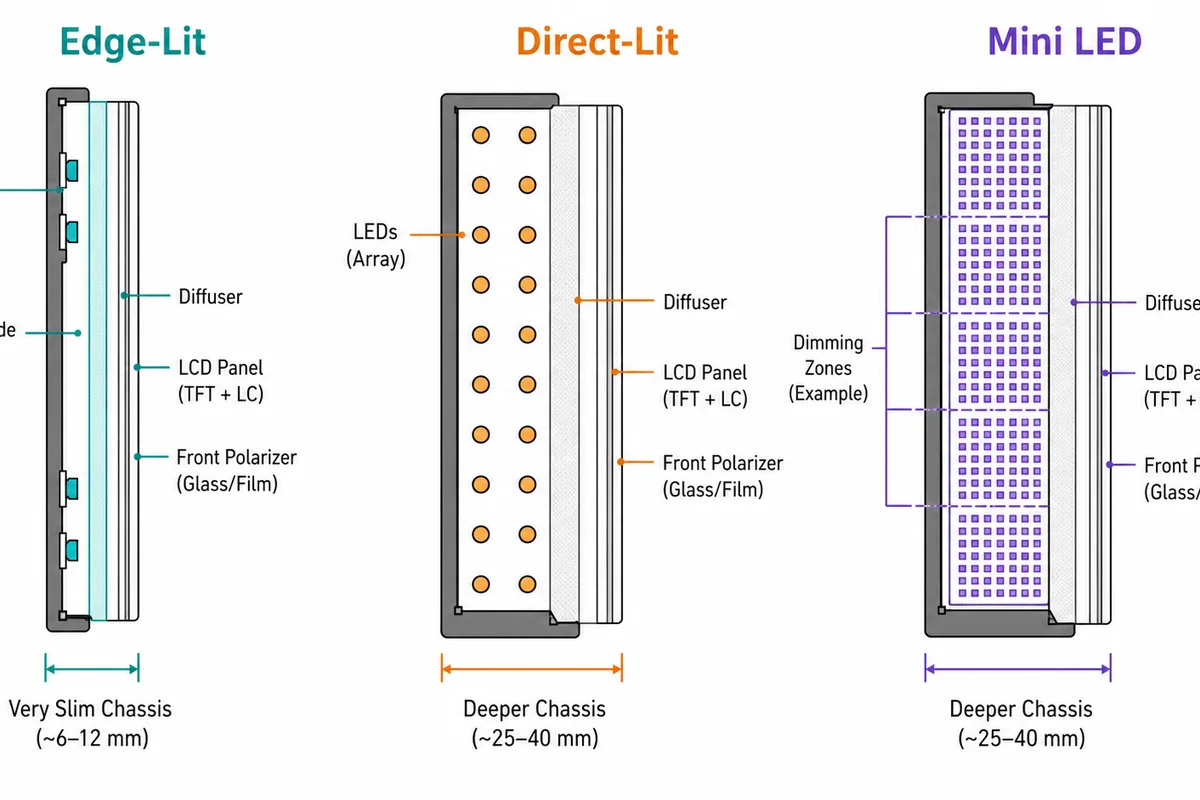
That alone does not guarantee local dimming. A cheap direct-lit television can still drive most or all of its LEDs together.
Full Array Local Dimming is the step that divides the backlight into independently controlled regions.
FALD gives an LCD a second, low-resolution image
One way to think about local dimming is as a second image sitting behind the 4K image.
The LCD creates millions of detailed pixels. The backlight creates a much coarser map describing where more or less light should be supplied.
The processor has to make those two maps agree.
Blooming is the resolution gap made visible
A white star may occupy only a few display pixels while the local-dimming zone behind it covers a much larger area.
Brightening that zone keeps the star luminous but raises the black level around it.
The resulting halo is blooming.
The smaller and more numerous the zones become, the less obvious that mismatch can be.
Mini LED shrinks the backlight sources
Mini LED is still a backlight technology. Much smaller diodes allow manufacturers to pack far more light sources behind an LCD and divide them into more local-dimming zones.
The LCD remains responsible for the actual 4K pixel structure.
This is why Mini LED and MicroLED are not two sizes of the same television architecture.
Raw LED count can be a misleading specification
A manufacturer may install tens of thousands of Mini LEDs while controlling groups of them as a few thousand or even fewer dimming zones.
The useful specification is therefore not simply how many diodes exist.
Zone density, algorithm quality, panel contrast and real blooming behavior tell you considerably more.
Mini LED gives LCD tremendous HDR headroom
A separate backlight can be driven extremely hard. Premium Mini LED TVs can deliver intense highlights and strong full-screen brightness.
That makes them especially effective in bright rooms and for HDR material.
Thermal and power management become increasingly important as backlights get brighter and denser.
Quantum Dots solve a different problem
A QLED television is usually an LCD with a quantum-dot color-conversion system added to its LED backlight stack.
Blue LED energy can excite quantum dots that emit narrow red and green wavelengths. Cleaner primaries expand color gamut and can preserve saturation at high brightness.
Quantum dots improve the color engine. They do not turn the LCD pixels into LEDs.
That is why QLED and Mini LED can exist in the same television
A premium LCD can use a VA panel, quantum dots and a Mini LED full-array backlight simultaneously.
Samsung's Neo QLED products are a familiar example of combining quantum-dot color technology with Quantum Mini LED backlighting.
The labels describe different layers of one display.
RGB Mini LED changes the backlight spectrum itself
The next major step replaces a largely blue or white backlight with separately controllable red, green and blue emitters.
A region that needs strong red no longer has to begin with a broad white source and discard unwanted energy through filters.
The backlight can vary both brightness and spectral composition.
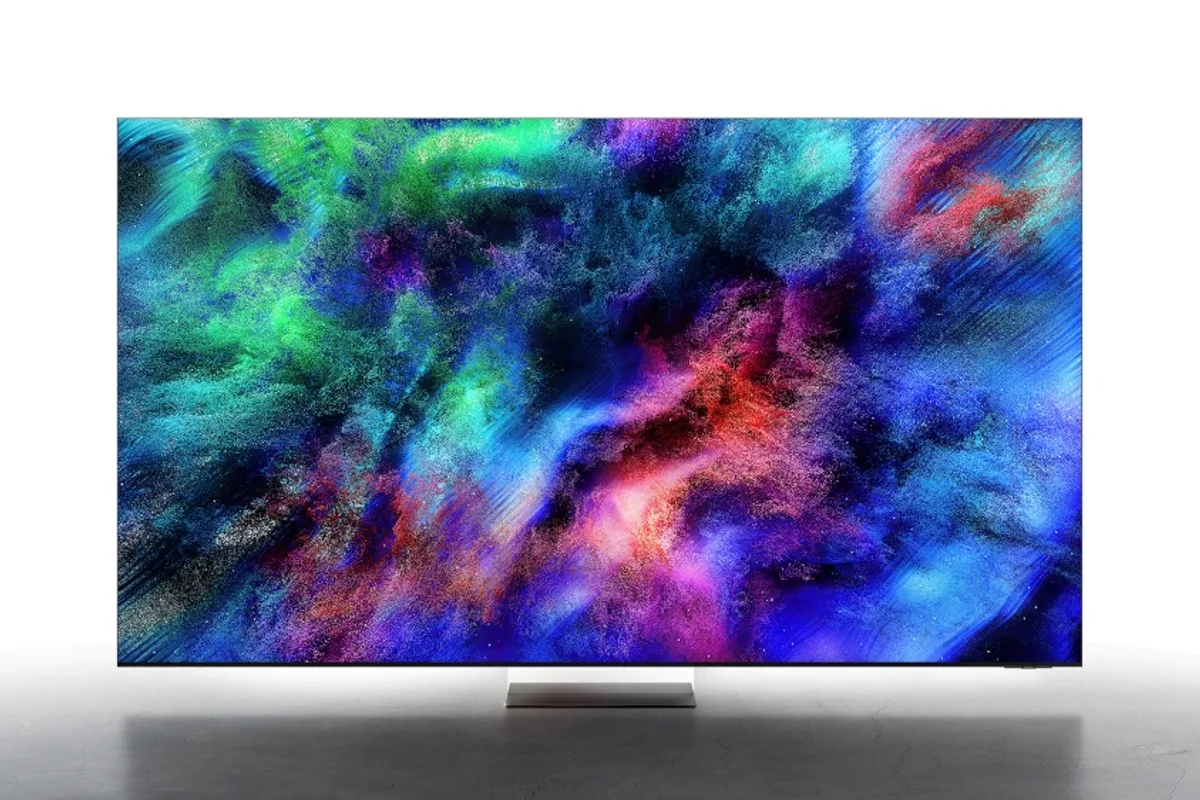
That is why RGB Mini LED is as much about color volume and efficiency as it is about local dimming.
2026 turned RGB backlights into a real premium category
Hisense expanded the RGB MiniLED approach it commercialized earlier. Samsung broadened Micro RGB from the original giant formats into 55-, 65-, 75-, 85-, 100- and 115-inch models.
Samsung says its Micro RGB backlight elements are individually red, green and blue and smaller than 100 micrometers.
LG launched Micro RGB evo and Mini RGB evo televisions during 2026, while Sony has also been developing independently controlled RGB backlighting.
Micro RGB is not MicroLED
The naming invites exactly the wrong assumption.
Samsung Micro RGB is an advanced RGB LED backlight positioned behind an LCD panel.
True MicroLED does not have a backlight at all.
Samsung itself describes the distinction explicitly: Micro RGB is backlit, MicroLED is self-emissive.
RGB local dimming has more variables to control
Traditional local dimming decides how bright a zone should be.
An RGB system can also alter the balance of its red, green and blue emitters. The processor now manages a spatial map of both luminance and color.
That creates opportunities for extremely wide gamut performance, but it also makes errors more complicated. A halo can potentially carry a color tint rather than being merely brighter than the background.
Some designs are already moving beyond RGB
Hisense has demonstrated high-end 2026 systems that add cyan to the red, green and blue backlight primaries.
The company has quoted color coverage reaching 110% of BT.2020 for its latest RGB Mini LED architecture.
Those are manufacturer claims for specific implementations, not a universal specification for RGB LED TVs.
MicroLED removes the LCD layer entirely
A real MicroLED display uses microscopic inorganic LEDs as the picture-forming elements themselves.
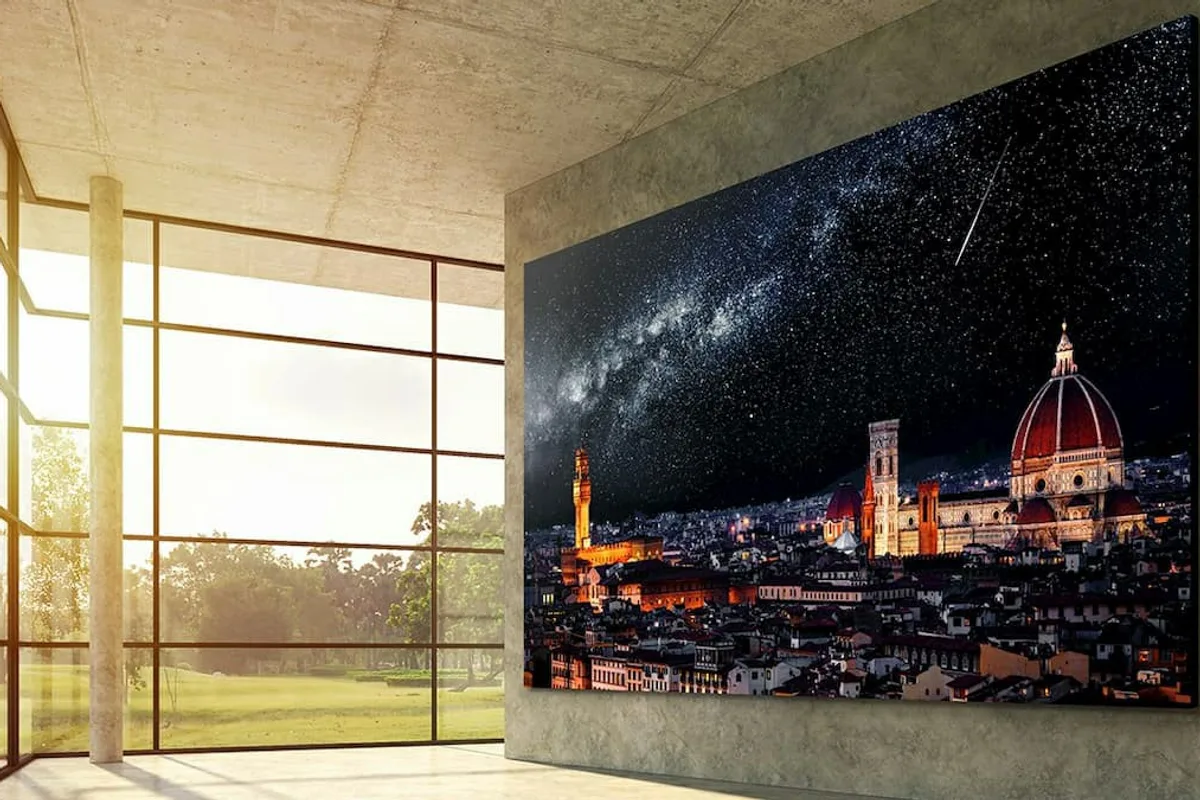
Each pixel can produce light and switch off independently.
There is no shared LCD backlight, which eliminates the basic local-dimming mechanism responsible for blooming.
MicroLED looks like an engineering wish list
Self-emission brings pixel-level black control. Inorganic LEDs can also offer high brightness, extremely fast response and long operating life.
Those characteristics make MicroLED one of the most attractive theoretical combinations in display engineering.
Manufacturing is the inconvenient part.
Millions of microscopic components have to work perfectly
A 4K display contains more than eight million pixels and potentially many more individual LED elements depending on the subpixel architecture.
Those devices have to be manufactured, transferred, aligned, electrically connected, inspected and calibrated at enormous scale.
A defect rate that would be excellent for many semiconductor products can still leave visible failed pixels across a television.
Yield is therefore central to MicroLED economics.
Smaller consumer sizes are especially difficult
A 4K image always needs the same number of pixels.
On a 200-inch screen, those pixels have much more physical room. On a 55-inch screen, the pitch becomes dramatically tighter.
Shrinking MicroLED toward ordinary living-room sizes therefore demands smaller emitters, tighter placement and better yields.
Modularity makes MicroLED natural for huge screens
Direct-view LED modules can be assembled into very large surfaces instead of requiring one gigantic glass panel.
Samsung's The Wall and professional LED systems exploit exactly this advantage.
The seams, brightness and color of neighboring modules have to be calibrated so closely that the assembled surface appears continuous.
Direct-view LED is much older than MicroLED TVs
Stadium displays, concert screens and digital billboards already form their images directly with LEDs.
Their pixels can be physically large because viewers stand far away.
The evolution toward fine-pitch and MicroLED is largely about shrinking that principle until the image remains continuous at domestic viewing distances.
SMD, COB and MIP describe how those LEDs are packaged
SMD packages LED components for surface mounting on a circuit board.
COB mounts LED chips directly onto a substrate and encapsulates them there, which can support finer pitches and robust surfaces.
MIP packages very small LED devices before they are incorporated into the final display modules.
These manufacturing approaches matter greatly in professional LED walls but should not be confused with consumer terms such as HDR10 or Mini LED.
OLED belongs to the LED family too
OLED means Organic Light-Emitting Diode.
Every image pixel generates its own light through organic electroluminescent materials. No LCD backlight is required.
A black pixel can simply stop emitting.
That gives OLED the same fundamental pixel-level lighting advantage that makes MicroLED so attractive, although the emitting materials and manufacturing methods are completely different.
WOLED and QD-OLED take different routes to color
Modern WOLED television panels generate broad-spectrum OLED light and use color filtering, with contemporary designs also using a white subpixel contribution.
QD-OLED starts with blue self-emitting OLED material and uses quantum dots to convert some of that blue light into red and green.
Samsung Display describes QD-OLED as a self-emissive display combining its light source with quantum-dot conversion.
OLED stacks continue to evolve
Modern organic displays increasingly use multiple emitting layers to improve efficiency and durability.
Samsung Display introduced QD-OLED Penta Tandem in 2026, using a proprietary five-layer organic emitting structure aimed at spreading electrical and thermal load while increasing luminance and lifespan.
The same broad tandem principle has become increasingly important across premium OLED development.
OLED burn-in and LED aging are not the same phenomenon
Organic emitters gradually lose output with use. Uneven usage can therefore produce uneven aging, which is the physical basis of permanent OLED image retention.
Modern televisions actively mitigate that with compensation cycles, pixel shifting, logo detection and brightness management.
Inorganic MicroLED does not use the same organic material system. Its emitters still age and individual components can fail, but the dominant aging mechanism differs.
Mini LED avoids OLED's organic aging but keeps LCD compromises
Mini LED backlights do not create the image pixels themselves, so they are not subject to OLED-style differential organic pixel wear.
They do retain LCD limitations including blooming, panel viewing angles, liquid-crystal response behavior and potential backlight uniformity issues.
No display architecture removes every compromise.
Blue LEDs and phosphors built the modern LCD backlight
Many conventional LED backlights start with blue emitters and phosphor materials that convert part of that energy into additional wavelengths, producing light that appears white.
The shape of that spectrum affects the gamut available after the LCD color filters.
Quantum-dot systems refine the spectrum. RGB LED systems take the next step and produce the primary colors directly in the backlight.
The useful distinction is functional, not a marketing size threshold
Mini, micro and other size-related terms are not used with perfectly consistent thresholds across every manufacturer and product category.
A sub-100-micrometer LED can still function only as a backlight element.
Instead of asking whether a diode is called mini or micro, ask whether it illuminates an LCD or forms the picture itself.
Backlight LEDs are extremely fast, but the LCD can still be slow
LED brightness can change rapidly. Liquid crystals need physical time to rotate into a new state.
That means an LED-backlit display's pixel response can still be limited by the LCD even when its lighting system reacts almost instantly.
Overdrive, scanning backlights and carefully synchronized local dimming are all attempts to manage different parts of that motion chain.
LED scanning can reduce sample-and-hold blur
A backlight does not have to remain continuously illuminated for the entire refresh period.
Strobing or scanning portions of the LED array can shorten the visible persistence of each frame and improve perceived motion clarity.
The usual trade-offs are reduced brightness and potential flicker.
HDR pushed LED backlights to become more complicated
Standard dynamic-range LCDs could get away with relatively crude backlighting because they did not need to place a brilliant highlight beside a deep black region with the same intensity demanded by HDR.
FALD and Mini LED made that contrast geographically controllable.
RGB Mini LED now gives the backlight additional chromatic control.
Peak brightness needs context
Modern LED televisions can quote astonishing peak-luminance figures.
Those figures are usually measured using a limited portion of the panel and under specific test conditions.
Full-screen brightness, sustainability of the peak, thermal behavior, color volume and tone mapping are equally relevant to real HDR performance.
Power efficiency depends on what the screen is showing
A backlit LCD needs a light source operating behind large portions of the panel, though local dimming can reduce output in dark regions.
Self-emissive screens consume almost no emission power for black pixels but must drive many individual emitters hard on bright full-screen content.
The most efficient architecture therefore depends on image content, screen size, brightness target and implementation.
Large screens continue to favor LED-backlit LCD economics
LCD manufacturing scales well into enormous television sizes, which is one reason 85-, 98- and 115-inch Mini LED sets have become increasingly attainable relative to similarly sized emissive displays.
RGB Mini LED is taking advantage of the same manufacturing base rather than replacing it.
MicroLED is also comfortable at huge sizes, but its manufacturing cost remains in another league.
OLED remains the practical self-emissive television
For ordinary consumers seeking pixel-level lighting control in 2026, OLED is still the widely available option.
MicroLED demonstrates what inorganic self-emission can ultimately offer, but it has not reached comparable pricing or distribution.
The real premium retail battle is therefore OLED versus increasingly sophisticated Mini LED and RGB Mini LED LCDs.
The terminology is easier when divided into two families
- Edge LED: LCD illuminated from LEDs around the edges.
- Direct LED: LCD illuminated by an LED array behind the panel.
- FALD: direct LED backlight divided into independently dimmable zones.
- Mini LED: LCD using much smaller backlight LEDs to increase light-source and dimming-zone density.
- QLED: generally an LED-backlit LCD enhanced with quantum dots for color.
- RGB Mini LED: LCD with separately controlled red, green and blue LEDs in the backlight.
- Micro RGB: Samsung terminology for an LCD using microscopic RGB backlight elements.
- Micro RGB evo and Mini RGB evo: LG's 2026 RGB-backlit premium LCD technologies.
- MicroLED: self-emissive inorganic LED display with no LCD backlight.
- OLED: self-emissive organic LED display.
- QD-OLED: self-emissive OLED source combined with quantum-dot color conversion.
- Direct-view LED: a broad class of displays where LEDs directly form the visible image.
What to check before buying a display with LED somewhere in the name
- Determine whether the panel is LCD or self-emissive.
- On LCD TVs, identify panel type separately from backlight type.
- Distinguish Edge LED, Direct LED, FALD, Mini LED and RGB Mini LED.
- Look for local-dimming zone behavior rather than relying on raw LED count.
- Treat QLED and Quantum Dot primarily as color-system information.
- Never assume Micro RGB means MicroLED.
- Never assume Mini LED means MicroLED.
- For HDR, check measured brightness, blooming, contrast and color volume.
- For gaming, evaluate refresh rate, VRR, pixel response and input latency independently.
- With OLED, consider brightness management and long-term differential wear.
- With MicroLED, availability and price remain the practical barriers.
The entire progression in one view
Traditional LED LCD uses relatively large diodes to illuminate a liquid-crystal panel.
Mini LED shrinks and multiplies those lights so the television can control brightness in smaller regions.
RGB Mini LED adds independently colored red, green and blue emitters so the backlight can control both brightness and color.
MicroLED finally removes the backlight concept altogether and turns the LEDs into the pixels.
The most important LED story of 2026 is happening behind the LCD
MicroLED remains technically fascinating but commercially rare. OLED is already mature as the consumer self-emissive option.
The rapid change this year is happening inside the supposedly old-fashioned LCD camp. Hisense, Samsung, LG and Sony have all moved toward RGB-controlled backlights, pushing color control into a layer that previously dealt mostly with brightness.
The LED did not replace the LCD. It simply keeps becoming a much more sophisticated light behind it.