
 By Camille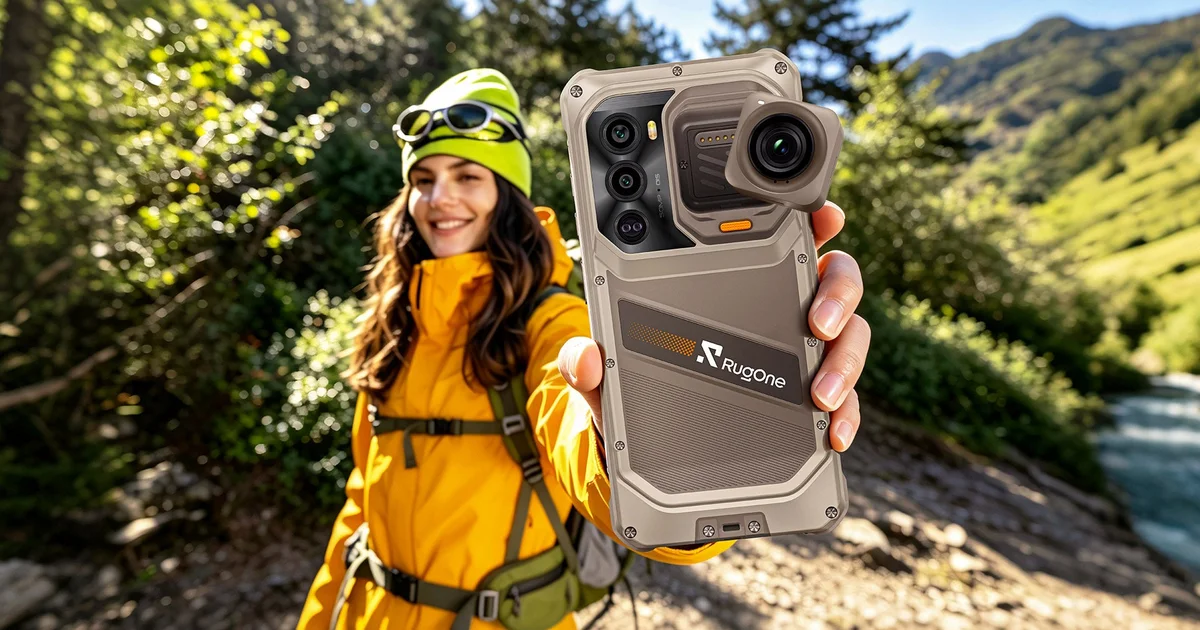
The 39g camera actually comes out of the phone
RugOne officially launched Xsnap 7 Pro at IFA Berlin on September 5.
The concept had appeared earlier as an engineering sample at Mobile World Congress, but the IFA launch adds pricing, crowdfunding and a retail schedule.
Kickstarter opened on September 7 with limited early units starting at €799.
RugOne plans broader availability in October at €1,099.99 in Europe and $999 in the US.
A dedicated bay in the phone's rear housing stores the action-camera module.
Magnets hold it in place while a mechanical safety lock helps prevent it from being thrown out during impacts or movement.
Once detached, it becomes a standalone action camera
The 39g module can be mounted on helmets, handlebars, straps or worn as a pendant using RugOne accessories.
It does not simply act as a removable smartphone lens.
The module has its own imaging processor, battery and storage and continues working after it physically leaves the handset.
That distinction is what makes the design genuinely modular rather than decorative.
2.7K at 30fps is not flagship GoPro territory
The camera records up to 2.7K at 30 frames per second with a 133-degree field of view.
RugOne adds intelligent distortion correction, FreeFrame capture, time-lapse, slow motion, pre-recording, loop recording and HDR stills.
SteadyX electronic stabilization works with a 360-degree horizon lock.
Dedicated action cameras that offer high-frame-rate 4K and more sophisticated stabilization still have an obvious technical advantage.
Xsnap's proposition is therefore not absolute image quality.

The module has its own battery and 64GB of storage
The detached camera runs for roughly 40 minutes on its internal battery.
It contains 64GB of onboard storage.
RugOne says that can hold as much as eight hours of 1080p footage.
Those two specifications matter because the camera does not need a cable or constant access to the phone's internal storage while it is being worn or mounted.
Recording can be started directly from the camera itself.
The phone becomes a wireless viewfinder from roughly 50 meters away
RugOne's Xsnap Pro app displays a live feed from the detached module.
Users can start recording remotely and access captured clips from the handset.
RugOne quotes a wireless operating range of roughly 50 meters under suitable conditions.
Hands-on demonstrations at IFA confirmed that the remote viewing system works, although a crowded show floor is not an appropriate place to verify the maximum range.
One person can therefore wear the camera while another monitors framing from the phone some distance away.
The little camera is actually rated for deeper water than the phone
The action-camera module is waterproof to five meters without an additional housing.
The Xsnap 7 Pro handset carries IP68 and IP69K ratings.
RugOne rates the phone for submersion to two meters for thirty minutes and resistance to high-pressure, high-temperature water jets.
That means the detachable module can enter some aquatic environments where the manufacturer would not necessarily recommend taking the entire handset to the same depth.
The 9,300mAh phone battery automatically recharges the camera
Returning the module to its rear bay reconnects physical charging contacts.
The camera then begins drawing power from the phone automatically.
RugOne says the handset's 9,300mAh battery can provide as many as twenty full action-camera recharges.
That is necessarily a theoretical maximum because the phone itself also needs energy for its display, modem, GPS and processor.
The practical advantage remains clear: the camera does not require a separate charging case.
Forty minutes can become several hours of intermittent recording
A forty-minute standalone rating sounds short next to a conventional action camera.
The usage pattern changes when the module repeatedly returns to the phone between clips.
RugOne says a complete module recharge takes around 35 minutes while docked.
For short cycling, hiking or climbing recordings spread across a day, the camera can continually top itself up instead of exhausting one large battery in a single session.
The design favors intermittent capture over uninterrupted multi-hour recording.
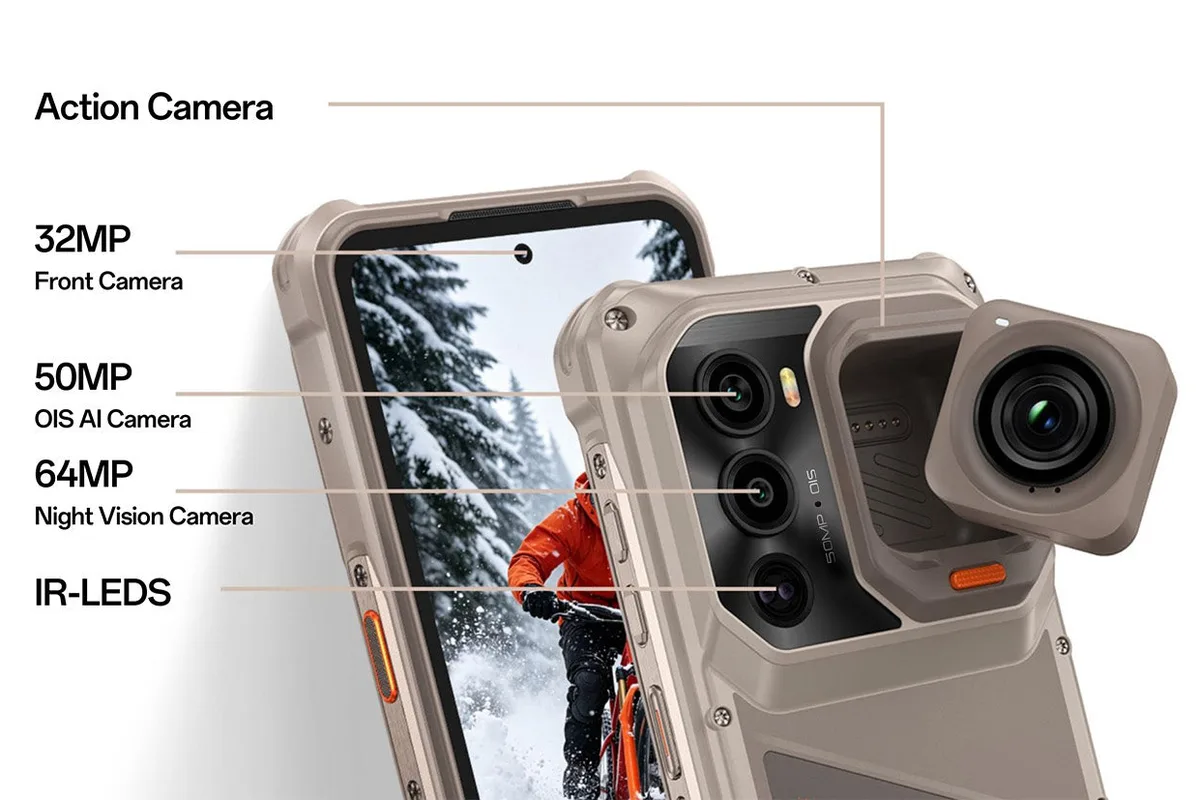
Removing the action camera does not remove the main phone camera
Xsnap 7 Pro still carries a conventional rear camera system.
Its primary camera uses a 50MP Samsung GN9 sensor with both optical and electronic stabilization and can record 4K video.
A separate 64MP infrared night-vision camera works with dedicated IR LEDs.
The front camera uses a 32MP sensor.
The detachable module therefore adds a new shooting position rather than replacing the main photography system.
Dimensity 8400 is capable rather than cutting-edge flagship silicon
MediaTek's Dimensity 8400 powers the handset.
It is paired with 12GB of LPDDR5X memory and 512GB of UFS 4.0 storage.
That is a solid platform, but the phone's €1,099.99 retail price is clearly not justified by processor performance alone.
Buyers are paying for ruggedization, battery capacity and the unique detachable-camera system.
A 120Hz AMOLED keeps the rugged phone from feeling industrial
The front uses a 6.67-inch 1.5K AMOLED panel with a 120Hz refresh rate.
Peak brightness is rated at 1,700 nits.
Corning Gorilla Glass Victus protects the display.
That is much closer to a modern mainstream smartphone experience than the thick, slow LCD panels historically associated with many rugged devices.
The biggest compromise weighs 477 grams
All of that durability is immediately noticeable in the hand.
A French hands-on report from IFA puts the device at 477 grams.
That is roughly twice the mass of many large premium smartphones.
A 9,300mAh battery, reinforced enclosure, mechanical camera bay and IP69K sealing physically require space and material.
Xsnap 7 Pro may let an outdoor user leave a separate action camera at home, but it is nowhere near the weight of an ordinary handset.
MIL-STD-810H and a 1.5-meter concrete drop rating
RugOne also lists MIL-STD-810H certification.
The company claims resistance to 1.5-meter drops onto concrete.
Two customizable physical shortcut buttons help with gloved use and situations where touch controls are inconvenient.
The phone also includes eSIM support, an in-display fingerprint sensor and an Aura Pulse rear status light.
Its target is clearly outdoor activity and field work rather than a normal flagship buyer looking for a quirky camera feature.
Android 16 ships with an upgrade promise through Android 20
Xsnap 7 Pro runs Android 16 out of the box.
RugOne says it can be upgraded through Android 20.
Software features include Gemini, Circle to Search, Live Translation, Call Summary, Writing Assistant and Math Recognition.
The company also references support for AI ecosystems including ChatGPT and Grok.
Those additions are secondary to the hardware concept, but actual long-term software support will matter on a phone priced above €1,000.
The huge battery gets 45W wired and 50W wireless charging
Wired charging tops out at 45W.
Wireless charging reaches 50W, while reverse wireless charging is rated at 10W.
Forty-five watts is not particularly aggressive for a 9,300mAh cell.
A full charge may therefore take considerably longer than on some flagships using smaller batteries with 100W-plus charging systems.
RugOne is prioritizing endurance and capacity over winning a charging-speed benchmark.
€799 is a crowdfunding price, not the normal retail price
The €799 figure applies to limited Kickstarter Super Early Bird units.
RugOne's announced European retail price is €1,099.99.
That creates a €300 gap between early crowdfunding and ordinary retail.
Crowdfunding also carries a different level of delivery risk from buying an already-stocked commercial product.
RugOne says global retail availability is planned for October, but a Kickstarter pledge is not identical to a conventional store purchase.
The detachable camera is weaker than a dedicated action cam and easier to actually have with you
That is the central Xsnap 7 Pro tradeoff.
A modern dedicated action camera can offer higher resolution, stronger stabilization and a broader accessory ecosystem.
It is also another object the user needs to remember to pack, charge and carry.
RugOne turns the phone itself into the camera's storage dock, remote screen and charger.
Its competitive advantage is not producing the best action-camera image.
It is eliminating the problem that often happens before recording begins: realizing the camera was left at home.
Xsnap 7 Pro makes an old modular-phone idea useful by letting the module leave the phone
Modular smartphones spent years promising interchangeable lenses, batteries and accessories before most of those concepts disappeared.
RugOne's approach is more practical because the module does not merely improve the handset while attached.
Its purpose appears when it leaves.
That makes the action camera more coherent than another magnetic add-on.
Xsnap 7 Pro is huge, heavy and expensive, and its 39g camera is not the best action camera money can buy.
But pulling that camera out of a phone, mounting it on a helmet and continuing to frame the shot from tens of meters away is genuinely different hardware rather than another specification-sheet upgrade.