
 By Camille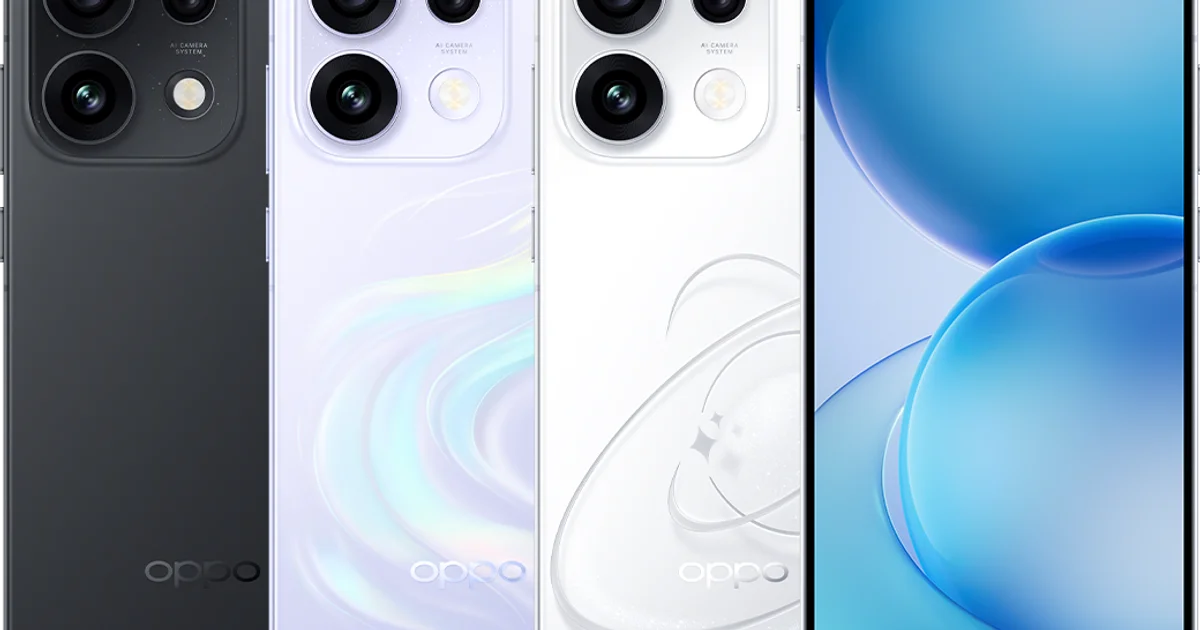
A 6.32-inch phone with a 6,700mAh battery
The Reno16t uses a flat 6.32-inch AMOLED panel with a 2,640 × 1,216 resolution and 460 pixels per inch. Refresh rate reaches 120Hz, while touch sampling goes up to 240Hz.
Oppo's specification material lists up to 1,800 nits of global peak brightness. Promotional material also refers to a higher local peak figure, but those measurements describe different display conditions and should not be treated as interchangeable.
Typical battery capacity is 6,700mAh, with a 6,490mAh rated capacity. That is substantial for a phone with a 6.32-inch screen and 72.42mm-wide body.
Weight tops out at 191 grams
The black finish measures approximately 8.20mm thick and weighs 188 grams. Galaxy Purple is around 8.29mm and 189 grams, while the Heartbeat finish reaches roughly 8.36mm and 191 grams.
Those dimensions make the battery-to-size ratio more notable than 6,700mAh viewed in isolation. High-density battery technology is pushing many phones toward larger capacities; fitting one into a relatively narrow chassis is the other half of the engineering problem.
Capacity alone still tells us nothing definitive about real battery life. Oppo supplies the cell specification, not an independent standardized endurance result for the Reno16t.
80W over SuperVOOC and UFCS
Maximum wired charging is 80W through SuperVOOC. Chinese specifications also list up to 80W through UFCS, the unified fast-charging standard developed by the Chinese industry.
Compatibility extends to 67W and lower SuperVOOC, 44W with third-party UFCS chargers, 55W PPS and 13.5W USB Power Delivery.
Those different ceilings are a useful reminder that the maximum number printed beside a phone does not describe what every USB-C charger will deliver. Protocol support still matters.
Dimensity 8550 SUPER sits at the center
The Reno16t is powered by MediaTek's Dimensity 8550 SUPER, an eight-core platform with a stated maximum CPU frequency of 3.4GHz.
Two commercial configurations are reported for China: 12GB of RAM with 256GB storage at CNY 3,699, and 16GB with 512GB at CNY 4,499. Storage uses UFS 3.1.
The associated specifications list LPDDR5X or LPDDR5 memory depending on configuration. There is no microSD expansion.
A 200MP main camera flanked by two 50MP sensors
The main camera has 200 megapixels, an f/1.8 aperture and a 24mm-equivalent field of view. Autofocus and two-axis optical image stabilization are included.
Oppo pairs it with a 50MP f/2.0 ultrawide equivalent to 16mm, complete with autofocus and a 116-degree field of view. The third camera is a stabilized 50MP f/2.8 telephoto equivalent to 80mm.
The telephoto system provides up to a stated 3.5x optical zoom. Oppo also advertises 120x digital zoom, which is the software magnification limit rather than anything resembling a 120x optical lens.
Even the front camera retains autofocus
The front camera is a 50MP f/2.0 unit with autofocus. Video reaches 4K at 60 frames per second on supported cameras.
At the rear, Oppo also lists stabilized 4K capture at up to 60fps, HDR video, a professional video mode and dual-view recording.
Four high-resolution cameras on a specification sheet still cannot establish image quality. HDR processing, noise, color rendering, motion and consistency between focal lengths require actual photography to assess.
IP69K looks dramatic on a spec sheet
The Reno16t carries IP68 and IP69K-level water and dust protection, alongside other ingress-resistance levels Oppo associates with the Chinese Reno16 family.
IP69K testing includes controlled exposure to high-pressure, high-temperature water jets. That does not make the phone an invitation to shoot underwater routinely. Oppo notes that laboratory conditions differ from everyday use and resistance can deteriorate through normal wear.
The practical value is additional protection against rain, splashes and accidents rather than turning a consumer smartphone into diving equipment.
Wi-Fi 6 rather than Wi-Fi 7
Connectivity includes Wi-Fi 6 with 2×2 MIMO and 160MHz channels, Bluetooth 5.4, NFC, infrared and USB-C. Listed Bluetooth audio codecs include AAC, LDAC, aptX, aptX HD and LHDC 5.0.
An optical fingerprint reader sits beneath the display. The Chinese model uses dual nano-SIMs and a set of 5G bands intended for its domestic configuration.
That is another reason not to treat the Chinese Reno16t as an automatically suitable European import. Radio bands, software services and payment features can vary between regional versions.
The Reno16t looks remarkably like China's Reno16
The unusual part of this launch is how closely the Reno16t specification follows the Reno16 already sold in China: the same 6.32-inch display size and resolution, Dimensity 8550 SUPER, 6,700mAh battery and 200MP plus 50MP plus 50MP rear-camera arrangement.
Chinese and specialist reporting consequently describes the Reno16t largely as a variant expanding the lineup into additional retail channels, particularly offline sales. Its CNY 3,699 starting price is CNY 200 above the cited launch price of a comparable Chinese Reno16 configuration.
This is not a hidden new hardware generation signaled by an extra letter. For Chinese buyers, its appeal will depend heavily on actual configurations, promotions and sales channels.
Europe's Reno16 is already a different phone
The naming gets more confusing outside China. Oppo France currently lists its Reno16 5G with a Snapdragon 7 Gen 4, a 6,000mAh battery and a 50MP main camera.
It retains a 6.32-inch display, 50MP telephoto camera and 80W charging, but its specification is therefore not the same as the Chinese Reno16 hardware on which the Reno16t closely builds.
That regional variation makes it unsafe to assume that a hypothetical European Reno16t would carry the Chinese specification unchanged. Oppo has not announced an international launch for the Reno16t alongside its Chinese release.
Compact mostly by 2026 standards
At 6.32 inches and 72.42mm wide, the Reno16t is not small by the standards of compact smartphones from a decade ago. It is compact in a market where displays around 6.7 inches and larger have become routine.
That is precisely what makes the hardware combination notable. Oppo is not forcing a choice between a large battery and a relatively contained body: 6,700mAh, 188 to 191 grams and a 3.5x telephoto camera coexist in the same device.
For international buyers, however, the most important specification remains geographic. Right now this is a Chinese-market phone starting at CNY 3,699. An impressive specification sheet in a market where the product has not been announced is not yet a local purchasing option.