
 By Adri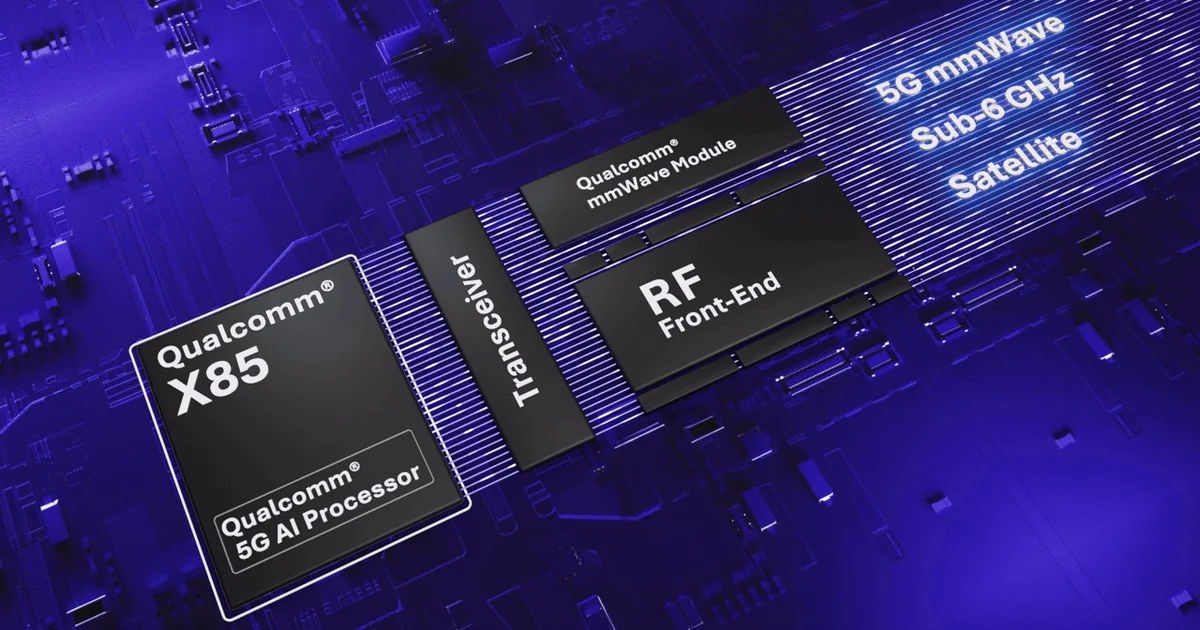
An AI-powered modem sounds more exotic than it actually is. Qualcomm has not embedded a miniature language model between Android and the antenna.
The X85 includes the Qualcomm 5G AI Processor, a dedicated hardware tensor accelerator designed for models that deal with radio conditions and network behaviour.
That is a very different workload from image generation. A modem constantly evaluates changing information: available cells, bands, interference, mobility, traffic type, transmit conditions and power constraints. Qualcomm is using local inference to make some of those decisions more adaptive.
The 30% improvement is an AI inference number, not a 5G speed promise
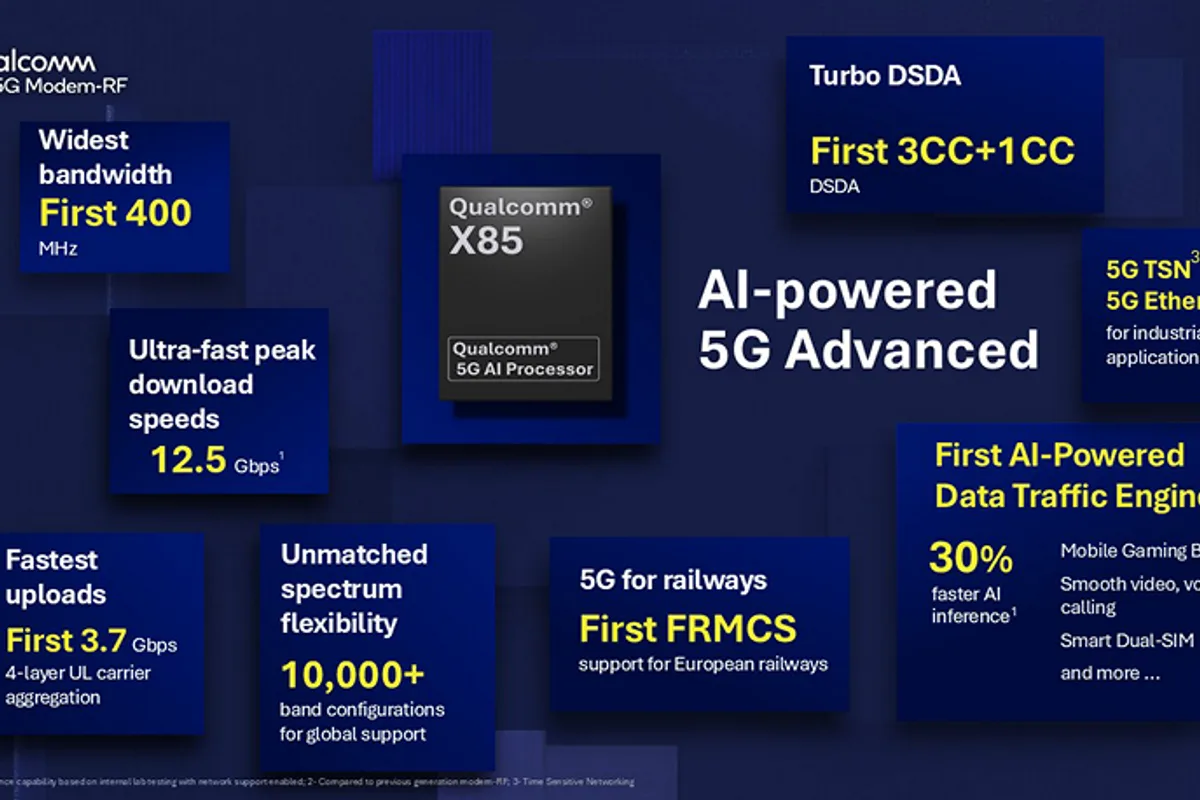
Qualcomm says the X85 performs AI inference 30% faster than its previous-generation modem platform.
That does not mean an X85 phone downloads files 30% faster. The company says the additional inference performance can contribute to better latency, coverage, power efficiency and peak performance, but the actual radio link remains dependent on the network.
Spectrum availability, cell load, signal quality, operator configuration and device design all matter far more than one isolated accelerator benchmark.
The useful part is that the modem can execute connectivity-specific models without continually borrowing general-purpose compute elsewhere in the SoC.
The X85 can classify the traffic crossing it
Qualcomm's AI-Powered Data Traffic Engine applies the same idea higher up the connection.
The company lists dynamic gaming-traffic prioritization, AI-enhanced OTT voice and video calling, and smoother Wi-Fi-to-cellular transitions among its use cases.
This does not allow a phone to remove congestion from a carrier network. It gives the device another mechanism for adapting its own behaviour according to what type of traffic is active and how the connection is changing.
Network selection is becoming a learning problem too
The Advanced Modem-RF Software Suite includes on-device learning-based network selection.
A modern phone may have several cells, bands, 5G modes and SIMs available at once. Simply choosing the strongest signal is not always the same as choosing the connection that will produce the best experience over the next few seconds.
Mobility, historical performance and changing radio conditions can all affect that decision. Qualcomm's approach moves more of that optimisation away from fixed thresholds and toward models that can react to context.
Six sub-6 carriers can be combined across 400MHz
On the conventional modem side, the X85 supports six-carrier aggregation in sub-6GHz with as much as 400MHz of aggregated downlink bandwidth.
Carrier aggregation lets the modem combine multiple chunks of spectrum into a wider logical connection. An operator does not need a single continuous 400MHz allocation for the basic concept to be useful; compatible carriers can be assembled when network configuration allows it.
The X85 also supports 1024-QAM in sub-6GHz.
Higher-order modulation packs more bits into each transmitted symbol, improving spectral efficiency when radio conditions are sufficiently clean. It also becomes harder to distinguish each symbol correctly as noise and interference increase.
In other words, 1024-QAM is a tool for good conditions, not a way to turn weak reception into a 12Gbps link.
Six receive chains are not the same thing as six aggregated carriers
Qualcomm also specifies up to 6Rx support for smartphones.
It is easy to confuse that figure with 6CC carrier aggregation, but they describe different layers of the radio system. Receive chains are physical signal-processing paths; carrier aggregation refers to combining frequency carriers.
Additional receive paths can provide more flexibility for MIMO, diversity and complicated band combinations. They also make the RF implementation around the modem more demanding.
A modem specification never exists in isolation. Antennas, filters, transceivers and RF front-end components still determine what a commercial phone can actually implement.
12.5Gbps is a ceiling, not a normal mobile connection
Qualcomm rates the X85 for a maximum 12.5Gbps 5G download speed and 3.7Gbps uplink.
The peak downlink figure can involve FR1 and FR2 resources, combining sub-6GHz and mmWave capabilities. The modem supports up to ten aggregated carriers in mmWave.
Those figures describe what the platform can support under suitable network configurations. They are not predictions for an ordinary user's speed test.
The AI layer is arguably most interesting away from those ideal conditions, where the modem has to decide how to use imperfect spectrum and changing signal quality efficiently.
Upload gets its own architectural work
The X85 supports four-layer uplink carrier aggregation across as much as 200MHz of sub-6 spectrum, alongside Smart Transmit Plus for uplink optimisation.
Uplink capability matters increasingly for video calls, cloud gaming, live broadcasting, backups and applications that continuously send data rather than simply consume it.
It is also a difficult power problem. Transmitting back to a cell site costs energy, and the device still has to stay inside thermal and RF exposure constraints.
This is a Release 18 modem
The X85 is Qualcomm's eighth-generation 5G modem-to-antenna system and is designed for 3GPP Release 18, the first major standards phase generally associated with 5G Advanced.
It supports 5G standalone and non-standalone operation, FDD, TDD, sub-6GHz, mmWave and legacy cellular technologies, with Qualcomm listing global 5G coverage from 0.6 to 41GHz.
NTN satellite communication is included as well. Turbo DSDA extends Dual SIM Dual Active operation with a 3CC + 1CC configuration designed to provide more downlink and uplink resources while both subscriptions remain active.
Why give the modem its own matrix hardware?
Because the central NPU is not automatically the most efficient place for every inference task.
Moving data between hardware blocks costs time and energy. A tensor accelerator sitting inside the modem subsystem can work closer to the radio information it needs instead of turning every connectivity decision into another workload for the application processor.
Smartphones are already moving in this direction elsewhere. Camera pipelines contain dedicated AI hardware, sensor hubs run tiny always-on models, and GPUs increasingly include matrix units for neural rendering.
The future mobile SoC therefore looks less like one large AI processor and more like a collection of specialised engines positioned next to the data they need.
AI has made it all the way to the antenna
Qualcomm introduced the X85 in March 2025 before it moved into commercial high-end platforms. Its radio numbers remain formidable: 6CC sub-6, 400MHz aggregation, 1024-QAM, 6Rx and a 12.5Gbps theoretical peak.
Those specifications are largely the continuation of a familiar modem race for more spectrum and more parallelism.
The more unusual architectural choice is the dedicated tensor accelerator sitting inside that connectivity subsystem.
A premium phone already has CPU, GPU and NPU hardware capable of AI. Qualcomm has decided that the modem now needs its own AI engine as well.